Desert Online General Trading LLC
Dubai, United Arab Emirates
Desert Online General Trading LLC
Dubai, United Arab Emirates

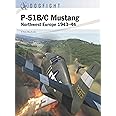
P-51B/C Mustang: Northwest Europe 1943–44 (Dogfight, 2)


O**N
Strategic Bomber Escort fighters in a TACTICAL Air Force?
The introduction of the P-51 is well described with one exception. Once again, the introduction of the P-51B into the 9th Air Force instead of the 8th passes without comment. To my knowledge NO P-51 book has explained why this happened. The reason is discussed below. At least Chris Bucholtz didn't guess why as some have done. I was particularly impressed with the discussion of Flaws beginning on page 47. So, five stars.A little background, I first met Clayton Gross in the 1970s at a meeting of IPMS model builders at Portland Air Base. He was our guest, and we ran a film, during which a sequence showed P-51s in tight formation "over Germany", Clayton commented from the back of the room that they did not fly like that over Germany, an obvious reference to the spread-out "finger four" formation. After the film, knowing that he had an Me 262 kill in April 1945 and American pilots flew limited "tours", I "informed" him that the 354th had trained at Portland Army Air Base. He responded that he knew that because he was there! Asked how that happened he said as best he could figure it was because they were a 9th Air Force Group under 8th Air Force control until June 1944 and neither Air Force was keeping track of their missions! At a later time, I asked him what he expected to fly, and he said the P-39!As noted, Gross was one of the pilots selected to train on Mustangs and introduce it to the others. He was also selected to fly in P-51s from the Depot, so he had more hours than most of them. He told me that some flew their first mission with single digit P-51 time!Now for the real reason they got P-51s: Planning for airfields on the continent in November 1943 joint American-British airfields standards were set at 3,600' runways 120' wide. The P-38 and P-51 could operate from such fields. It further states that the length was increased to 5,000' later due to the employment of the heavier P-47. It was a simple matter of logistics, less Pierced Steel Plank meant more of something else. Adjustments had to be made.This data is found in the Final Report of the Chief Engineer, ETO, Volume I, Page 342. I ran across this book around 1994. Already having Volume II, I bought it just to complete the set. Not a title that one would expect to have an important piece of aviation history, until I began reading it. The hairs on the back of my neck stood up when I got to page 342, and I read the runway story. I groaned - OH NO!Investigating the arrival of Fighter Groups in the period November 1943 to March 1944 and a little beyond, a pattern emerged. ALL such groups assigned to the 8th Air Force received P-47s. 9th Air Force Groups received ALL available P-38s and P-51s, only getting P-47s as a last resort. The 370th Fighter Group trained on P-47s but when assigned to the 9th received P-38s! It all began to change around March, the 4th Fighter Group converted while maintaining their scheduled P-47 missions. The 358th was traded to the 9th for the 357th.In the end it made little difference, the P-51s of the 9th escorted the bombers of the 8th and the Mustang did exactly what it was designed to do. The late arriving 354th adapted so well to their new mounts that they emerged as the top scoring air to air group in the entire USAAF.PS: Clayton finally got a leave after his Me 262 victory, when he returned, he found his P-51 "Live Bait" had been assigned to another pilot and was now "Ensign Babs". He was NOT happy. Talking with his buddies about post-war plans he thought he would become a dentist. They laughed. He became an Oral Surgeon!
H**E
Gamechanger...
The first models of the U.S. P-51 Mustang arrived in northwest Europe in 1943. With their extended range, they would be a gamechanger in the escort of long-range bombers over Nazi Germany. This Osprey Dogfight series book has the details.Author Chris Bucholtz has an attention-getting narrative that opens with examples of air combat, before getting into the development of the P-51. The text is loaded with accounts by pilots flying over Germany, backed by period photographs and modern illustrations and air combat diagrams. The P-51B/C fighters had an impact, but at a high cost. A table at book's end reveals the tough fates of many of the P-51B/C aces. Well recommended to students of the air war over Europe, 1939-45.
R**K
I reviewed the Fw-190 D my comments apply to this book too!
Will not go into detail about the book, you can find my review under four stars on the 190 book. Took off one star because I do not like the combat panels as I believe they are too crowded and would be better served by limiting the number of events on each panel and adding more panels, i.e. two panels per page and two events per panel.
C**.
Awesome book
I love the military history of this book.
W**T
Excellent!
Well researched and illustrated.
A**R
as described
Nice book
Trustpilot
2 weeks ago
1 week ago