
DOWNLOAD THE APP


Customer Services
Copyright © 2025 Desertcart Holdings Limited
DOWNLOAD THE APP
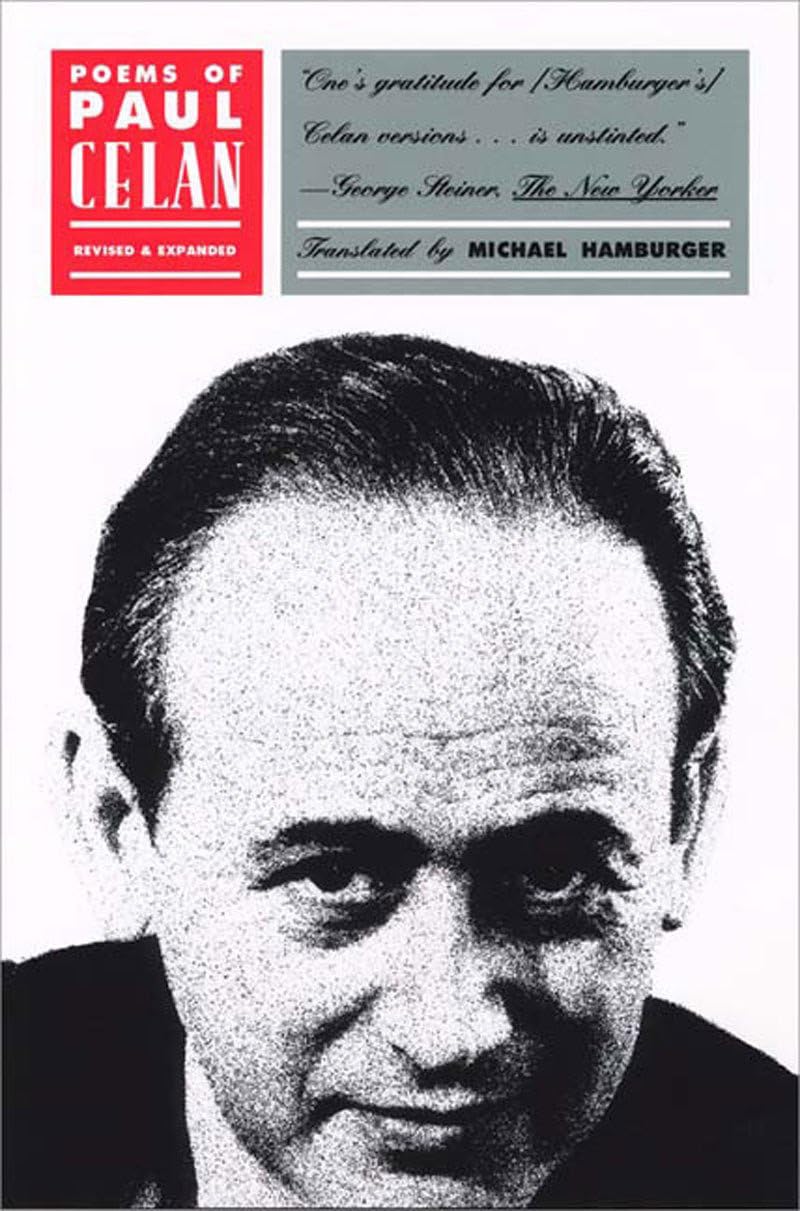
Poems of Paul Celan: A Bilingual German/English Edition, Revised Edition [Celan, Paul, Hamburger, Michael] on desertcart.com. *FREE* shipping on qualifying offers. Poems of Paul Celan: A Bilingual German/English Edition, Revised Edition Review: Trust Steiner - It is an inauspicious beginning to a review to admit that I am really not positioned well to evaluate this collection. I came to Celan from reading George Steiner and George Steiner has nothing but high praise for this collection. Steiner is, like Celan, haunted by the Holocaust, particularly the degree to which the Holocaust changes our views of language, art and culture and, a fortiori, humanity. Celan is, in effect, the poet who gives voice to Steiner's feelings, but that voice is strikingly complex and sometimes opaque in its simplicity. In speaking of cultural literacy E.D. Hirsch will point out that there are passages in texts where we understand the individual words (more or less) but still fail to grasp the overall meaning of the texts because we do not share the material that can go unspoken, the material which those with cultural literacy can take for granted. In the case of Celan the 'background' that is not immediately apparent may be literary; it may be historical and it may be utterly personal. We read the words and can achieve some sense of the meaning that emerges from them but have a great deal of difficulty understanding them in their ultimate richness and complexity. There are some exceptions, as in the powerful and haunting poem, 'Death Fugue', but such poems are few and far between here. The vast majority of the poems create impressions but do not, for the uninitiated, convey specific meanings. The poems are printed in facing pages with the German texts on the verso pages. Divide the 333 pp. or so by two and you have a sense of the length of the book. Some of the poems are very brief. Hence, one can read through the entire text in two hours or so (or spend decades doing so). The bottom line is that you can gain an elementary appreciation of the nature of Celan's work here in a relatively brief period of time, even though you realize throughout the exercise that you are not even beginning to scratch the surface of the depth of his feelings and his ability to utilize his linguistic medium in profound ways. I trust Celan because I trust Steiner, but understanding him at any level of depth will perforce be the labor of years. Review: Classic Collection - This excellent edition of Paul Celan's major poetry (translated excellently by Michael Hamburger) provides the full scope of Celan's considerable genius. Included is the famous 'Death Fugue,' perhaps the most darkly beautiful and profound works of art about the Holocaust yet created. One is left with Celan's transitions; he began immersed in the syle of early 20th century German poets suck as Rilke, and later progressed in Breathturn and Threadsuns to reveal his capacity for highly creative and original linguistic play. The final poems are characterized by a deep morbidity and anguish; they are patently indicative of the poet's distrught spirits. He would later kill himself by drowning. Celan is now written about intensively by the philosophers Derrida and Lyotard, he is probably as important to them as Holderlin was to Heidegger. The editor has included a poem that Celan did not intend for publication; but you can understand why it was included, as it is a magnificent triumph of expressive sorrow over the loss of his parents during the war. Celan was a very great poet, readers are still trying to catch up with his complexity and deep artistic insight.
| ASIN | 089255276X |
| Best Sellers Rank | #276,512 in Books ( See Top 100 in Books ) #61 in German Poetry (Books) |
| Customer Reviews | 4.5 4.5 out of 5 stars (51) |
| Dimensions | 5.4 x 1 x 8.3 inches |
| Edition | Bilingual |
| ISBN-10 | 9780892552764 |
| ISBN-13 | 978-0892552764 |
| Item Weight | 1 pounds |
| Language | English |
| Print length | 416 pages |
| Publication date | November 1, 2002 |
| Publisher | Persea |
R**Z
Trust Steiner
It is an inauspicious beginning to a review to admit that I am really not positioned well to evaluate this collection. I came to Celan from reading George Steiner and George Steiner has nothing but high praise for this collection. Steiner is, like Celan, haunted by the Holocaust, particularly the degree to which the Holocaust changes our views of language, art and culture and, a fortiori, humanity. Celan is, in effect, the poet who gives voice to Steiner's feelings, but that voice is strikingly complex and sometimes opaque in its simplicity. In speaking of cultural literacy E.D. Hirsch will point out that there are passages in texts where we understand the individual words (more or less) but still fail to grasp the overall meaning of the texts because we do not share the material that can go unspoken, the material which those with cultural literacy can take for granted. In the case of Celan the 'background' that is not immediately apparent may be literary; it may be historical and it may be utterly personal. We read the words and can achieve some sense of the meaning that emerges from them but have a great deal of difficulty understanding them in their ultimate richness and complexity. There are some exceptions, as in the powerful and haunting poem, 'Death Fugue', but such poems are few and far between here. The vast majority of the poems create impressions but do not, for the uninitiated, convey specific meanings. The poems are printed in facing pages with the German texts on the verso pages. Divide the 333 pp. or so by two and you have a sense of the length of the book. Some of the poems are very brief. Hence, one can read through the entire text in two hours or so (or spend decades doing so). The bottom line is that you can gain an elementary appreciation of the nature of Celan's work here in a relatively brief period of time, even though you realize throughout the exercise that you are not even beginning to scratch the surface of the depth of his feelings and his ability to utilize his linguistic medium in profound ways. I trust Celan because I trust Steiner, but understanding him at any level of depth will perforce be the labor of years.
S**R
Classic Collection
This excellent edition of Paul Celan's major poetry (translated excellently by Michael Hamburger) provides the full scope of Celan's considerable genius. Included is the famous 'Death Fugue,' perhaps the most darkly beautiful and profound works of art about the Holocaust yet created. One is left with Celan's transitions; he began immersed in the syle of early 20th century German poets suck as Rilke, and later progressed in Breathturn and Threadsuns to reveal his capacity for highly creative and original linguistic play. The final poems are characterized by a deep morbidity and anguish; they are patently indicative of the poet's distrught spirits. He would later kill himself by drowning. Celan is now written about intensively by the philosophers Derrida and Lyotard, he is probably as important to them as Holderlin was to Heidegger. The editor has included a poem that Celan did not intend for publication; but you can understand why it was included, as it is a magnificent triumph of expressive sorrow over the loss of his parents during the war. Celan was a very great poet, readers are still trying to catch up with his complexity and deep artistic insight.
D**M
Wonderful book.
Exceptional translation of the poems of a great poet and notes about his tragic life.
B**E
Celan: A poet who writes to obscure rather than illuminate
The rating questions asking to rate the author's writing, violence, or sexual content are completely irrelevant for this bilingual book of poetry. Paul Celan wrote in German (although he was a Romanian Jew), his writing fascinates because of his extensive neologisms, and also perhaps because his writing is mysterious and hard to understand. Speaking for myself, I found him to be an inaccessible writer and his poems too mysterious and unwieldy--and I think Celan writes for the sake of playing with words rather than providing meaning. Thus--if you enjoy figuring out obscure references, hidden meanings, and can appreciate Celan's clever neologisms, then perhaps you will find the experience of reading his works interesting. Many books have been written about Celan's poetry and the discussions are far-ranging if not exactly illuminating. I believe that if you need a scholar to explain a poem to you, a threshold has been crossed leading to obscurity rather to illumination. The meaning of Celan's poetry remains a riddle to me, but I've profited from his imaginative neologisms. As Celan might have said, I am still reaching-digging and falling-upward as I plow through his linguistic mazes.
D**D
Excellent poet of the German language.
I find this to be an excellent selection of Celan's poetry. Book arrived in good condition and quicker than expected. I'm enjoying reading it. Many thanks.
N**G
everyone go read Celan!
especially this one: Speak, You Also
B**Y
Beautiful poetry
One of Celan's best poetry volumes, beautifully trans;ated from theGerman into English.
D**.
Four Stars
Good
B**E
I fell upon a hardback edition of these translations by chance years ago (early 1990s) - the local town library was clearing out old stock and Hamburger's 'Poems of Paul Celan' - the Carcanet edition of 1980 - was among them. I think my antennae had been primed by reading George Steiner's Real Presences - Celan is referenced a number of times in that deeply disconcerting book - and I couldn't believe my luck. Steiner tells a moving story about chancing upon Celan for the first time at a railside bookstall between trains. Stories like these, and the entire Celan oeuvre, bring into focus the great question of the presence or absence of divine order (read truth, beauty and goodness) in the universe. Celan is sometimes bracketed with the "nay sayers" - the atheists - but his ideas, or - better - his feelings (Gefühle), are much more subtle and complex than that (Psalm to No one, is still a Psalm, yet to no one...) Celan's poems are each a "Variable Key" which unlock the house of unspoken meaning. Whether you can use the keys offered depends on many things - your patience, your determination, perhaps even your willingness to surrender to Celan's strange voice. The poems are mostly difficult although some are remarkably direct ("I can still see you" comes to mind) and Hamburger's translations will forever hold a special place in my heart. For the record, my copy arrived in good condition, did not fall apart, and has survived many rereadings over the last four years.
H**O
It took a long time to arrive (longer than expected). But it finaly arrived, in very good condition.
A**Y
These are wonderful, terrible poems of painful memories and gratitude for survival. They are not easy, the language sometimes wrenched almost to breaking point, but the images and the sounds remain with you long after you have closed the volume. However the paperback is very badly made and falls apart at the seams immediately it is opened. I would not dream of returning it, but have hamfistedly glued back whole sections somehow to keep it together.
Trustpilot
3 weeks ago
1 month ago