
⚙️ Upgrade your creative workflow with Ender 3 V3 SE — where speed meets precision!
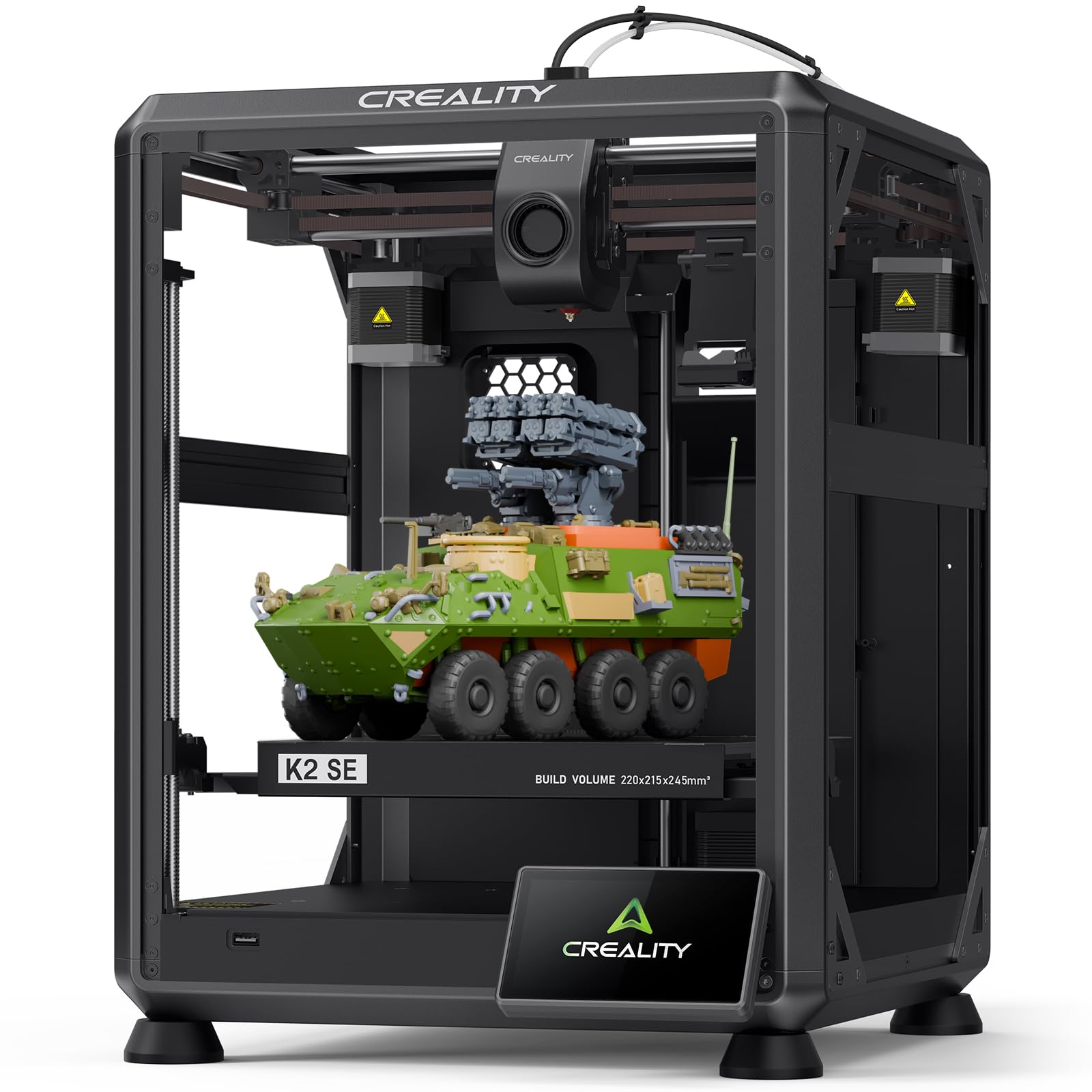
The Ender 3 V3 SE is a high-performance 3D printer featuring a blazing 250mm/s max print speed, a market-proven Sprite full-metal dual-gear direct extruder, and a generous 8.66x8.66x9.84 inch build volume. It boasts CR Touch auto leveling with strain sensor for hassle-free calibration, dual Z-axis lead screws for enhanced stability, and automatic filament loading/unloading for seamless operation. Designed for quick assembly and reliable prints, it’s the ultimate upgrade for makers seeking speed, precision, and ease.


| ASIN | B0D91S75Y5 |
| Best Sellers Rank | #8,084 in Industrial & Scientific ( See Top 100 in Industrial & Scientific ) #15 in 3D Printers |
| Customer Reviews | 4.0 4.0 out of 5 stars (1,168) |
| Date First Available | July 8, 2024 |
| Item Weight | 27.5 pounds |
| Item model number | K2 SE |
| Manufacturer | Creality |
| Product Dimensions | 13.98 x 13.9 x 18.98 inches |
N**E
Not the biggest kid on the schoolyard, but plays a solid ground game.
The K2SE is an excellent printer for users who are still interested in learning and growing within the 3D-printing ecosystem, but who no longer want to spend the majority of their time troubleshooting basic hardware issues. While it may not be a flagship, top-tier machine by today’s standards, it represents a significant step forward—especially when compared side-by-side with older platforms like the Ender 3 Pro. Out of the box, the K2SE delivers a level of refinement that once required extensive upgrades on earlier printers. Features such as automatic bed leveling, filament runout detection, a sturdier frame with vibration-dampening feet, and a properly supported raised Z-axis bed all come standard. The addition of cloud access and a fluid web interface—complete with optional root access for advanced users—bridges the gap between a consumer-friendly machine and a system that still rewards technical curiosity. My first print, a simple Kirby model, was intentionally done with minimal tuning to get a baseline feel for the machine. The results were impressive, especially coming from years of compensating for aging components on my Ender 3. With that printer long overdue for a new extruder, I had grown accustomed to managing variables that simply don’t exist on the K2SE. The consistency and reliability here are immediately noticeable. Although I didn’t have the budget to add the multi-filament CRT system at launch, the printer’s upgrade path is clearly well thought out. Planned expansions like an enclosure, camera monitoring, and multi-material support make it easy to justify future investments. I would also welcome a firmware or hardware update that introduces Bowden extruder support, as it could further improve filament switching speeds and overall print performance. As someone who has stuck with the same Ender 3 since long before touchscreens, CR-Touch, and modern quality-of-life upgrades became commonplace, it’s refreshing to see Klipper remain a core component of the K2SE. For users who are on the fence about moving away from heavy DIY builds, this printer strikes a compelling balance—offering reliability and speed without sacrificing control. Perhaps the most underrated benefit is time savings. The K2SE is noticeably faster than older models, and its intuitive touchscreen interface makes it accessible even for non-technical users in my household. After setup, my wife and children can confidently start prints on their own, which speaks volumes about the usability of the system. Print quality alone justifies the upgrade for patient users. While some may find the stock cooling fans slightly underpowered, the machine compensates with excellent compatibility for multi-tool and threaded expansion systems—an advantage over many Bowden-dependent designs that require significant modification for production or multi-material workflows. And as a final bonus, despite being scheduled for February delivery, the K2SE arrived weeks early. Getting this machine ahead of schedule was the perfect way to confirm that the upgrade was absolutely worth it for the value price point.
T**S
Fast, easy to use, loud and scary at full speed, so put it in a dishwasher.
Fast and easy to setup and use. Even the steps needed to use fluidd/mainsail are easy to execute and update. It is very much a remove from box, turn on (wait for calibration) and use. The PC and mobile software is really easy and convenient to use, while I heavily recommend getting the $20 AI camera that is available. Now, here is the super sneaky way of making it even cooler if you're up for a little bit of creative repurposing things. I had a broken dishwasher that I pulled out all the internal workings of, the top rack, and then modified the bottom rack to have an open front, cut the tines off and measured and cut a piece of plywood for a bottom. The printer sits inside the dishwasher, and using the modified bottom rack, it rolls in and out when I need to change filament. Making this enclosure, and having the AI camera on the printer, has given me an absolutely silent printer, that's easy and convenient to access. I even went as far as to equip some PC fans on the bottom and sides that can attach to an exhaust tube if I need to either cool the chassis (which I haven't yet) or vent harmful fumes. The MCU hasn't gotten any hotter, and the enclosure keeps a very stable temp. Just an idea for those that are comfortable with building their own enclosure that might look a bit unorthodox, but is incredible in practice. Mine is attached to a platform I built using a couple PA speaker cabinets, but I could have just as easily built a rolling cabinet island for the kitchen or workshop and mounted it inside that. Once quieted down and temp controlled in this enclosure, I was able to push the stock hardware to its absolute limits without any issues. Prints that would have taken 29hrs are clocking in at 6hrs, without any issues with quality (and this is with PETG, with PLA being able to push even harder) Definitely worth it, and I'm looking at getting the upgrade kit that adds multi filament abilities to it.
J**B
Broke after a month of use
It worked well while it worked, but that didn't last more than a few weeks (less than 100 hours of printing) before the printer head completely broke and wouldn't feed filament reliably, making weird noises before completely breaking and refusing to even feed at all. We used only Creality-supplied filament the entire time. I thought the price was too good to be true, and what most of the reviews here don't capture is that you get what you pay for, but you don't find out about that until you've used it a bit. This is my second Creality purchase, and the first one died too. I should've learned my lesson the first time. What's worse is there's really not much warrantee. The printer head only has a 90 day warrantee (really the only things that break on these things). It tells you a lot when a company advertises a year warrantee and then when you read the fine print it turns out it's only 90 days for the important parts. I should've paid a bit more an gotten a Bambu lab printer. Those are the gold standard and there's a reason. You'll pay more initially (and surprisingly not much more at all) but in the long run you'll save money. I've now wasted $500 on this company and have two piles of junk to show for it.
J**B
Makkelijk te installeren. Zorg wel dat je als je alles weer in elkaar zet de x-as waterpas vast zet, dit voorkomt problemen met het bed.
N**D
Bra grejer
J**N
Die Teile sind alle passgenau und gut verarbeitet. Der Ein- bzw. Umbau ging gut von der Hand.
D**N
tout parfait, livraison rapide et soignée, conforme à la description 10/10 pour le vendeur
C**N
Muy bien presentado y muy buen funcionamiento, fácil de montar, se nota la calidad de la impresión
Trustpilot
2 weeks ago
1 month ago