
DOWNLOAD THE APP


Customer Services
Copyright © 2025 Desertcart Holdings Limited
DOWNLOAD THE APP
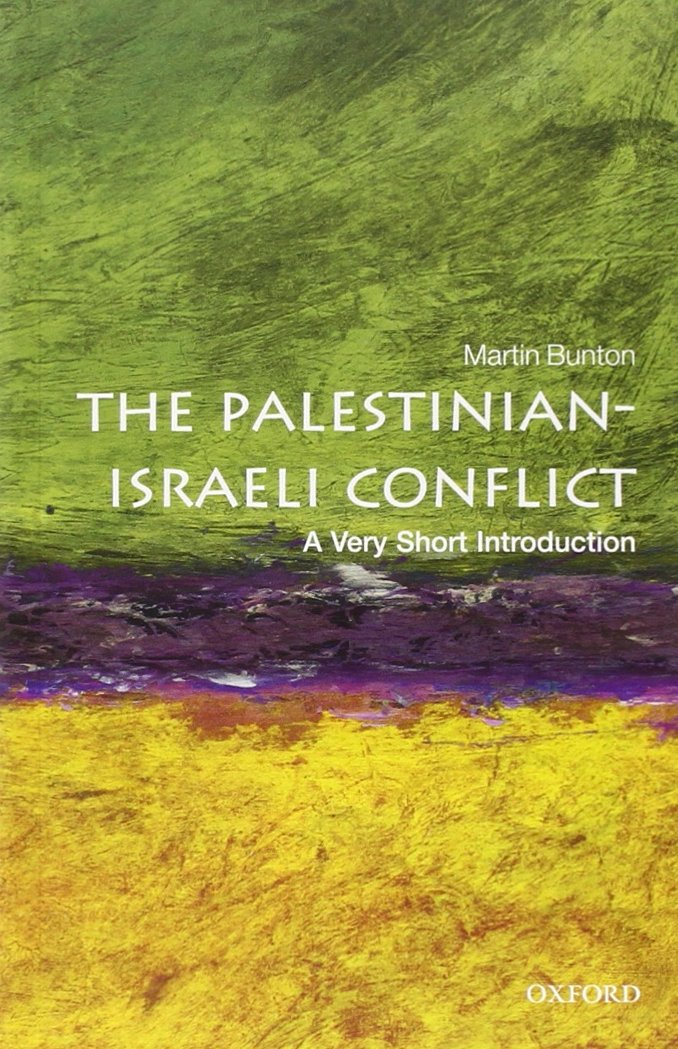
desertcart.com: The Palestinian-Israeli Conflict: A Very Short Introduction: 9780199603930: Bunton, Martin: Books Review: great un-biased overview of the conflict - This book does an excellent job of giving a clear and comprehensive overview of the Palestinian-Israeli conflict in a compact format. It covers the history, politics, and key events without overwhelming the reader, making it approachable for someone new to the subject. Despite being part of the “Very Short Introduction” series, it doesn’t feel shallow. The explanations are balanced and thoughtful, providing enough depth to understand the complexity of the conflict while still being easy to follow. A great starting point for anyone wanting to learn about this topic, and a solid reference to keep on the shelf. Review: Very Informative and Readable - A well-written and very readable overview of the history of the Palestinian-Israeli conflict. I don't know enough about the conflict to state whether the author leaves anything important out of the book, although he does appear to be slightly biased toward the Palestinian side of the conflict and against the Israelis. I can say that his writing style is very clear, and the organization of each chapter, with an introduction stating what he was going to talk about in the chapter and a conclusion that recapped what was said in the chapter and laid the groundwork for the following chapter, made it very easy to follow and remember the various historical events that gave rise to and are a part of the conflict.

| ASIN | 0199603936 |
| Best Sellers Rank | #143,253 in Books ( See Top 100 in Books ) #7 in Middle Eastern History (Books) #66 in Middle Eastern Politics #67 in Israel & Palestine History (Books) |
| Customer Reviews | 4.4 4.4 out of 5 stars (867) |
| Dimensions | 6.85 x 0.32 x 4.58 inches |
| Edition | Illustrated |
| ISBN-10 | 9780199603930 |
| ISBN-13 | 978-0199603930 |
| Item Weight | 2.31 pounds |
| Language | English |
| Part of series | Very Short Introductions |
| Print length | 160 pages |
| Publication date | October 1, 2013 |
| Publisher | Oxford University Press |
J**J
great un-biased overview of the conflict
This book does an excellent job of giving a clear and comprehensive overview of the Palestinian-Israeli conflict in a compact format. It covers the history, politics, and key events without overwhelming the reader, making it approachable for someone new to the subject. Despite being part of the “Very Short Introduction” series, it doesn’t feel shallow. The explanations are balanced and thoughtful, providing enough depth to understand the complexity of the conflict while still being easy to follow. A great starting point for anyone wanting to learn about this topic, and a solid reference to keep on the shelf.
A**Y
Very Informative and Readable
A well-written and very readable overview of the history of the Palestinian-Israeli conflict. I don't know enough about the conflict to state whether the author leaves anything important out of the book, although he does appear to be slightly biased toward the Palestinian side of the conflict and against the Israelis. I can say that his writing style is very clear, and the organization of each chapter, with an introduction stating what he was going to talk about in the chapter and a conclusion that recapped what was said in the chapter and laid the groundwork for the following chapter, made it very easy to follow and remember the various historical events that gave rise to and are a part of the conflict.
B**E
In-depth Wuick explanation
With the current news cycle, I wanted something that streamlined my understanding. Without opening millions of new tabs and google searches, this book did just that. It was a quick chronological synopsis up to the year 2012 that opens the door for deeper understanding and conversations about the Israel-Palestine conflict.
J**N
Buy this book
Excellent brief survey
L**A
Good overview of the conflict
Straightforwardly written and gives a good overview of the conflict in unbiased terms.
C**1
Unfortunately biased, but might be worth it
I bought this book as a better way to understand the origins of the conflict between Israel and Palestine. Since most online sources seem to be very bias one way or the other, I was hoping this would be more objective. As someone who doesn't favor one side or the other, the bias against Israel was fairly apparent. Often times, the author would describe Israel's actions as excessive and brutal, but would seem to completely ignore or only mention in passing equally brutal tactics and acts by the PLO and Hamas. In times where the IDF took military action against Arab states, the text almost portrays IDF victories as unfair because the IDF was better trained and armed whereas Arab aggressors couldn't effectively coordinate between one another. He also mentions things like the mass expulsion of Palestinians after the 1948 war, but (unless I missed it) didn't really mention the expulsion of Jews from Arabs states following that same war. Just a few examples. Often times I would pause when reading and look up events on things like Wikipedia only to find that Wikipedia contained more facts and dialogue that would balance the argument between the Israelis and Palestinians, whereas this book would seem to lean more towards a pro-Palestinian narrative. I've noticed other reviews of this book, even highly rated reviews, call out this pro-Palestinian bias. With all that said, I suppose I met my objective in that I certainly better understand both pro-Palestinian and pro-Israel arguments in this conflict. I found the writing itself to be a bit clunky and difficult to follow in certain spots. While the chapters themselves were written in chronological order, the text within the chapters seemed to jump around a bit. I also felt like there were certain areas that probably warranted at least a little more discussion, like the 1948 war between the IDF and Arabs states. Rather, the author very quickly glosses over the motivations behind the war, and the war itself, and jumps to discussing the impact on Palestinians post-war. Also, despite a 2013 copyright, there is effectively no discussion of some of the more recent conflicts and issues. Regardless of the criticisms, the book did present a number of facts, important dates, policies, and individuals that help people better understand the history of the conflict. Also, as the book's title indicates, this is a short introduction and, at best, is a basis to help with reading other more in-depth books about the subject. While I'm still searching for the "unicorn" that's an unbiased view of this conflict, the best thing might be to pick a book from each end of the spectrum and formulate your own opinion after reading both. I'm thinking there isn't anything out there that discusses this subject in a completely objective manner.
L**A
Academically sound and easy to read
Used as a supplement for our huge textbook in my (Ivy League) college class on the conflict. After slogging through dozens of pages of minutiae, this was a joy to read. A simple, clear account of the conflict that identifies disagreement where it exists and attempts (insofar as possible with such a controversial subject) to avoid bias.
B**E
Understanding Is Painful
I will wear my mask to write this review because what I want to write might not help the situation. So, here it is: Thank you Mr. Bunton. I appreciate you. To those debating on the purchase of this text - purchase it. If nothing else - you will gain more information. 2012 and Mr. Obama, Rock On!!!
M**Z
With the Palestine-Israel conflict in the news for the last few months, and the polarization it produce, I wanted to have a better background of the topic to form my own opinion. Is Israel really a setter colonial state? Is Hamas justified in it's actions? Who really is the attacker and who is defending themselves? This book does not answer those questions. At least, not explicitly. And that is a good thing, because that is exactly what I was looking for. The author simply narrates the events without giving his opinions. True objectivity is impossible, the author can shift the narrative based on which events he decided to include and what he decided to exclude. But this book looks pretty balanced, and I feel it was written with the genuine intent to be as objective as possible. And that is appreciated in this polarizing climate. This book was written in 2013, so it obviously does not have the developments of the last 10 years (I think this book is a prime candidate to release a second edition). But the historical development of the conflict is there. It's also relatively short and easy to read. I highly recommend this book to anyone who wants to better understand the current political climate.
J**E
What was behind the Arab - Israel conflict? I had a vague idea about Zionism and that Israel is a few months older than I am but was otherwise ignorant. Reading a biography of Einstein, Zionism came up again - as a Jew and a very public figure in the first half of the 20th century how could it not? So I decided to find out more and bought this Kindle edition. Martin Bunton has, in my opinion, provided a thorough and well written guide to the historical causes behind the conflict. The post first world war dividing up of the Ottoman empire, the British wish to protect the security of its trade routes. The disregard for native Arabs who formed 90% of the population with Jews making up the remaining 10% living on what was effectively and unnamed land provide some of the ingredients. The whole population never having experienced self determination being passed from one empire to another. The buying up of the most fertile land by Jews, usually from rich absentee Arab, dare we say Islamic, landowners providing the embryo of the state of Israel are described without criticism. I could go on but recommend you read the book. If you are put off by the title which suggests brevity don't be. The book is not as short as the title suggests. One, perhaps at least one, reviewer complained about the small size of the graphics in the Kindle edition. On Android tablets, and I think on Kindle devices but my battery is flat and I can't check this until later. These can be viewed full screen by holding the finger on the image until the menu appears and selecting the magnify symbol.
A**R
Llegó extraordinariamente rápido y en unas condiciones fabulosas, parecía nuevo. El contenido del libro es tal y como aparece descrito en la página web y es bastante útil para conocer la realidad del conflicto, con mapas interesantes.
S**I
A perceptive and accessible introduction to a seemingly intractable topic which has been made so by unjust policies of powerful states. The author has explained in a lucid way the different periods since Theodor Herzl's publication of Der Judenstaat in 1896 and the word Zionist Congress in the next year through the creation of Israel in 1948 to the Arab-Israeli wars in 1967 and 1973 and the Palestinian intifadas, failure of peace efforts and Israeli settlements in the West Bank. The author's palpable sympathy towards Palestinian cause is understandable as this is no longer a "neutral" conflict. The timeline given at the end of the book adds to its lucidity. All in all, a must read for those who're interested to sift through the deluge of opinions about the conflict from various quarters in India (mostly prejudiced one way or the other).
U**Q
As a so-called specialist on the topic I read this with a degree of hesitation as I wanted something balanced and accurate for my under graduate and post graduate students. This is the best 'introduction' I have found. It is succinct, accessible and balanced. All you could ask. It is very good and for any one who wants a fair idea (it can do no more than that) this is as good a starting point as any.
Trustpilot
1 day ago
2 weeks ago