
DOWNLOAD THE APP


Customer Services
Copyright © 2025 Desertcart Holdings Limited
DOWNLOAD THE APP







🎧 Elevate your audio game—where focus meets freedom.
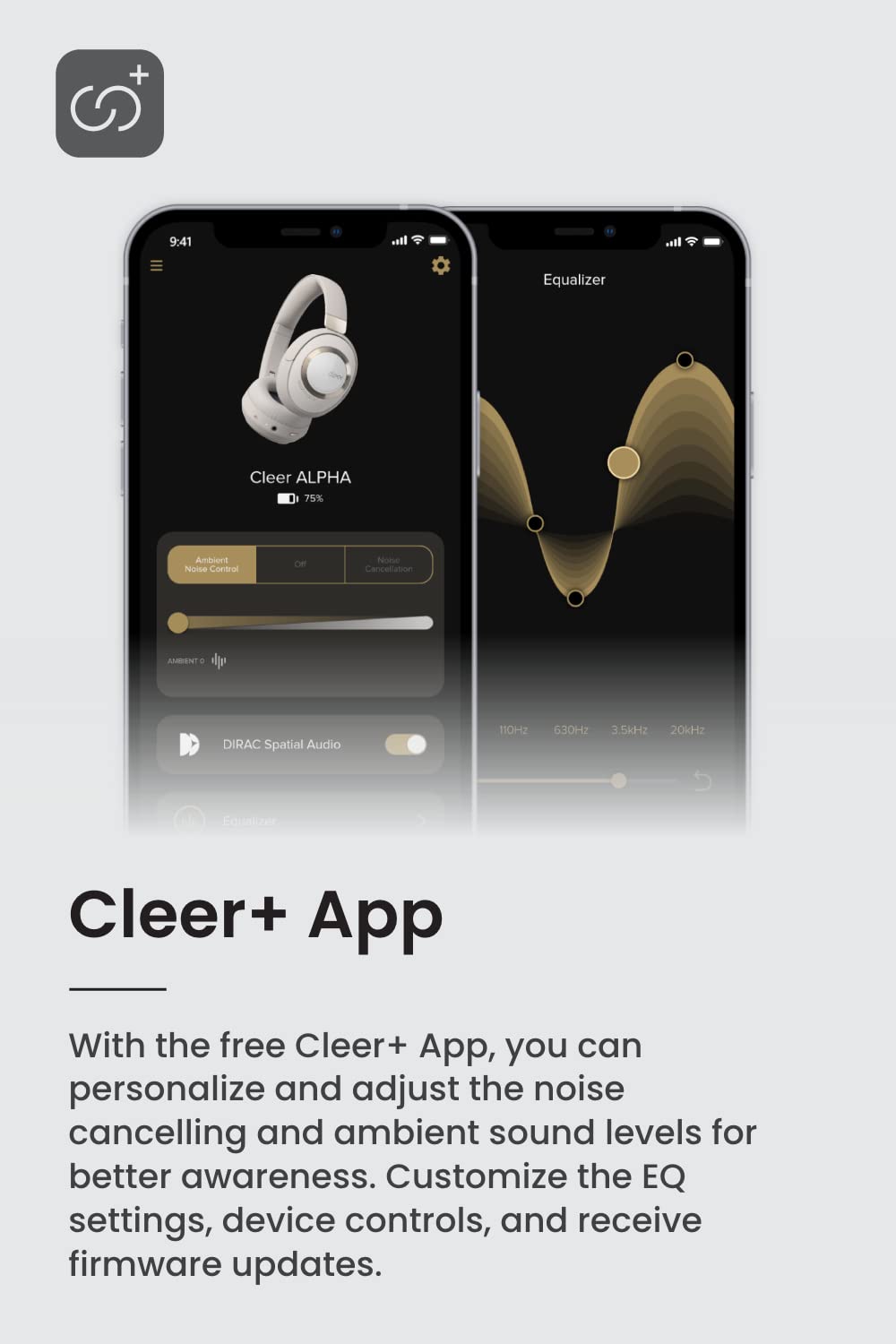
The Cleer Audio Alpha headphones combine adaptive noise cancelation, Qualcomm aptX Adaptive Bluetooth 5.1, and dual microphones for crystal-clear calls. With 35 hours of battery life, quick charging, and multipoint connectivity, they deliver immersive, customizable sound controlled via the Cleer+ app—all wrapped in a sleek midnight blue design.


| ASIN | B09K33JZP1 |
| Additional Features | Adjustable Headband, Fast Charging, Integrated Equalizer, Noise Cancellation, Surround Sound |
| Age Range Description | Adult |
| Audio Driver Type | Dynamic Driver |
| Battery Average Life | 35 Hours |
| Battery Charge Time | 10 minutes |
| Best Sellers Rank | #106,476 in Electronics ( See Top 100 in Electronics ) #2,153 in Over-Ear Headphones |
| Bluetooth Version | 5.1 |
| Brand | Cleer |
| Brand Name | Cleer |
| Built-In Media | Alpha Wireless Noise Cancelling Headphones, Audio Cable 3.5mm to 3.5mm, Charging Cable USB-C to USB-A, In-Flight Adapter, Protective Case |
| Cable Features | Without Cable |
| Carrying Case Color | Midnight Blue |
| Carrying Case Material | Hard Case |
| Color | Midnight Blue |
| Compatible Devices | Bluetooth-enabled devices |
| Connectivity Technology | Wireless |
| Control Method | Touch |
| Control Type | Media Control |
| Controller Type | Battery Powered |
| Customer Reviews | 3.9 out of 5 stars 121 Reviews |
| Ear Placement | Over Ear |
| Earpiece Shape | Rounded |
| Enclosure Material | Plastic |
| Form Factor | Over Ear |
| Frequency Range | 20Hz-20kHz |
| Frequency Response | 20 KHz |
| Headphone Folding Features | Over Ear |
| Headphone Jack | 3.5 mm Jack |
| Headphones Ear Placement | Over Ear |
| Is Autographed | No |
| Item Weight | 11.4 Ounces |
| Manufacturer | Cleer |
| Model Name | Alpha |
| Model Number | GS-7140-02-A1 |
| Noise Control | Active Noise Cancellation |
| Number of Items | 1 |
| Number of Power Levels | 1 |
| Specific Uses For Product | Travel |
| Style Name | Active Noise Canceling Headphones |
| UPC | 841084100633 |
| Unit Count | 1 Count |
| Warranty Description | 1 Year Warranty |
| Wireless Technology | Bluetooth |
C**S
An overlooked premium headphone with a refined sound
This headphone hasn't gained much popularity in the UK - perhaps due to a combination of its relatively high RRP, which places it in competition with safe-choice market leaders like Sony, Bose, and Sennheiser, and a brand name that may not be familiar to many. However, having owned both the Sony WH-1000XM4 and XM5, I can confidently say this headphone fits squarely in the premium segment. It boasts solid build quality, effective ANC, and sound performance that, in my opinion, surpasses the aforementioned Sonys.While my review will focus primarily on sound quality, I’ll briefly mention the build. The headphone appears well-constructed and uses the same kind of velvety, high-quality plastic as the XM5. However, it has a reassuring heft to it, which may appeal to those concerned about the longevity of lightly-built headphones like the XM5 that are prone to breaking at stress points along the headband. This model weighs about 80 grams more than the XM5. Though the weight is noticeable, I haven’t experienced any discomfort. The headband is wider than that of the XM5, helping to distribute pressure more evenly - addressing a common complaint among XM5 users regarding the narrow, uncomfortable headband.The active noise cancellation is very good- perhaps a generation behind the XM5 - but it competes closely with the XM4. I suffer from misophonia, an aversive reaction to certain sounds, and this headphone does an excellent job of shutting out unwelcome noise. Research suggests it uses the same noise-cancelling chip as the Sony WH-1000XM3, one of Sony’s previous ANC flagships, and the performance certainly reflects that.Now on to the sound.I come from the world of audiophile headphones, and while I don’t expect wireless ANC headphones to rival £400 open-backs, I do appreciate when they exhibit qualities reminiscent of higher-end models. In my view, wireless ANC headphones aren't meant for reference listening. Instead, they’re typically used for background listening, where a consumer-friendly tuning - with slightly elevated bass and a relaxed treble - is preferable, especially at low to moderate volumes over extended periods.While this headphone’s tuning is still consumer-oriented, the designers have done a good job in making it sound noticeably more balanced than the XM4 and XM5 I previously owned. It also benefits from the novel ironless drivers, which appear to outperform those in the Sonys on a technical level. The result? Clearer sound, improved micro-detail retrieval, and better instrument separation.The sound is engaging and visceral, thanks to its well-executed bass and a shining midrange. There’s a satisfying bump in the sub and low bass, while the upper bass and low mids are slightly restrained—exactly what I want. My biggest issue with many consumer headphones is their muddiness and boxy quality, caused by excessive upper bass and low-mid boosts compensating for weak sub-bass. The XM4 suffered from this issue. The XM5 was an improvement but still had a hint of muddiness. In contrast, the bass here is deep, punchy, and controlled, with tangible texture - reminding me of Beyerdynamic headphones - rather than a monotonous hum.The midrange, where most vocals and instruments reside, is more forward than on most consumer headphones. This brings it closer to reference-grade tuning and enhances intelligibility. Vocals and instruments are presented clearly and with presence, without ever sounding shouty. The treble has just enough energy to deliver brightness and shimmer, contributing to an open, lively sound. However, the upper treble is slightly muted, so it doesn't have the airy quality some might expect. That said, there’s no trace of sibilance, making for a smooth, fatigue-free listening experience.The soundstage is decent for a closed-back headphone - comparable to the XM5 without Dirac Virtuo enabled. Instrument placement within the intimate soundstage is precise, allowing for easy tracking of individual elements. While not especially wide, the stage has a pleasing depth, which adds a sense of three-dimensionality.Enter Dirac Virtuo.This built-in spatial audio technology is a clear answer to Dolby Atmos and Sony’s 360 Reality Audio. Unlike those systems, it works with all content and doesn't require specially encoded tracks. I was never impressed by Sony’s 360 Reality Audio and haven’t tried Dolby Atmos, but Dirac Virtuo is spatial audio done right. It doesn't rely on excessive reverb or artificial gimmicks. While it won’t make the headphones sound like speakers, it does expand the soundstage naturally and preserves precise imaging.Dirac Virtuo has a nearly magical effect - placing the singer directly in front of you while arranging instruments around and behind them. The midrange becomes more prominent, and the low bass is slightly boosted, yet even more distinct and separated. The bass gains impact and nuance, almost as if it’s coming from a separate speaker, adding to the immersive quality. The overall effect is both engaging and realistic, without sounding artificial or over-processed. Notably, Dirac Virtuo sounds best with noise cancellation turned off, as ANC tends to overemphasize the bass, detracting from the balance. Frankly, Dirac Virtuo elevates this headphone above many other premium ANC offerings.A few drawbacks remain, though none are deal-breakers for me. The app is buggy - it often requires multiple attempts to toggle features before the headphone responds. Additionally, there’s no AAC codec support. This could be a significant downside for iPhone users, who are left with only the basic SBC codec. Android users, like myself, benefit from AptX HD support, which is a high-quality codec well-suited for capable headphones like these.
Trustpilot
4 days ago
2 weeks ago