
DOWNLOAD THE APP


Customer Services
Copyright © 2025 Desertcart Holdings Limited
DOWNLOAD THE APP
📖 Grab Your Copy Before It's Gone!
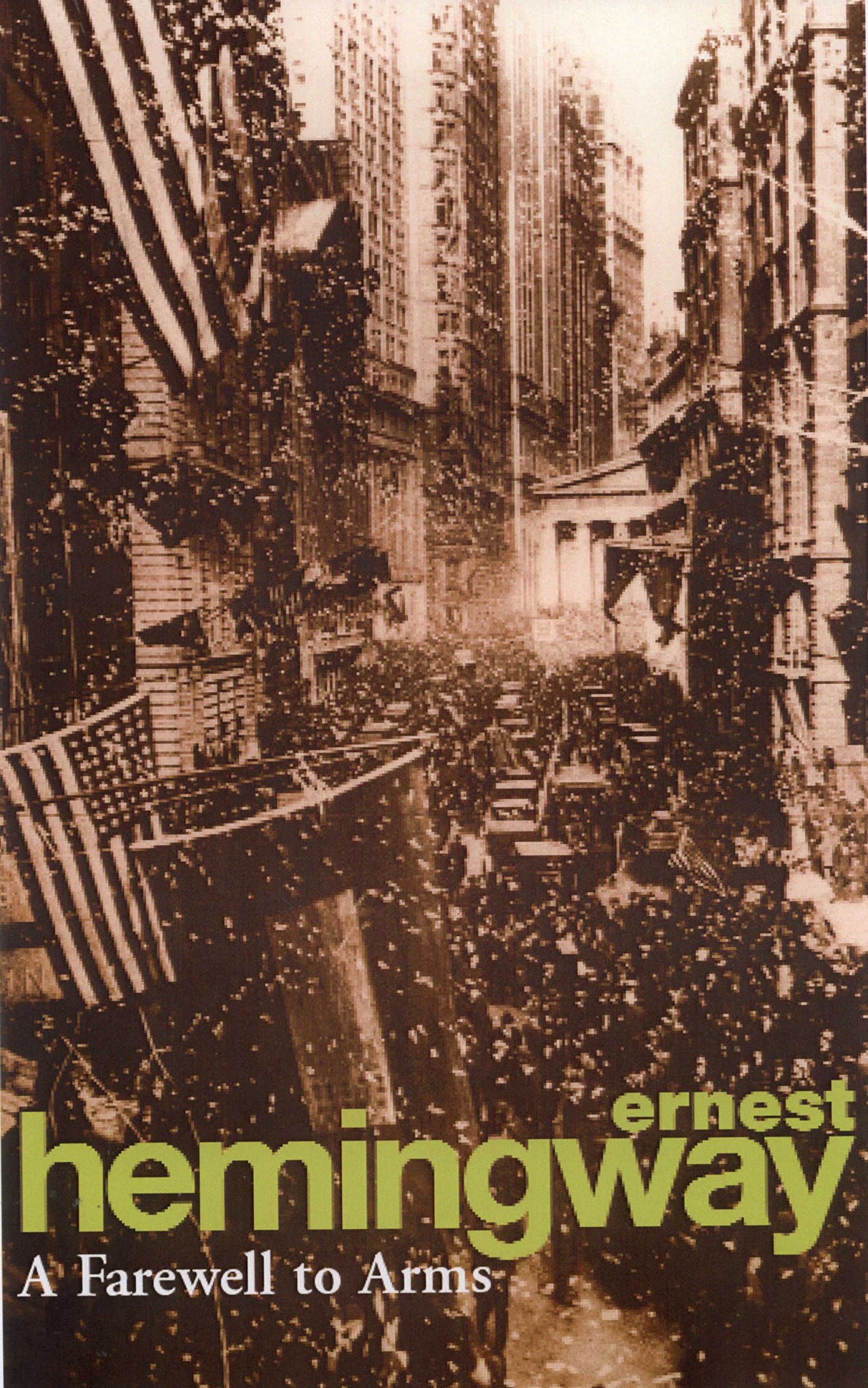
A Farewell to Arms is a classic novel by Ernest Hemingway, presented in new mint condition with same-day dispatch for orders placed before noon. Enjoy guaranteed packaging and a no-quibbles return policy, ensuring a seamless shopping experience.
| Best Sellers Rank | 30,333 in Books ( See Top 100 in Books ) 163 in Biographical & Autofiction 287 in Fiction Classics (Books) 637 in War Story Fiction |
| Customer reviews | 4.1 4.1 out of 5 stars (11,378) |
| Dimensions | 11.1 x 2 x 17.8 cm |
| Edition | 1st |
| ISBN-10 | 0099910101 |
| ISBN-13 | 978-0099910107 |
| Item weight | 168 g |
| Language | English |
| Print length | 304 pages |
| Publication date | 18 Aug. 1994 |
| Publisher | Arrow |
E**E
Great print on very thin pages
It's a classic wartime novel, and it's easy to find reviews of it. I am going to write about the actual book, by which I mean the thing you hold in your hands, with the picture of the nurse and the patient on the front cover. It is much smaller than I expected when I ordered it (my fault for not looking properly at the product details.) The type is quite small. At first I thought, oh no, I'm not going to be able to see the words clearly. But the type is really clear and black. Although the pages are thin, the type doesn't show through them at all. So it's really clear and easy to read, and also really small and light. The only drawback is that I sometimes felt I was making no progress! I was 100 pages through the book and with just a few millimeters of read pages to show for it. Great though. No complaints at all.
M**R
Fatalism and Futility
In a world riven by conflict, a fact that truly threatens to define humanity, Hemingway’s masterpiece remains as poignant and wrenching as ever. Utterly beautiful in its literary poeticism, utterly heartbreaking in its moral, it is understandable why this was lauded as the greatest American novel of the 20th century. Hemingway's style of writing is as unique as JD Salinger's or Joyce's. It is very sparse, purposeful and reserved. In the introduction his grandson writes that Hemingway wrote "on the principle of the iceberg. For the part that shows there are seven-eighths more underwater." The story follows Frederic Henry, an American lieutenant serving as an ambulance driver on the Italian front in WWI. He is wounded while eating cheese in a trench, gets a medal for bravery, and falls in love with a typically beautiful, devoted and idealistic English nurse while he is recovering. In their resultant journey, both physically and emotionally, Hemingway masterfully portrays the sheer futility of war and the ultimate truth of existence, that life marches inexorably on even after the most shattering of tragedies. It is an enlightened novel, a true exploration of the human condition. In the end there is always death. Henry's daring journey across the Italian countryside is my favourite part (as well as when he rows all night through the storm down the lake to try and cross the Swiss border before dawn - the image of him using his umbrella as a sail is so comic and desperate and perfect). But one of the most powerful moments takes place when Henry gazes into the fire. Hundreds of ants on a log are trying to escape the flames. He contemplates being a “messiah” and lifting them from their deaths, but after a moment, he simply empties his water glass on them so he can fill it with whisky. The water only makes the ants burn and sizzle faster. This book also has possibly the most shocking and abrupt ending to a novel I have ever read. Hemingway’s style of writing is indeed unique: very sparse, purposeful, reserved and intensely powerful. In the very opening paragraphs his technique emerges. If Emily Bronte’s writing was a blossom tree in full bloom, Hemingway’s would be a sparse acacia on a barren plain. He creates a rich and exquisite scene by continually returning to several powerful sensory images that root us firmly in the moment: the dusty leaves, the marching troops, all distilled beneath a clear, hot sky. There is almost a whispering undercurrent of assonance to the words through the repetition of ‘leaves’ and ‘river’ and ‘trees’ and ‘dust’ and ‘troops'. It is hypnotic. And this introduces us to the setting throughout the novel, the war-ravaged orchards and towns of Italy in summer. But the rain, oh the rain. It was perhaps a few chapters into the novel that I realised how Hemingway was using the rain to directly convey the events. Whenever the rain started, something bad happened. This got so extreme that as soon as the sky clouded over dread descended upon me. But we must interpret Frederic Henry’s narrative while bearing in mind that there are in fact two Henry’s, the man living out the events and the man recounting them an unknown number of years later (as it is first person past tense). So we see the world through a lens of bitterness and pain, lending a slightly detached and cold air to his words. Ultimately this is an anti-war novel. I have had a year or so now to recover from the end and to try to work out why this most heartbreaking and bitter of novels is such a national treasure. I have decided it is not the intensely powerful literary poeticism that makes the novel so raw and painful and hypnotic and perfect, but how it enlighteningly explores the human condition and exposes the brutal reality of war and the sheer inevitability of death. In the end there is always death, merely death and oblivion. From the moment Henry gets that pointless wound while eating cheese in a trench to the moment Catherine begins hemorrhaging I was captivated and tortured in equal measure. Alongside the meaningless slaughter of millions life goes on and by definition so does tragedy, of even the most natural kind. It will leave you feeling hollow, but it is one of those necessary reads. Fatalism and futility, that’s what I got from this novel. But is there any hope in this abyss? Perhaps it is indeed that life simply marches inexorably on, and ultimately by allowing it to break us we become stronger at the broken places. "If people bring so much courage to this world the world has to kill them to break them, so of course it kills them. The world breaks every one and afterward many are strong at the broken places. But those that will not break it kills. It kills the very good and the very gentle and the very brave impartially. If you are none of these you can be sure it will kill you too but there will be no special hurry."
D**T
Powerful Prose
The basis of the novel `A Farewell to Arms' is author Ernest Hemingway's own experience as an ambulance driver on the Italian front during Wold War I when he was badly wounded and fell in love with a nurse. This semi-autobiography approach makes for reality as `A Farewell to Arms' becomes both a love story and a bleak commentary on the horror and futility of war. It will appeal to readers like myself who have visited the settings of the story in the disputed areas of Gorizia, northern Italy and the Swiss border country, and who are saddened by the folly of fighting in such wonderful mountain environments. The story is recounted in the first person by main protagonist American Frederic Henry, a tenente or lieutenant in the Italian medical corps, and it is divided into 5 books that allow a build up to his character. The tenente communicates easily and freely with others and as a hard drinker is full of both `joie de vivre' and apprehension to his circumstances. `A Farewell to Arms' tells a gripping story as the tenente endures much pain and misery and hardship in addition to appraising his own moral attitudes and passions. The books cover initial meeting with nurse Catherine Barkley and his being wounded, then growth of their relationship, followed by return to the front, defeat and retreat, escape from his own allies, and a finale in neutral Switzerland. Ernest Hemingway's writing style may now be regarded as somewhat old-fashioned, yet at the time of first publication in 1929 it was a break from earlier romantic prose. Though writing is gritty and forceful it is strange to have expletives replaced with dashes and yet to have non-PC words employed. Hemingway relies heavily on dialogue and uses basic simple language that adds credibility to characters and situations. His terse and sparse phrasing is especially powerful in revealing the chaos of war with mental as well as physical conflicts. Often there are what appear to be understatements, but never does the novel slacken pace or lose direction. `A Farewell to Arms' is a classic of its style which has deservedly withstood the test of time - it is powerful prose.
A**G
Ce livre est génial, un livre culte d'Hemingway pour se plonger dans l'absurdité de la Grande Guerre sur le front italien. Le livre est beau, et l'édition a inclus à la fin les nombreuses et différentes fins imaginées par Hemingway. Si vous aimez Hemingway et que vous aimez le lire en anglais, vous ne serez pas déçu!
C**N
Everyman's Library Classics edition It arrived with the paper cover stained, which I could clean almost completely with some alcohol. I cannot rate it less than the best because the edition is flawless, I absolutely love both covers, the most decorated paper one and the dark textile hard cover, with nothing but the title on the side. The introduction is vast and includes a timeline of the social and literary context from Hemingway's life, and I found no errors nor misprints yet, 40 pages to the end.
K**R
It's many years since I first read this, over 60. I had forgotten all but the nighttime flight up the lake into Switzerland. Perhaps Hemingway was of that mind but I never have fathomed why anyone in the First War would have voluntarily joined the Italian Army to supervise ambulance drivers. Or why anyone would have gone to Spain to fight in war not their own. But that was Hemingway - his story was that the evils of war was everyone's business. In this story there is essential courage and dedication until the realities of war (any war is a vicious interlude in our lives) bring out the realities and barbarism that comes over individual men when every moment could be life or death. And I do not find it difficult that either Henry or Catherine in the midst of a passionate discovery of each other would eventually flee to the safety of Switzerland. I found Rinaldo unnecessary to the story and somehow offensive; on the other hand, I found the Count delightful with his two bottles of champagne a day at 94, hoping to reach 100. For me, there were many sections that were long and drawn out far beyond what was requited in the story - but that is Hemingway and he is the one with the Nobel and the Pulitzer. But lurking under and alongside this story there is cruelty and sadness that Hemingway cannot seem to evade, and while he tries to make it a noble sacrifice at first, it later descends into tragedy. So far in my re-reading of Hemingway he has been excellent at turning a beautiful and passionate love into a hopeless tragedy. And at this distance, hopeless and pointless, although a five star hopeless and pointless. .
A**.
One of Hemingway's finest books.
S**D
I really enjoy these editions of hemingways books. This was my second novel of his and it was quite enjoyable.
Trustpilot
2 days ago
1 month ago