
DOWNLOAD THE APP


Customer Services
Copyright © 2025 Desertcart Holdings Limited
DOWNLOAD THE APP
Full description not available
H**S
A wonderful guide to the medieval world of guilds
One would think the book to be rather dry but one would be wrong the writing paints the subject in a deeply interesting manner and is nothing short of a joy to read.
A**N
One for the reference section
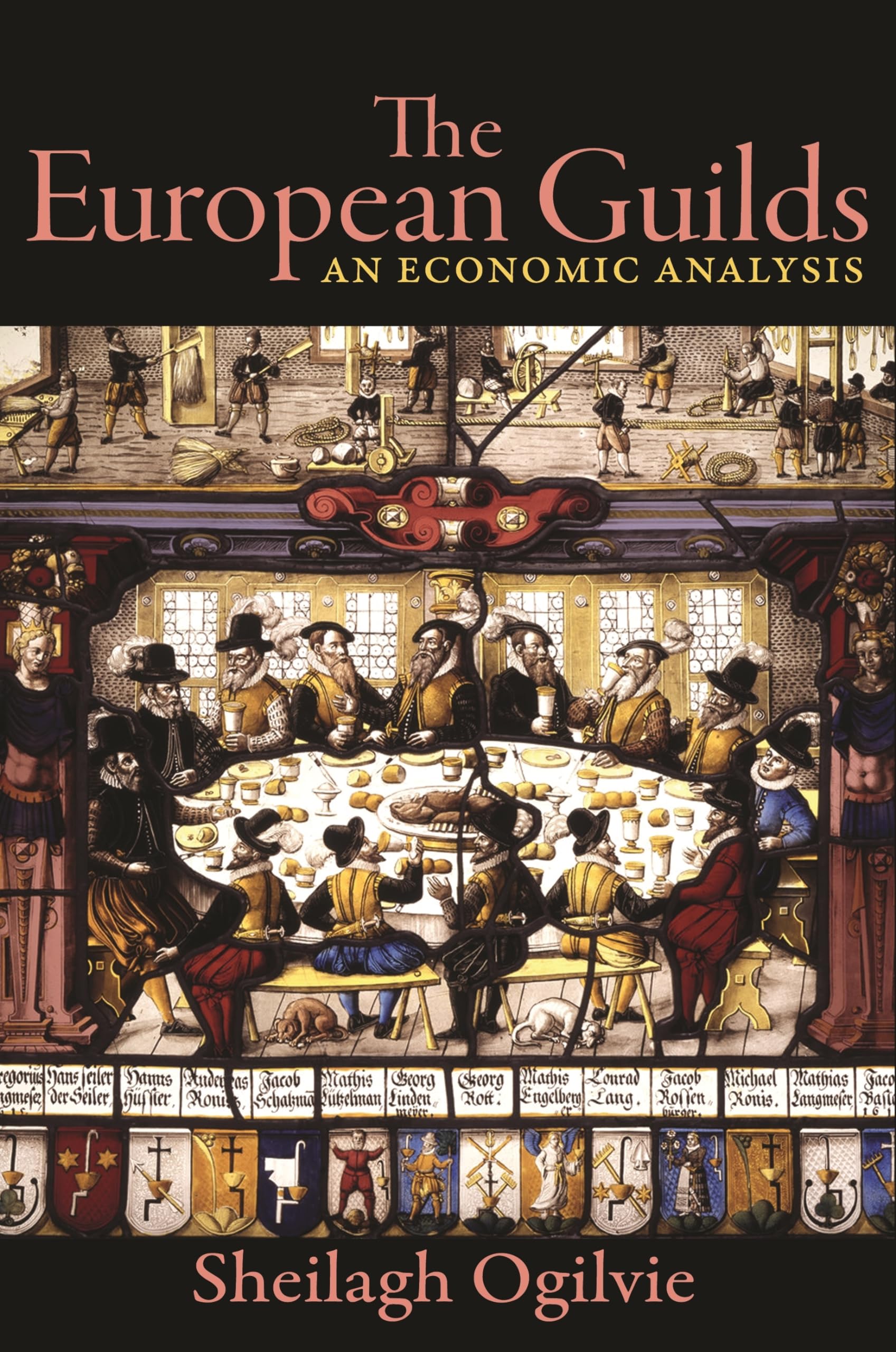
As a car-crazed kid in 1980’s Greece, when I saw “The Automobile Encyclopaedia” at Eleftheroudakis, I BEGGED my mom to have it. She relented within a week and came back home one day with the massive tome. I remain to this day a car fanatic and I’m very happy we bought it, but upon receiving it I quickly realized it was a reference work: the makes I cared to know more about had at most a page dedicated to them and were buried among lesser makes that had a paragraph or even a sentence to show for their inclusion.“The European Guilds” is a lot like that. It belongs strictly in the reference section. Strictly!Riddled with, quite literally, thousands of footnotes (2365 across ten chapters) and 102 tables of data compiled by scholars in the field of economic and social history (this data rather arbitrarily falling into “quantitative” and “qualitative”) it is, pardon the pun, a “masterpiece” in forensic research regarding European crafts guilds.It starts with two chapters which establish through references to previous research that guilds (i) bought their privileges by essentially bribing government and (ii) established extensive barriers to entry of all sorts of kinds. Six chapters follow that comb through all possible arguments made in modern academia in support of guilds.I’ll spare you the agony, the book refutes every single one of them!To summarize: the book basically rifles through fifty (give or take) nice things academic scholars have said before about European guilds (and, in particular crafts, not merchant guilds) and for each one pulls up at a minimum one study that looks at the sources and counts incidents / edicts / regulations / complaints / laws that provide strong circumstantial evidence against the scholarly argument defending the guilds. Paper being a two-dimensional medium, the author tabulates these results across two of (i) city/country (ii) craft (iii) period and and from there proceeds to demolish said scholarly argument in defence of guilds.There are some pictures in the middle and a twenty page conclusion along the lines of what I’d hoped the book would be: first a precis of the preceding 565 pages of data and then ten pages placing the guilds historically, asking why they arose and providing an answer to why they eventually perished (after of course having refuted four alternative explanations, for good measure). In case you’re curious, the winner is the “distributional approach” according to which “institutions arise and survive that serve the distributional ends of the most powerful individuals and groups and decline only when the powerful find other institutions that better serve their needs.”Yes, I know, I was hoping for an explanation to which the guilds are endogenous, but hey.But the book is not without merit. It’s a tremendous reference. It’s just that I was hoping to pick up where I’d left off a couple Christmas seasons ago, when my Mika had bought me “Life in a Medieval City” at the book fair. It’s nothing like that, it’s basically an exhaustive compilation of data supported by an often very repetitive narrative that takes you through the data. (It’s OK that the narrative is repetitive, because each chapter in a book like this had better be able to stand alone)But it wasn’t without its moments. I felt a frisson of true pride when I learned (p.241) that among the only three all-female guilds ever to have operated in Europe outside of clothing, textiles, retailing and personal adornment, one was the soap-makers of my mom’s home town of Trikala!!Worth reading this 585 page brick for? Probably.
Trustpilot
2 weeks ago
1 month ago