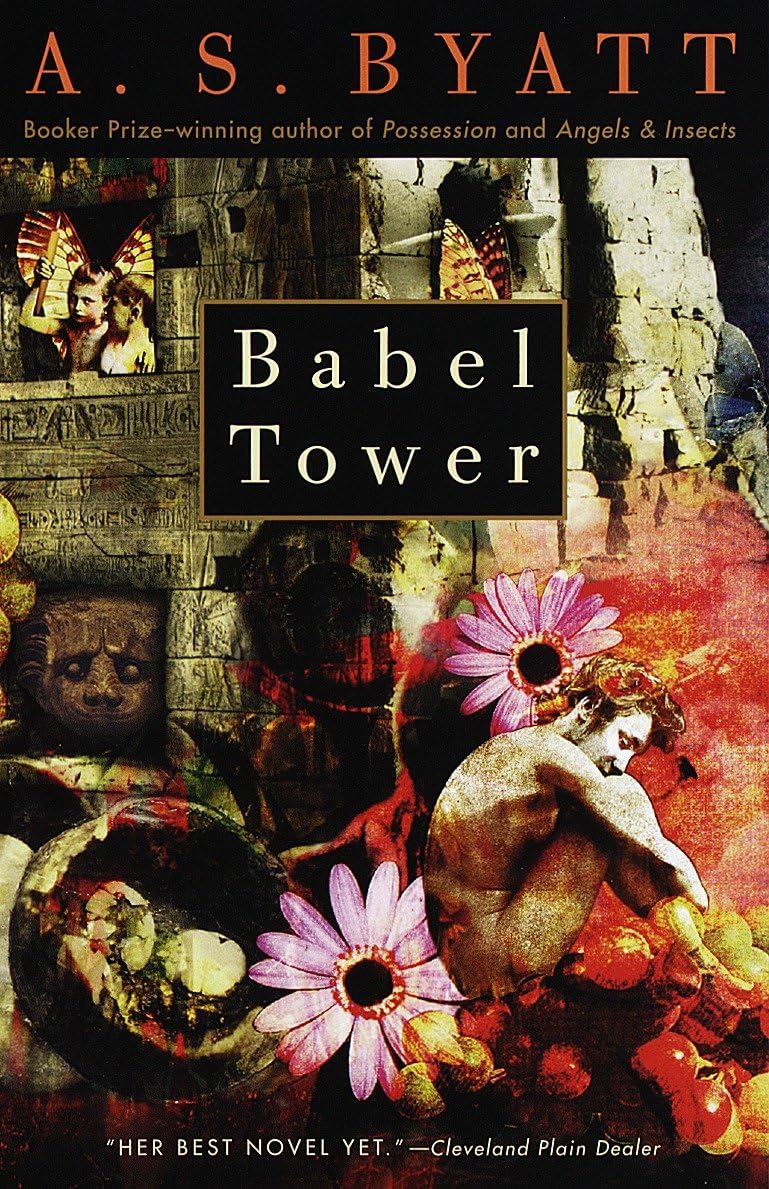
Babel Tower
D**S
Rich And Strange
This is a long and difficult book for a reviewer to tangle with, and I can only do so by breaking it into parts. But, ere I do so, let me make one urgent and important comment for the prospective reader on this, the third book in Byatt's "Yorkshire Tetralogy": THE BOOK IS VERY DISTURBING. Those reviewers here who dismiss it as boring or what not are only exposing their own obtusity, in all sorts of ways. They are in fact demonstrating as true the T.S. Eliot quote from "Burnt Norton" here (p.482) that "human kind cannot bear very much reality." - I, personally, would not trust someone who is not disturbed by this book - Because, as I'll come around to shortly, anyone who is not at first horrified then titillated then horrified at their own titillation in the spectacle of Lady Roseace's death in the book within the book here is simply not a sensitive or aware human being, aware of the cruelty latent in his/her sexuality, whether s/he likes it or not.----And we don't like it, generally. So on to Part1.) The book "Babbletower" within "Babel Tower." - This layering is what makes the book as a whole so thematically powerful. Yes, the character, Jude Mason's, book is in part a rehash of how utopias become dystopias and part a commentary on the Sixties. But, primarily, as in the two previous novels in the tetralogy, it's about human nature, particularly human nature as manifested in sexuality, a theme Byatt doggedly pursues throughout her works. And for Byatt, and for most of us when we consider it, the religious impulse is inextricably intertwined with the sexual. This observation is nothing new. All one has to do is read about the religious rites as practiced by the Ancient Greeks, for example. But it's somehow different when one thinks of one's own religious or spiritual impulses in the modern world. As a church official puts it here: "The Church has ALWAYS been about sex, dear, that's what the problem is. Religion has always been about sex. Mostly about denying sex and rooting it out, and people who are trained to deny something and root it out become obsessed with it, it becomes unnaturally monstrous..." (p.25) Thus, Culvert's discovery of the paintings of the suffering Christ in the tower marks the dawn of his awareness that there is a pleasure, a sexual pleasure, in cruelty. And this discovery leads, ultimately, to the monstrous way in which Lady Roseace is tortured and killed. At first I didn't make too much of this scene, too over the top I thought, but it's difficult to get the imagery and disgust out of one's mind, where it dwells, and eventually one eventually finds oneself responding to it in a sexual manner, because really, of course, as Culvert intended, Roseace's execution is more about sex than death. The moment one undergoes a sexual response in oneself to this horrid imagery and comes to an awareness that part of one takes pleasure in it is the moment one realises what a bewildering and disorienting book this is. Like all literature, it stirs deep things other works leave to convention and causes one to rethink basic assumptions about what one is all about in this world. On to Part2.) Frederica - I don't like her. I like her husband even less. But that's beside the point. The problem with not liking Frederica and her distrust of emotion and her way of trying to think through everything and put everything into "laminations" is that one realises that, to a great extent, the person one truly dislikes is Byatt. But it has to be said for Byatt that she (unlike Iris Murdoch, who draws a moral lesson from her own proclivities in her books and makes them intolerable reading, to me anyway) is fully aware of Frederica's, ahem, her own, shortcomings and shrewdly points them out, which makes Frederica bearable, if not exactly likeable.3.) The book as a whole - Is too full of parody. The scene on the moors where Federica departs her dashing husband is straight out of Wuthering Heights, rescribed for the modern reader. And then parody breaks out all over: Modern poetry, contemporary education, English divorce law proceedings (before no-fault divorces were commonplace) and on and on. The saving grace here is that Byatt parodies her own parodies, making Frederica's "laminations" as much of a shipwreck as her life is at times here, thus making them and her palatable. What the none-too-subtly named Magog says in the trial about the Babbletower is more true of Babel Tower, that, "it is a text that twists round and round itself like the snake around the tree. What IS its true message?" p.586One might well wonder. And go on wondering, for, despite certain reservations on my part, this is a rare book indeed, one not just to think and ponder over, but to WONDER over.
T**9
Byatt at her best
In fact, she's at her best in every single book she has written.
R**R
"It's Easy To Be Sorry After the Event..."
Typically enough, I was about a quarter of the way though "Babel Tower" when I found out it was actually the third book in a quartet featuring the character Frederica Potter. Perhaps I should have gone back and started with The Virgin in the Garden, but by that point I felt I had read too much of "Babel Tower" to simply abandon it. As it happens, the book is perfectly readable as a standalone story, though I do wonder whether my feelings on Frederica and her situation would have been different had I already known her from the previous novels.In any case, the story revolves around two thematically connected plots. In the 1960s Frederica Potter is a young woman trapped in a stifling marriage that soon turns violent. With her young son she escapes into the night, but naturally her husband isn't prepared to give either one of them up that easily. Soon Frederica is facing a court case that calls into question her abilities as a mother, with the entire deck stacked in her husband's favour: he has money, prestige, respectability, and female family members willing to disparage Frederica in court.Both the domestic abuse and the ensuing court case are quite disturbing, with Byatt exploring the hypocrisies and injustices of pitting an intellectual, liberated woman against a system that's still archaic in its upkeep of moral standards. Here is slut-shaming, gas-lighting, condescension, and (perhaps worst of all) women betraying women for the sake of a domineering male.The secondary plot involves a book called "Babbletower" written by one of Frederica's acquaintances that she recommends for publication. On its release it is deemed perverse by censors and (much like Frederica) put on trial to assess the damage it might do to society.Using a book-within-a-book strategy (rather like she did in Possession) passages from "Babbletower" are strewn throughout the novel, detailing a group of aristocrats fleeing from the Revolution and attempting to form a utopia in an abandoned country tower. Pure intentions eventually give way to depravity and violence, though the question remains whether the book's content is too obscene for public consumption.So "Babel Tower" is a novel in which a woman and a book are put on trial, both for reasons that are closely related to the uninhibited sexuality they display (or flaunt, if you're one of their detractors). Like many of Byatt's books, it's occasionally bogged down with period details and literary allusions, and is initially quite difficult to sort out the dizzying array of characters. In my second-hand copy of the book I was amused to find a folded bit of paper upon which was written a list of the characters and their relationships to each other; an attempt by the book's previous owner to keep track of everyone!But for the patient reader there is plenty to enjoy: a harrowing depiction of an emotionally/physically abusive marriage, a close character study of a young woman struggling to free herself from the expectations/values of others, a vivid depiction of mid-1960s England, and several thought-provoking themes explored in Byatt's careful, detailed prose.
S**M
Satisfying reading with rich details yet somewhat elusive
Byatt does a good job in lifting a mundane, sordid, humiliating and ugly and yet somewhat ordinary divorce story into a page turner by attempting to elevate the episode into an epic proportion by relying on simultanous narrative of Babeltower, an obscenity book case.
Trustpilot
1 month ago
2 months ago