
Buy anything from 5,000+ international stores. One checkout price. No surprise fees. Join 2M+ shoppers on Desertcart.
Desertcart purchases this item on your behalf and handles shipping, customs, and support to Australia.
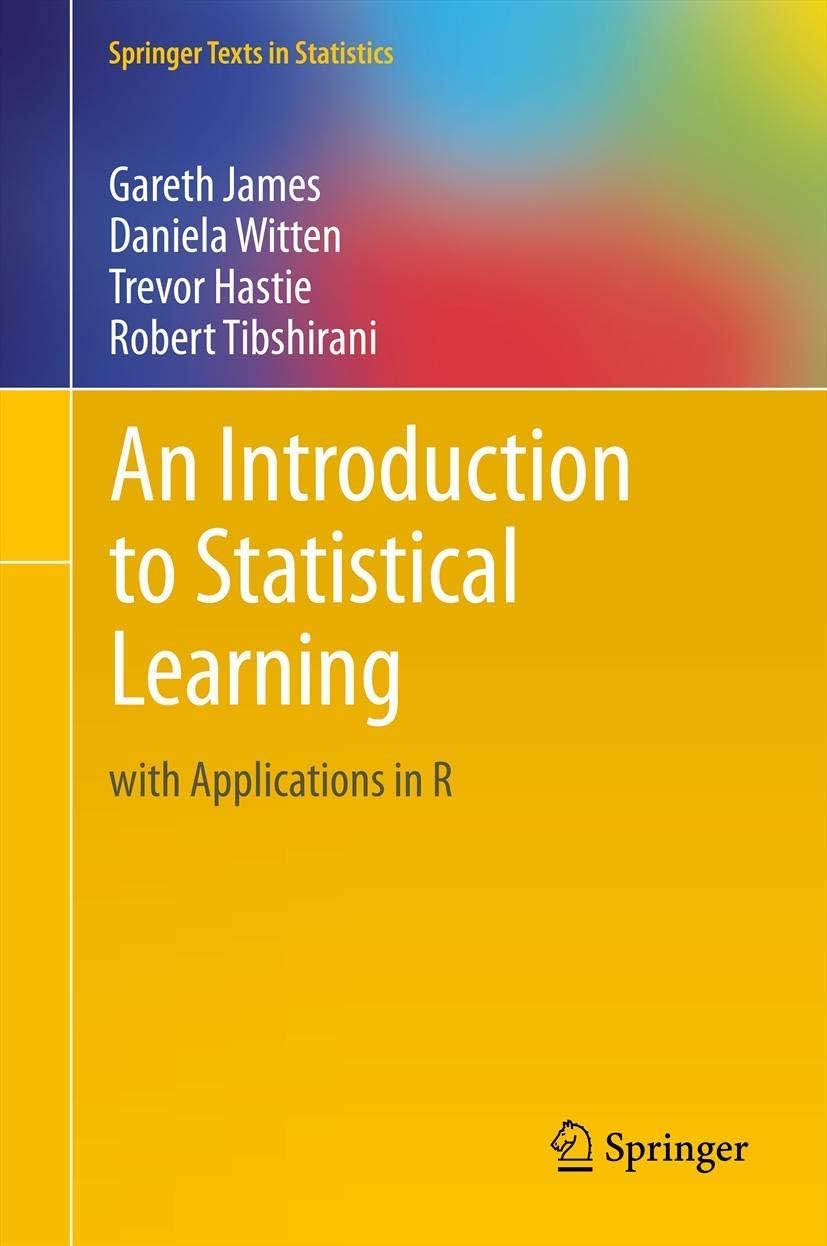
An Introduction to Statistical Learning provides an accessible overview of the field of statistical learning, an essential toolset for making sense of the vast and complex data sets that have emerged in fields ranging from biology to finance to marketing to astrophysics in the past twenty years. This book presents some of the most important modeling and prediction techniques, along with relevant applications. Topics include linear regression, classification, resampling methods, shrinkage approaches, tree-based methods, support vector machines, clustering, and more. Color graphics and real-world examples are used to illustrate the methods presented. Since the goal of this textbook is to facilitate the use of these statistical learning techniques by practitioners in science, industry, and other fields, each chapter contains a tutorial on implementing the analyses and methods presented in R, an extremely popular open source statistical software platform. Two of the authors co-wrote The Elements of Statistical Learning (Hastie, Tibshirani and Friedman, 2nd edition 2009), a popular reference book for statistics and machine learning researchers. An Introduction to Statistical Learning covers many of the same topics, but at a level accessible to a much broader audience. This book is targeted at statisticians and non-statisticians alike who wish to use cutting-edge statistical learning techniques to analyze their data. The text assumes only a previous course in linear regression and no knowledge of matrix algebra. Review: This book is more like a ticket of a beautiful park - This is a wonderful book for an intro to the world of statistical learning. As an engineering students, it is very approachable and readable. It took me 2 days to finish all chapters, without exercise. To read through the chapters, it's much more enjoyable than reading other math/stat books, since the ideas behind each model or algorithms are very clear even intuitive, a lot of well-made plots make the understanding even easier. I would like to recommend to anyone who want to enter the world of statistical learning. However, from a graduate level student, I would say this book is more suitable for a undergrad stat or related field student, practitioners, or an entry level graduate student who is not majoring in stat or math. The ideas are much more intuitive than rigorous. If only use such book to do any real world problem, even though they talk about cross validation or something a little bit involved, practitioners may either came across so much problems in statistical analysis, or come to a wrong conclusion. Not saying the methods within this book is wrong, but without deep understanding of some theories or rigorous assumpions of the methods, pure blind trying different algorithms to find lowest MSE may not be suitable for some cases. Still, this is a wonderful book for two cases: 1. If you have some background in theoretical or mathematical statistics and want to gain some knowledge of applied methods, this book will be wonderful for you to find applications with your theoretical knowledge; 2. If you have few knowledge about rigorous statistics, but want to enter the world of statistical/machine learning, this one is very suitable to trigger your interest for reading deeper and more rigorous books, such as ESL. For myself, this books is more like a ticket. I have the ticket of a beautiful state park. I use it to cross the gate of the park, but stand near the gate to give an overlook of the beautiful scenes of the park. The map described on the ticket is only contained the main road of the park. If you want to check more beautiful scenes, you need more work, more tickets, more tools to take an adventure within this park for quite a while. Review: Written by statisticians for non-statisticians - Without any suspense, "An Introduction to Statistical Learning" (ISL) by James, Witten, Hastie and Tibshirani is a key book in the Data Science literature. I would summarize it as a book written by statisticians for non-statisticians. Indeed, while the book "The Elements of Statistical Learning" was heavy on theory and equations, ISL is the practical counterpart. The book is very clear and contains only theory you need to understand the data mining algorithms covered. It's thus a invaluable resource for Data Scientists who don't need all theorems and proofs related to a given algorithm, but still need to understand how it works. Several examples are provided to illustrate each algorithm. Each chapter contains a section with R labs, showing the code needed to move from reading the book to doing data science. The book has a strong emphasis on linear regression and related non-linear approaches (more than half of the book). This lets very few place to other approaches such as decision trees and SVM, which are still covered. The final chapter rapidly covers PCA and clustering. Although the book is targeted towards a larger audience than statisticians, you shouldn't be afraid of equations (by the way, if you look for an excellent book covering data science algorithms with nearly no equation, have a look at "Data Science for Business" from Provost and Fawcett). With such an excellent book, we are obviously more exigent and I was looking for more coverage of validity indices for clustering, Support Vector Regression, and a final chapter about trends and challenges. In conclusion, ISL is the definitive resource for Data Scientists who want to get the correct level of statistical background in their work.
| Best Sellers Rank | #559,636 in Books ( See Top 100 in Books ) #220 in Statistics (Books) #311 in Probability & Statistics (Books) |
| Customer Reviews | 4.8 out of 5 stars 1,935 Reviews |
J**G
This book is more like a ticket of a beautiful park
This is a wonderful book for an intro to the world of statistical learning. As an engineering students, it is very approachable and readable. It took me 2 days to finish all chapters, without exercise. To read through the chapters, it's much more enjoyable than reading other math/stat books, since the ideas behind each model or algorithms are very clear even intuitive, a lot of well-made plots make the understanding even easier. I would like to recommend to anyone who want to enter the world of statistical learning. However, from a graduate level student, I would say this book is more suitable for a undergrad stat or related field student, practitioners, or an entry level graduate student who is not majoring in stat or math. The ideas are much more intuitive than rigorous. If only use such book to do any real world problem, even though they talk about cross validation or something a little bit involved, practitioners may either came across so much problems in statistical analysis, or come to a wrong conclusion. Not saying the methods within this book is wrong, but without deep understanding of some theories or rigorous assumpions of the methods, pure blind trying different algorithms to find lowest MSE may not be suitable for some cases. Still, this is a wonderful book for two cases: 1. If you have some background in theoretical or mathematical statistics and want to gain some knowledge of applied methods, this book will be wonderful for you to find applications with your theoretical knowledge; 2. If you have few knowledge about rigorous statistics, but want to enter the world of statistical/machine learning, this one is very suitable to trigger your interest for reading deeper and more rigorous books, such as ESL. For myself, this books is more like a ticket. I have the ticket of a beautiful state park. I use it to cross the gate of the park, but stand near the gate to give an overlook of the beautiful scenes of the park. The map described on the ticket is only contained the main road of the park. If you want to check more beautiful scenes, you need more work, more tickets, more tools to take an adventure within this park for quite a while.
S**A
Written by statisticians for non-statisticians
Without any suspense, "An Introduction to Statistical Learning" (ISL) by James, Witten, Hastie and Tibshirani is a key book in the Data Science literature. I would summarize it as a book written by statisticians for non-statisticians. Indeed, while the book "The Elements of Statistical Learning" was heavy on theory and equations, ISL is the practical counterpart. The book is very clear and contains only theory you need to understand the data mining algorithms covered. It's thus a invaluable resource for Data Scientists who don't need all theorems and proofs related to a given algorithm, but still need to understand how it works. Several examples are provided to illustrate each algorithm. Each chapter contains a section with R labs, showing the code needed to move from reading the book to doing data science. The book has a strong emphasis on linear regression and related non-linear approaches (more than half of the book). This lets very few place to other approaches such as decision trees and SVM, which are still covered. The final chapter rapidly covers PCA and clustering. Although the book is targeted towards a larger audience than statisticians, you shouldn't be afraid of equations (by the way, if you look for an excellent book covering data science algorithms with nearly no equation, have a look at "Data Science for Business" from Provost and Fawcett). With such an excellent book, we are obviously more exigent and I was looking for more coverage of validity indices for clustering, Support Vector Regression, and a final chapter about trends and challenges. In conclusion, ISL is the definitive resource for Data Scientists who want to get the correct level of statistical background in their work.
J**N
cover all of your bases
If you want to build a comprehensive machine learning library, this would be the first book to purchase. While it does cover all of the basics, it is not watered down by any means. (I had the same fear as BK Reader) I found the following to be especially helpful; 1. Straight talk - These experts come right and say which methods work best under which circumstances. While there are many fancy algorithms covered in the book, they highlight the advantages of the simpler ones. 2. Emphasis on subjects that are not heavily addressed in most ML books - They thoroughly cover the challenges of high-dimensionality, data cleaning, and standardization. They do not limit their attention to these subjects to one chapter. They bring them up continually throughout the book. 3. Expertise - Dr. Hastie and Dr. Tibshirani are two of the thought leaders in statistical learning. You can be assured that you are learning from the best. 4. Many levels of depth - While the book does cover the basics, it is not watered down by any means. (I had the same worry as BK Reader) There is a great deal for any student of statistics; beginner or advanced. 5. R code - You are given enough code and examples to gain confidence in your ability to independently perform excellent analysis and modeling. 6. The concepts are just plain exciting! - You will feel an excitement as you discover and re-discover the algorithms they present. The book is a standard work along with Elements of Statistical Learning and Pattern Recognition and Machine Learning (the Bayesian approach). If you enjoy the book, you may also want to consider Applied Predictive Modeling. It has the same style and approach.
M**S
Excellent Practical Introduction to Learning
The book provides the right amount of theory and practice, unlike the earlier (venerable and, by now, stable) text authored (partly) by the last two authors of this one (Elements of Statistical Learning), which was/is a little heavy on the theoretical side (at least for practitioners without a strong mathematical background). The authors make no pretense about this either. The Preface says "But ESL is intended for individuals with advanced training in the mathematical sciences. An Introduction to Statistical Learning (ISL) arose from the perceived need for a broader and less technical treatment of these topics." ISL is neither as comprehensive nor as in-depth as ESL. It is, however, an excellent introduction to Learning due to the ability of the authors to strike a perfect balance between theory and practice. Theory is there to aim the reader as to understand the purpose and the "R Labs" at the end of each chapter are as valuable (or perhaps even more) than the end-of-chapter exercises. ISL is an excellent choice for a two-semester advanced undergraduate (or early graduate) course, practitioners trained in classical statistics who want to enter the Learning space, and seasoned Machine Learners. It is especially helpful for getting the fundamentals down without being bogged down in heavy mathematical theory, a great way to kick-off corporate Learning units, or as an aid to help statisticians and learners communicate better. A needed and welcome addition to the Learning literature, authored by some of the most well respected names in industry and academia. A classic in the making. Recommended unreservedly. ____________________________________________ UPDATE (12/17/2013): Two of the authors (Hastie & Tibshirani) are offering a 10-week free online course (StatLearning: Statistical Learning) based on this book found at Stanford University's Web site (Starting Jan. 21, 2014). They also say that "As of January 5, 2014, the pdf for this book will be available for free, with the consent of the publisher, on the book website." Amazing opportunity! Enjoy! ____________________________________________ UPDATE (04/03/2014): I took the course above and found it very helpful and insightful. You don't need the course to understand the book. If anything, the course videos are less detailed than the book. It is certainly nice, though, to see the actual authors explain the material. Also, the interviews by Efron and Friedman were a nice touch. The course will be offered again in the future.
M**N
Recommended reading for graduate programs with computational data analysis
ISLR is possibly the best book I've ever encountered on the subject of statistical learning. Throughout my studies, I spent countless days reading more complicated theoretical texts, but few have stuck, and I've never fully understood how to translate the theory to code (specifically, in R). This is probably because my background in statistics was limited to a single prerequisite undergraduate course. I have been waiting a decade to find a book like this, containing basic theory (with plenty of figures), some math, code snippets and reproducible examples. If you are completing a graduate degree in any field where data is collected en masse, I *strongly* recommend this book. I think graduate advisors should make it required reading in the first year of graduate school for students who will be performing computational data analysis. ISLR teaches basic regression techniques for prediction and classification and formally explains sampling methods (cross-validation, bootstrapping). The figures are great and the code examples make it very easy to apply the lessons in your own studies. This book formalizes what took me years to learn by diffusion watching seminars and reading papers and blogs. 5 stars! Bear in mind that this book is not a solid introduction to the R programming language. To learn R, study online courses, the "swirl" package. Once you've mastered the basics, look for the book "Advanced R".
R**A
Good book if you have a strong foundation in math
This book covers most of the primary techniques used in data science and machine learning. Each chapter is devoted to a topic and explained further throughout sections within the chapter. I don't quite have the mathematical foundation I need to get the most out of this book. For example, in reading chapter 3 on linear regression, I was following along just fine but once all the mathematical formulas got more complex page after page, I was lost. I realized I don't have the proper grounding in match to follow along. If you're someone like me with a poor math foundation, it will prove to be a difficult hurdle to overcome as you cover the book. (I believe they still offer a free PDF version on their site, so take a quick perusal and if you find yourself crosseyed from the myriad of formulas presented, then it's best to save it for a later purchase.) If you've got strong math skills, then this book will be a joy to read. I need someone more basic in terms of explaining not only the symbology used, but how the formulas are derived. Hopefully I can find something more "beginner" and "basic" to guide me along so I can finally use this book for all it has to offer.
S**Y
This is the easy book from Hastie, et al. on Statistical Learning (Machine Learning)
In 2009, Stanford Statistics professors Hastie/Tibshirani/Friedman wrote 'The Elements of Statistical Learning', a book that demands a Master's or Doctoral level knowledge of Mathematical Statistics. Years ago, as a part of earning my MS Mathematics, I passed a doctoral-level qualifying examination in Mathematical Statistics. But that was years ago and I needed a friendly refresher before reading 'Elements', which is gathering dust on my shelf. Well, I'm lucky (and probably so are you) because in 2013 Stanford Statistics professors James/Witten/Hastie/Tibshirani wrote this simpler 'An Introduction to Statistical Learning' that requires only a Bachelor's degree in Mathematics or Statistics. If you have that math grounding, then this is a wonderful book to start your Statistical Learning. The book offers a clear application of Mathematical Statistics and the programming language R to Statistical Learning. At the end of each chapter, the authors provide 10-15 questions to test whether you've digested the material. Only a few times have I needed to review my Hogg/Craig 'Introduction to Mathematical Statistics'. If you want an excellent book on Mathematical Statistics to prepare you for both 'Introduction to Statistical Learning' and 'The Elements of Statistical Learning', buy the 7th edition of 'Introduction to Mathematical Statistics' by Hogg/McKean/Craig, which is typically used for a year-long (2 semesters) class for 1st or 2nd year graduate students in Mathematics or Statistics. In fact, you could simply bone up on Hogg/McKean/Craig, skip 'Introduction to Statistical Learning', and go straight to the more challenging 'Elements of Statistical Learning'. I wanted to digest some Statistical Learning asap and probably so will you. Enjoy.
C**Y
One for the non-mathematicians amongst us!
This is an outstanding introduction to statistical learning that requires no prior knowledge of calculus or linear algebra. It replaces mathematical rigor with intuitive descriptions of why and when each of the discussed methods work. The focus is on the process of learning from data using software libraries, and about the strengths and limitations of each method. Implementation details of the methods, proofs of correctness, and rigorous mathematical analyses are simply left out. Readers looking for those details will be disappointed. However, the presentation will be rewarding to anyone willing to accept statements of mathematical properties at face value. The R programming language is used to demonstrate methods, and it is also the basis for all the hands-on exercises. The text assumes absolutely no prior knowledge of R, nor does it pretend to teach people how to become R programmers. Instead, there is enough material included to allow anyone with rudimentary programming experience to solve the exercise problems and gain some real experience with statistical learning. If you are a software developer looking to understand what the field is all about, this is the best introduction to the subject I've read. Even readers with sophisticated mathematical training will recognize how carefully the subject is developed for the non mathematical reader (the authors being amongst of the leading researchers in the field).
J**K
Great book received in perfect condition
Received in good condition.
R**A
Die beste Einführung zum Thema
Wie schon hier erwähnt, ist An Introduction to Statistical Learning (ISL) eine ausgezeichnete Einführung ins Machine Learning. Man kann es als den kleinen Bruder von "The Elements of Statistical Lernen" (ESL) sehen. Es werden alle relevanten Themen vom Statistical Learning/Machine Learning (classification, clustering, supervised, unsupervised, usw.) in wenigen Seiten behandelt. Denn ISL ist extrem gut erklärt und benutzt eine einfache Sprache. Wenn man noch zusätzlich das Stanford MOOC "Statistical Learning" belegt, bekommt man eine sehr fundierte Basis. ISL verzichtet auf komplexe mathematische Beweise und ist tatsächlich als Anwendungsbuch zum Selbstlernen gedacht. Es wird keine großen Vorkenntnissen erwartet. Man lernt anhand von der Programmiersprache R, wie man Datensätze analysiert und Zusammenhänge vorhersagen kann. Wenn man noch über die Theorie dahinter erfahren möchte, oder tiefer ins Thema gehen will, ist ESL bestens empfohlen. Hier machen die Autoren sehr deutlich, dass ISL sich um ein Praxisbuch handelt. Das Buch ist auch sehr schön und hochwertig gemacht (man merkt es an den Preis). Die Seiten sind bunt und aus qualitativem Papier. Der Preis ist außerdem komplett gerechtfertigt, da es einem sofort klar wird, wie viel Zeit und Leidenschaft die Autoren investiert haben, um ein konzises aber präzises Fachbuch zu konzipieren. Es handelt sich um ein extrem didaktisches Buch und leider ist dies in der Informatik/Mathematik häufig eine Seltenheit. Man kann das Buch kostenlos (und legal) im Internet als PDF herunterladen. Die Autoren haben es zur Verfügung gestellt. Es lohnt sich aber zum Kauf. Denn die Autoren haben es sehr wohl verdient. ISL wird wie ihr Großbruder zum Standardwerk und es kann jedem empfohlen werden, der ein Interesse an dem Thema hat.
S**O
Easy to understand
This is a great book if you want to learn the basics of statistical analysis and how to apply these methods in R. If you're an absolute beginner then you might get a little confused, but it's all written in simple terms and does a good job of avoiding unnecessary terminology.
D**S
Muy buen libro
Libro básico altamente recomendable para introducirse en el tema de aprendizaje de máquina. Lo uso para mis clases como referente de texto.
G**E
Great introductory survey to many statistical tools and R code
This book is quite fantastic for an introductory level. I have a specialised training in mathematics and this books puts me up to date on several topics and algorithms without having to deal much time in the mathematical technicalities (for that, there are specialised treatises on each subject). The R code is quite good and although I think some of their advice is not appropriate (e.g. the attach function is in R only for legacy purposes but shouldn't be used since it overrides other functions, including base, aka default, functions), it is workable and so it's a great investment. The book is introductory focusing mostly on intuition and how to do, little time is spent in mathematical formalities, so that's a plus. I think there is a NEWER edition than the one I reviewed but otherwise I suspect the newer edition will be just better. Recommended.
Trustpilot
2 weeks ago
1 month ago