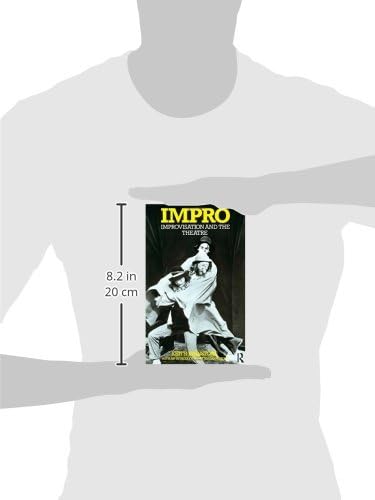



Impro: Improvisation and the Theatre
Product ID: 1428949
Buy anything from 5,000+ international stores. One checkout price. No surprise fees. Join 2M+ shoppers on Desertcart.
Desertcart purchases this item on your behalf and handles shipping, customs, and support to Australia.
Impro: Improvisation and the Theatre [Johnstone, Keith] on desertcart.com. *FREE* shipping on qualifying offers. Impro: Improvisation and the Theatre Review: Eye-opening book, goes beyond theater - Keith Johnstone has a very interesting worldview. This book is clearly aimed at people who want to either learn about improvisational theater, or even moreso people who want to teach it. There are a few explicit exercises, but the text is mostly prose about the nature of improvisation, and the way that relates to human psychology. As an example of an interesting psychological insight, Johnstone discusses trance states. He strongly recommends using theatrical masks for improvisation, and his method for using them—though he references many earlier teachers with the same idea—involves using mirrors and skillful encouragement in order to take the student out of their normative self and get them to really experience being something else. But we are in fact always going in and out of trance states, he explains: it's impossible to always be "in control," and attempting that just leads to frustration and anxiety. Another basic point is that imagination is a kind of natural state of the human mind. At one point he says explicitly that imagination is the "true self," which is if nothing else a fascinating hypothesis. His take on school education recalls other writers, especially John Holt, whom he cites several times: basically, modern education tends to discourage spontaneity and imagination. Finally, his structural way of seeing theater, comedy, and human interaction in general, involves "status games," which makes a lot of sense. For example, he loves Beckett's way of playing with master-servant dynamics, one-upping, etc. He describes a method of teaching theater that involves getting people to understand their own habits of "status posturing," in order to assume other positions and act naturally. He says that long spontaneous improvisation sessions can grow out of just a simple configuration of status, and gives examples of such games. Johnstone's outlook reminds me of life's strange beauty. Life is indeed much like improvisational theater, and it's great to learn from the insights of someone whose life work involves taking this seriously. Review: The Best Book on Improvisation, and Mask Trancing too~! - I have taken workshops under Mr. Johnstone, but was really glad I read his book beforehand. It is an excellent collection of exercises, anecdotes, and case studies of improv, scene building, and especially masks. The last fourth of the book includes numerous mask exercises and scenes, along with a good discussion of the origins and history of mask work. I have been using his book to teach mask workshops since 1981 with great success. I heartily recommend this book not just to actors, but to anyone who would like to understand better the profound influence our outer appearance has on our psyche and our relationships to others. How many times have you heard, "What do you mean by that look?" or "Don't give me that look." Very interesting and applicable to everyday life, not just theatre. I even use what I've learned in my voiceover auditions and sessions--because I've found that if I can make the face, I'm halfway to creating the voice needed, whether it be an impersonation of a famous personality, or even just a simple announce job. "Smile when you say that, partner!" is more than a cliche--it's a fact of human communication.


| ASIN | 0878301178 |
| Best Sellers Rank | #61,700 in Books ( See Top 100 in Books ) #4 in Theater (Books) #10 in Acting & Auditioning (Books) |
| Customer Reviews | 4.5 4.5 out of 5 stars (586) |
| Dimensions | 5 x 0.5 x 8.1 inches |
| Edition | 1st |
| ISBN-10 | 9780878301171 |
| ISBN-13 | 978-0878301171 |
| Item Weight | 7.2 ounces |
| Language | English |
| Part of series | Performance Books |
| Print length | 208 pages |
| Publication date | January 7, 1987 |
| Publisher | Routledge |
M**K
Eye-opening book, goes beyond theater
Keith Johnstone has a very interesting worldview. This book is clearly aimed at people who want to either learn about improvisational theater, or even moreso people who want to teach it. There are a few explicit exercises, but the text is mostly prose about the nature of improvisation, and the way that relates to human psychology. As an example of an interesting psychological insight, Johnstone discusses trance states. He strongly recommends using theatrical masks for improvisation, and his method for using them—though he references many earlier teachers with the same idea—involves using mirrors and skillful encouragement in order to take the student out of their normative self and get them to really experience being something else. But we are in fact always going in and out of trance states, he explains: it's impossible to always be "in control," and attempting that just leads to frustration and anxiety. Another basic point is that imagination is a kind of natural state of the human mind. At one point he says explicitly that imagination is the "true self," which is if nothing else a fascinating hypothesis. His take on school education recalls other writers, especially John Holt, whom he cites several times: basically, modern education tends to discourage spontaneity and imagination. Finally, his structural way of seeing theater, comedy, and human interaction in general, involves "status games," which makes a lot of sense. For example, he loves Beckett's way of playing with master-servant dynamics, one-upping, etc. He describes a method of teaching theater that involves getting people to understand their own habits of "status posturing," in order to assume other positions and act naturally. He says that long spontaneous improvisation sessions can grow out of just a simple configuration of status, and gives examples of such games. Johnstone's outlook reminds me of life's strange beauty. Life is indeed much like improvisational theater, and it's great to learn from the insights of someone whose life work involves taking this seriously.
R**L
The Best Book on Improvisation, and Mask Trancing too~!
I have taken workshops under Mr. Johnstone, but was really glad I read his book beforehand. It is an excellent collection of exercises, anecdotes, and case studies of improv, scene building, and especially masks. The last fourth of the book includes numerous mask exercises and scenes, along with a good discussion of the origins and history of mask work. I have been using his book to teach mask workshops since 1981 with great success. I heartily recommend this book not just to actors, but to anyone who would like to understand better the profound influence our outer appearance has on our psyche and our relationships to others. How many times have you heard, "What do you mean by that look?" or "Don't give me that look." Very interesting and applicable to everyday life, not just theatre. I even use what I've learned in my voiceover auditions and sessions--because I've found that if I can make the face, I'm halfway to creating the voice needed, whether it be an impersonation of a famous personality, or even just a simple announce job. "Smile when you say that, partner!" is more than a cliche--it's a fact of human communication.
A**.
Meaningful stuff, makes you think.
This was the first improv book that I ever read, and in retrospect I kind of wish I'd read something like Charna Halpern's TRUTH IN COMEDY or Mick Napier's IMPROVISE first. Those books will give you a better introduction to what most of us know of as group improvisation - the "Whose Line is it anyway" sort of thing. They'll give you a better framework to work with. Keith Johnstone's book, on the other hand, is kind of like a complete rethinking of the Improv framework ... he writes about things I haven't read about anywhere else. And it really made me think about things in a different way. First of all, I have to admit that the first couple of sections are pretty dry. I had to struggle to get through the section on "Status" ... I was thinking to myself, why did people give this BORING book a good review?? ... I did consider that maybe it's because the man is British (I think), and so the style of writing and the type of humor is a little different than I'm used to. However, when he gets around to talking about the story/narrative, suddenly there is a flash of brilliance and it all started to make sense ... basically he talks about just letting GO of the things that are inhibiting us, how to stop listening to the voice that is telling us NO all the time ... and, I don't know, there's just something very profound in the way that he discusses it - little insights here and there that are just, for lack of a better word, very MEANINGUL. For example, he says, of parents and teachers who scold their children, to keep their undesirable 'creativeness' under wraps: "... when these children grow up, and perhaps crack up, then they'll find themselves in therapy groups where they'll be encouraged to say all the things that the teacher would have forbidden during school." SO TRUE. This is what all the group therapies in Psych hospitals do - try to bring back the creativeness of the child. Why do we limit it in the first place?? Basically he stresses that EVERYONE has "weird" thoughts and an "artistic" nature that many of us have learned to say NO to, because they are forbidden or at least not encouraged. He says, "In one moment I knew that the valuing of men by their intelligence is crazy, that the peasants watching the night sky might feel more than I feel, that the man who dances might be superior to myself - word-bound and unable to dance. From then on I noticed how warped many people of great intelligence are, and I began to value people for their actions, rather than their thoughts." And that's not EVEN getting into the last chapter, on MASKS - at first I was thinking, "OK, this is weird, why is there a huge chapter on MASKS in a book about IMPROV"? But the things he describes there are perhaps the most amazing, and disturbing, of the whole book. It almost makes me fear what I would "do" if I were to follow his instructions and suggestions ... but it's an excited sort of 'fear' - actually I wish I had readier access to instructors who are comfortable in these methods ... well, I can't really describe it much better than that.
H**Y
devoured the book quickly then dove back in for more in depth reading. So very glad this book is available on Kindle
H**G
Johnstone was clearly writing from the perspective - and for the benefit - of theatrical improvisation. But he makes a ton of sense from a personal, managerial, leadership and teamworking perspective as well. His breadth of thinking and range of references are stunning. His arguments are elegant and appealing. I got little from the fourth section on Masks and Trance - great for actors and directors I'm sure but not so much use to me and the business people I work with - but the first three sections, on Status, Spontaneity and Narrative Skills, are worth more than the price of admission by themselves. Marvellous.
J**A
Una obra maestra de su disciplina. Imprescindible. Es el mejor libro que he leído sobre improvisación de todos los que he leído. Es como leer los descubrimientos del maestro. Espectacular en todos los sentidos.
S**A
Wonderful book for imagination
A**A
Fantastic book about the essence of improvising, and also the importance of working together as humans. Very interesting read.
Trustpilot
3 weeks ago
2 weeks ago