
DOWNLOAD THE APP


Customer Services
Copyright © 2025 Desertcart Holdings Limited
DOWNLOAD THE APP

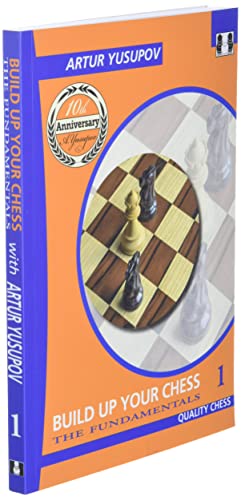
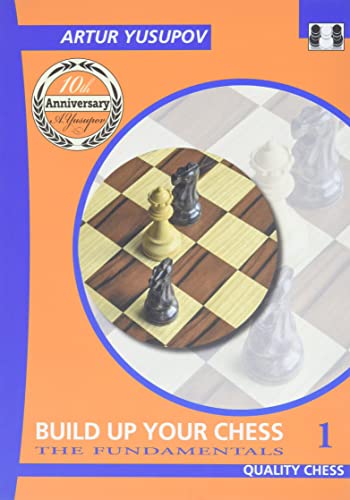
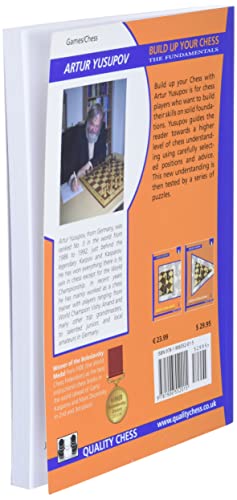
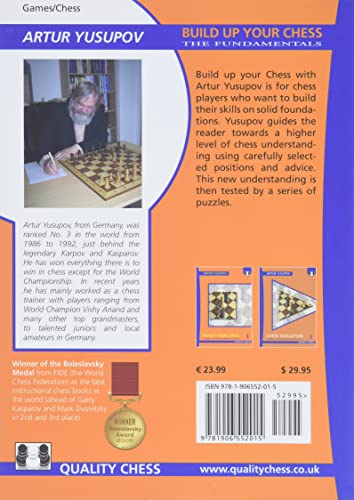


Buy Build Up Your Chess 1: The Fundamentals (Yusupov's Chess School) Illustrated by Yusupov, Artur (ISBN: 9781906552015) from desertcart's Book Store. Everyday low prices and free delivery on eligible orders. Review: High quality book, high quality instruction - I ordered this book after playing a few hundred online games and felt that I was hitting a wall in terms of strategy at the ~1000 mark. This book covers a nice range of topics that are each illustrated by diagrams and the line played for half a dozen examples, with the instruction then to turn your attention to a dozen exercises to pull off the chapter's strategy. You will need to sit down, set out the position in the exercise, and then stare at the board trying to find the best sequence. If this sounds intimidating -- this book might not be for you! But if you are at the position where you are playing online or club games where you can evaluate 3, 4 or 5 move lines in your head, this book will be perfect, as most of the exercises require only that many moves for a solution. Yusupov doesn't add much in evaluation or explanation of the tactical themes -- this book is presented plainly as a "Get on with it!" style of instruction after a quick summary of the topic. However, the example games and exercises are all taken from high-level games from chess throughout the 20th century -- no tired retreading of 19th century classics here. Even better, the exercises often have multiple solutions, some better than others. I'd highly recommend this book if you're serious enough about chess to want to invest the time and effort to work through the exercises with a board. Review: Excellent Course - Arthur Yusupov took his knowledge from the Moscow school of chess. Wrote it down and created the best chess education materal I have ever seen. 9 books in total + test&excem. Each book has 12 chapters. Focusing on one thing at the time. Build as course material shall be. Examples, excercises and test. Like any University course 3 hours minimum per chapter => 72 hours. 75-100 hours per book is what I estimate as "normal" effort. If you manage one book. You will improve. If you do all 9. Wow !!!
| Best Sellers Rank | 156,114 in Books ( See Top 100 in Books ) 163 in Chess (Books) 382 in Indoor Games |
| Customer reviews | 4.8 4.8 out of 5 stars (214) |
| Dimensions | 15.24 x 1.27 x 22.86 cm |
| Edition | Illustrated |
| ISBN-10 | 1906552010 |
| ISBN-13 | 978-1906552015 |
| Item weight | 445 g |
| Language | English |
| Print length | 264 pages |
| Publication date | 15 April 2008 |
| Publisher | Quality Chess |
J**R
High quality book, high quality instruction
I ordered this book after playing a few hundred online games and felt that I was hitting a wall in terms of strategy at the ~1000 mark. This book covers a nice range of topics that are each illustrated by diagrams and the line played for half a dozen examples, with the instruction then to turn your attention to a dozen exercises to pull off the chapter's strategy. You will need to sit down, set out the position in the exercise, and then stare at the board trying to find the best sequence. If this sounds intimidating -- this book might not be for you! But if you are at the position where you are playing online or club games where you can evaluate 3, 4 or 5 move lines in your head, this book will be perfect, as most of the exercises require only that many moves for a solution. Yusupov doesn't add much in evaluation or explanation of the tactical themes -- this book is presented plainly as a "Get on with it!" style of instruction after a quick summary of the topic. However, the example games and exercises are all taken from high-level games from chess throughout the 20th century -- no tired retreading of 19th century classics here. Even better, the exercises often have multiple solutions, some better than others. I'd highly recommend this book if you're serious enough about chess to want to invest the time and effort to work through the exercises with a board.
E**K
Excellent Course
Arthur Yusupov took his knowledge from the Moscow school of chess. Wrote it down and created the best chess education materal I have ever seen. 9 books in total + test&excem. Each book has 12 chapters. Focusing on one thing at the time. Build as course material shall be. Examples, excercises and test. Like any University course 3 hours minimum per chapter => 72 hours. 75-100 hours per book is what I estimate as "normal" effort. If you manage one book. You will improve. If you do all 9. Wow !!!
G**K
Five Stars
okay
J**N
Perfect for self-study
The hardest thing about this book is deciding which one to read next. There are 10 in the series including a final exam. Clearly, the final exam should be done last and this one, Build Up Your Chess Vol. 1 should be read first. The ones in between can be treated more fluidly. The publisher, in an attempt to quell controversy, has stated that you should read all the orange ones first (The Fundamentals, 1, 2 & 3), then the blue ones (Beyond the Basics 1, 2 & 3), then the green ones (Mastery 1, 2 &3). That may be the intention but there are some very basic tactics covered in the blue books and some very difficult positional ideas in the orange ones. The green ones cover some important endings. Some suggested opening repertoires for white and black are scattered throughout the series. There are many things this series does right. The layout is superb. This is how all instructional chess books should be laid out. There are 24 chapters in each book and each chapter consists of some explanatory examples followed by 12 exercises. In both cases there is a very clear diagram showing whose turn it is to move. In the examples the diagrams are on the left and right and the text is in the middle so it is very easy to cover the text and work out what you would play before reading the explanation. With the exercises there are solutions on separate pages immediately following the positions. You are encouraged to play over the positions on a chessboard and write down your analysis. You score points for the variations you find as well as for the most accurate solutions. This is the best way to do any kind of chess training and by far the best way to improve. It is only by engaging with the material as you would in a game that you can really absorb the instruction. If you score badly you are encouraged to re-read the chapter and repeat the exercises. I like to re-read and repeat anyway because I forget things fast. The layout makes it really easy to do this. But in any case I have put all the positions and explanations into Chessbase. It is not a waste of time. The material is really good. The positions are very well-chosen and always satisfying to solve. There is nothing in here that is ambiguous or wrong. Even the grammar and punctuation is perfect. (Actually I found one or two typing errors across the series but I find the annotations and text very aesthetically pleasing.) I would say the main weakness with this book and perhaps with the series is that it doesn't explain endings very well. I have turned to other books to find better material on endings. The opening repertoires are also very sketchy and, in general, not very ambitious for either colour. Yusupov recommends safe and quiet openings such as The Spanish Four Knights for White and the Petroff for Black. But clearly no book can cover everything. This series tries very hard to do that and it does a very good job of filling in any gaps in your knowledge but its main strength is in its ability to get you to engage with the material and really learn it. You don't leave this behind when you close the book. It stays with you. That is very difficult for any teacher to accomplish so in my view this is the best instructional chess series currently in print.
M**N
Roll Up Your Sleeves and Get Your Hands Dirty!
A systematic way to progress in chess knowledge. I most certainly have benefited from having this book. It is the first of nine books in the series. The book is not easygoing by any stretch of the imagination. This is a very challenging read at times, because it asks you to think. I know, it sounds like a very stupid sentence, but this book is only beneficial if you put your chess computer away, roll up your sleeves and stare at some chess pieces on a board. If you bring that attitude with you, Mr Yusupov will bring the opportunity to advance your game to another level.
D**D
The author states not to check your answers with a computer - it's because the answers don't work
After following two chapters with the familiar checkmating patterns (all useful stuff to learn) I take the chapter 2 test - three of the puzzles give me considerable trouble, but I figure I will lose the points and try to learn. But no, I was right, the mating patterns are there BUT only if your opponent plays directly into them. (The examples in the text are mostly like that too). Chess is an easy game if you are allowed to choose bad moves for your opposition. I put the diagrams that troubled me into Stockfish, and it confirmed - in one of the puzzles the response from the opponent was not even in the top 5 moves Stockfish suggested - how I am supposed to not only guess such a bad move, but EXPECT my opponent to play it and submit it as my answer?
E**A
Livro caiu como uma luva para o meu nível. Devo comprar o restante da série
N**E
Build Up Your Chess、Boost Your Chess、Chess Evolutionと続く最初のコースの第1巻。IntroductionでElo 1500以下、Elo 1800以下、Elo 2100以下のコースを開講したことからこのシリーズが出来上がったとあるから、上記のコースはこのレイティングに対応しているのだと思う。 24のレッスンがあり、各レッスンの最後に試験がある。合格点に達しないともう一度勉強しなさいということになる。全体の最後にまた試験がある。試験の部分は手番が示されるだけでノーヒント。 レッスンはページの外側(綴じていない方)に盤面があり、綴じ目の方に説明がある。本を小さく開いて、まず考えることができるように工夫されている。 私の棋力では、難しすぎず、易しすぎず、ちょうど良いレベルだと思う。楽しみながら力がつきそうである。
D**L
Me habían hablado bien de ésta serie y las reseñas en internet eran buenas, pero tenía mis dudas. Sin embargo el material es muy bueno; me siento muy satisfecho con el libro y creo, aunque solo estoy comenzando, que será para trabajar la serie!!!
D**N
The only negative things I have to say about this book are: 1) the organization is bizarre as heck; and 2) I don’t think Yusupov has a very good sense of what is and what is not difficult. The first point is more of an oddity than it is a serious detractor. Each lesson is internally complete, so it is just weird that one finds the collection of topics in this book that one does. As far as content, this is probably the most important content one needs at the high intermediate level to improve. On the second point, Yusupov gives many reasonable problems, but I don’t think the exercises are always given the correct number of difficulty stars. Some of the 3-star problems deserved 4, and some of the 2-star problems deserved 3. There were also a number of 4- and 3-star problems that I thought should have been a star (or 2) less in rating. The book is all around exceptional. The most important thing to know when considering this text is that it is difficult, and that I’m not sure that the intended audience is really the audience that should seek this book out. I’m not sure what my USCF strength is (officially, my rating peaked at 1608, but I am very likely much stronger), but among myself and two friends --one rated 1660, the other 1780--, both of them had difficulty solving the average problem, while I was occasionally stumped. If this book is intended to move players from 1500-1800, then it has a bizarre quality of being extremely difficult for players that are just about there and who are on the way. The topics, themselves, are not out of the ordinary of what you’d expect for 1500-1800. However, the degree of difficult makes me believe that the end goal of this first series of “1800” might be FIDE, not USCF; or maybe the end goal of this series is really 1850 FIDE, i.e., approx. 1950 USCF. These are certainly not complaints, but clarifications for potential buyers and readers. Let me be clear: this is the best system I have come across, and it is the most information dense. I only wish to provide a caveat lector and caveat emptor, because I’ve spoken with players in the 1400’s and 1500’s (USCF) who said this book was horribly difficult, and they scored 3pts out of 22 on the sections with exercises (e.g., the book rates results as: 12 pts is “pass,” 16 pts “good,” 19pts is “excellent,” and these vary among chapters). The book includes content, as I said, that seems basic in name, but Yusupov makes it quite complex, rich, and sophisticated. These areas included are tactical motifs, opening principles, Steintz’ strategic principles, and endgame concepts. I really can’t believe I got so much out of this book, looking at some of the lesson titles, but I did. I think that’s a testament to this book’s quality in developing sound fundamentals, even in advanced players. About the only complaint I have on the content is that Yusupov claims that forced moves are the same as combinations. While this is true for a professional player, I think the distinction has pedagogical value, and so it is legitimately a downside of this book. That aside, this book is endlessly informative, and very deserving of the Bolaslavski Book Award –and it should be noted that Yusupov beat out some of the biggest names in chess teaching for the award, e.g. Dvoretsky. All in all, I have to recommend this to anyone around USCF 1500. Despite the fact that much of it is easy for me, I see rapid improvement in my game, and I can only conclude that this system is shoring up my holes.
A**R
my tenant has improved
Trustpilot
1 month ago
1 month ago