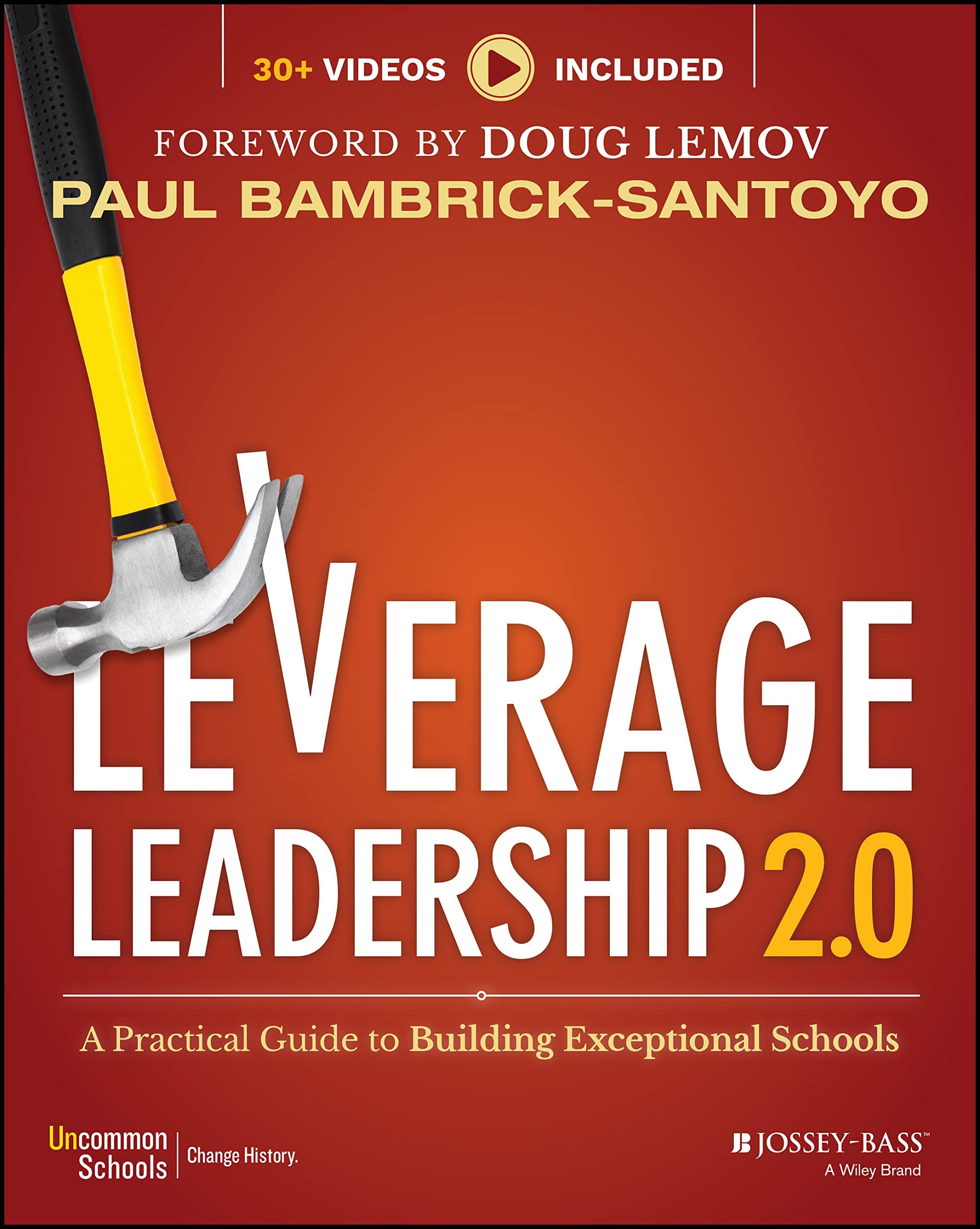
Leverage Leadership 2.0: A Practical Guide to Building Exceptional Schools
Product ID: 102519757
🏆4.7/5 star rating from 1,190+ reviews
📏Compact 18.8 x 3.3 x 23.11 cm for easy carry
📚432 pages of actionable leadership insights
Desertcart purchases this item on your behalf and handles shipping, customs, and support to Australia.
📈 Lead with confidence, inspire with impact — your school’s success starts here!
Leverage Leadership 2.0 is a highly-rated, 432-page practical guide for school leaders seeking to build exceptional schools. Authored by Paul Bambrick-Santoyo and Doug Lemov, this second edition offers updated, actionable strategies backed by strong community endorsement, making it an essential resource for educational professionals aiming to climb the leadership ladder and drive real change.





| ASIN | 1119496594 |
| Best Sellers Rank | 153,526 in Books ( See Top 100 in Books ) 576 in Education Management & Organisation 4,399 in School Education & Teaching 34,569 in Society, Politics & Philosophy |
| Customer reviews | 4.7 4.7 out of 5 stars (1,190) |
| Dimensions | 18.8 x 3.3 x 23.11 cm |
| Edition | 2nd |
| ISBN-10 | 9781119496595 |
| ISBN-13 | 978-1119496595 |
| Item weight | 1.05 kg |
| Language | English |
| Print length | 432 pages |
| Publication date | 21 Aug. 2018 |
| Publisher | Jossey-Bass |
P**N
We love this book!
My senior leadership team at school love this book. We’ve based our improvements around it and the impact is amazing.
C**.
Great for educational leaders
Great read for educational leaders that would be invaluable if you are contemplating going up the ladder in your school. Well written and as a school leader myself I also found some useful pieces in this. 10/10
L**S
Useful reference book and CD for any SLT
This book complements the author's other book 'Driven by Data 2.0', which puts learning ahead of teaching with a focus on ensuring learning is happening when teachers are teaching. This book takes the next step and says that the SLT must enable the teaching that facilitates such learning. The books are both American and as such need to be adapted to the British system but this is possible and there is a lot of very useful information. I am a supply TA and really these books are aimed at teachers and particularly the SLT, but I am considering going into teacher training and want to read up on the subject. There is a lot of useful information that I can use in my capacity as a TA and I do think that it will be a useful reference book for when I do my teacher training. I think that this will be good preparation for me.
A**N
Great resource, DVD damaged
The book is incredibly practical gives easy to implement advice and support to help schools improve. The videos on the DVD is useful and gives clear insight to support the work in the book. The DVD was damaged as it was glued into the spine of the book and a replacement would've cost more than the book in postage. Check your DVD upon receipt.
�**�
Exceptional schools
Ok it's very American but it has some lessons that can be applied in the UK. It sets out to help students succeed. Clear and at 400 pages has quite a bit of useful advice.
B**E
Some good ideas, but best used as a cookbook, not a silver bullet
I know very little about the American school system and culture, but as a former school chair of governors I (hopefully) have some idea about school leadership. This book, and several on-line sources, claim that the Leverage Leadership methodology has had widespread success, so it deserves attention. You have to search a bit for the book’s objectives. My take is as follows. Bambick-Santoyo argues that what makes education effective is great teaching, which cannot be achieved without great leadership, and then asks the question “Can this work for you?” His answer is “a resounding ‘yes’”, and he then states that his aim is to show how, with the correct use of the techniques he expounds (illustrated by several real-life examples), “success is possible everywhere”. The conclusion says “the central question school leaders must confront is about how to use their time”. A lot of the book is useful stuff about time management, and this is largely focussed on enabling school leaders, especially principals, to spend more time in the classroom, rather than firefighting and spending the day glued to their PC. (What underpins this is a “data driven” approach towards both students and staff – see later.) This is an admirable aim, and who would not support it? (One problem I had as a chair of governors was not having much time to go into the classroom, due to the amount of meetings; I am willing to concede this may have been partially my fault.) However, the book tends to gloss over two factors: -There is a limit to how much a head teacher/principal can delegate so as to allow them to spend more time in class -The book is concerned with students and staff not just primarily (which would be acceptable) but almost exclusively. Parents, for example, barely get a look in. This is symptomatic of the way the school is presented as almost a closed community. To take another example, heads in the UK have to spend a significant amount of time and nervous energy dealing with the educational authorities, but this book gives no hint on how a principal should manage their relationship with their principal (or any other higher authority). This partial sense of unreality also pervades the guidance on student culture. There is a strong implication that, as soon as you roll out the right culture the students will start behaving like angels, and discipline issues will be few and easily resolved. (I tried the index, but “behaviours” simply links to “staff behaviours”!) Call me old and cynical if you like. I know inspirational leadership in schools can work wonders, but the book appears not even to consider the possibility of failure. There are two areas where the alarm bells started to ring: -There is some advice on “holdouts”, i.e. teachers resistant to culture change. The book suggests that, if you rollout this approach the right way, with “a culture consistent around ideas and values”, “holdouts” will become isolated and will start looking for jobs elsewhere. Or, as one of the principals mentioned in the case studies observes, “it was this way or the highway, and some chose the highway.” This can happen with any new staff regime in any field, not just education, but there’s a lot of it about in the UK at present. The book suggests that, when recruiting, you test the water to see if candidates are happy with the data-driven approach, which is sensible; what is not mentioned is that good teachers don’t grow on trees, and that it takes more than five minutes to build a good school team. -My other concern was with the data-driven approach. When I did the right Google search, I got past all the success stories and found a rising tide of scepticism in the US about the data-driven approach. I could not help thinking of what Amanda Spielman said only last week: “The focus on data is coming at the expense of what's taught in schools, so we want to bring the inspection conversation back to the substance of what children learn and treat teachers as experts in their fields, not just data managers." Bambick-Santoyo and his associates and acolytes might argue that the data-driven Leverage Leadership approach is precisely the way for teachers to be treated as “expert in their field”. Personally, I would advise a mix-and-match of this and other approaches; even allowing for modification to allow for national differences in educational regulation and culture, I don’t view this book as a panacea for the UK. It would be fascinating to find out how well this book fits with the companion volume aimed at superintendents, “A Principal Manager's Guide to Leverage Leadership 2.0: How to Build Exceptional Schools Across Your District”.
A**Z
The Uncommon Schools Approach - leadership probably USA centric
I've read quite a lot from the Amercian school of thought of Doug Lemov, and have had success in implementing the methods described in "Teach like a Champion" in my own school. As a (newish) leader of a small team in a school, I was interested to read this. I do like the way it's laid out with space to jot notes, and the back up of videos, however much that is in offer here doesn't necessarily adapt to the British way of managing schools. The way assessment works and observations are suggested doesn't necessarily take into account the British ways of doing things and the different focus of leaders in schools. There is, still, probably something for every leader to take from this, and it's interesting to read the approach and the inspiring stories of schools that have been turned around. For a school like mine though, with a strong ethos, sense of identity and tradition I'm not sure that the ideas in this book are that relevant. Interesting, but probably best for the American market if I'm honest.
R**L
Heads up- It's American...
There is some great advice in this book but you have to work to adapt it to the UK context. Its worth you knowing that before you go any further. There are some considerable and fundamental differences to how systems in UK and USA differ, despite the central purpose of teaching being easily transferable across the ocean. What this means is, if you want to use any of the worksheets, the clips and the examples with your team, you've got to alter them to make them fit for purpose. That is extra work for you. And of course, we're all familiar with the 'Eeyore' in every team who resists change and will therefore use 'cultural inappropriateness' as an excuse not to engage in a central message shift during training sessions, unless you make those adaptations. That said, the ideas are sound and whilst many will already be familiar to any reasonably experienced and emotionally intelligent leader, there is still exciting new ground to be explored and ideas to steal. The clips are also useful as finding clips of people teaching that don't involve 'actors' is quite hard. These can spark some good debate. I suppose then, it depends if you are looking for a 'plug and play' training manual as to how useful you'll find this. If you are, I'd suggest leaving this one and instead exploring some of the offerings from the lovely people at UK based 'Independent Thinking' such as Ian Gilbert. I did find the 'Americanisims' to be intensely annoying and felt the cultural backdrop often derailed the central message. It therefore wasn't as useful to me as I'd hoped.
Trustpilot
3 weeks ago
2 weeks ago