


Full description not available
M**B
A devilish good read
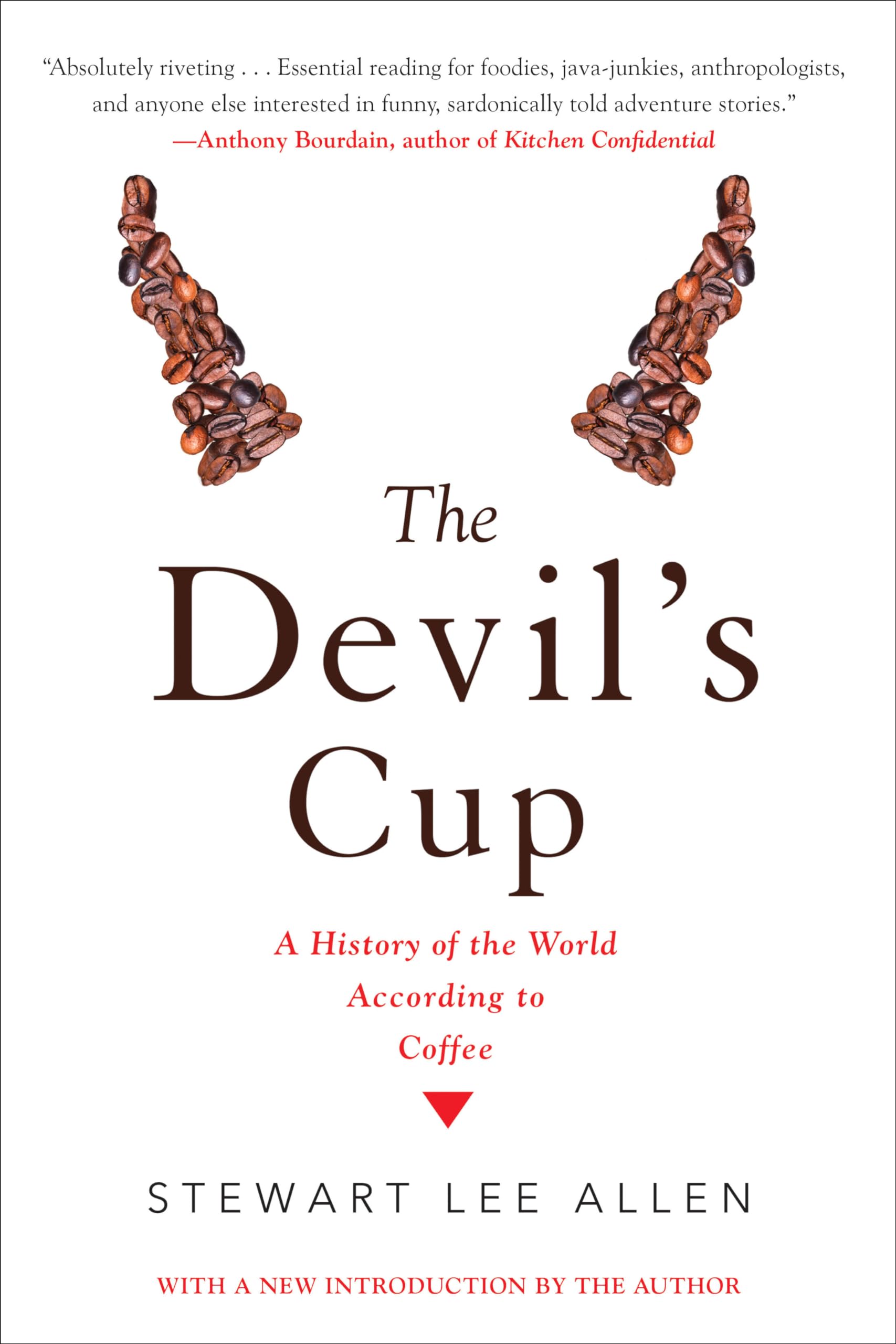
The premise is simple enough, travel through the countries where coffee drinking originated and evolved while trying to find little bits of that history along the way. Stewart's trail starts in Ethiopia, on to Yemen, India, to Turkey and across to Austria, Germany, France, Brazil and finally to the United States. He combines the adventures of his very unconventional free-form travel with outstanding research on how coffee influenced history and culture along the way."The Devil's Cup" is full of pity historical insights, laced with humor, sometimes even a bit of dark bitter brew. Coffee plantations and slavery are part of the story. I've read other histories of coffee, but this one is the perfect blend. Stewart's final travels across the U.S., looking for the best of the worst coffee in middle America is a hoot.There's much to ponder here about the quest for caffeination. The morning coffee in the office or standing in line at Starbucks isn't really that different than the many tribal coffee ceremonies hundreds of years ago.
J**N
a fascinating story about how the cup of Joe cross the pond
A nice reading that invites you to travel (at least for me) and go find new coffees and insights as to how possibly the beans came to America and the rest of the world .
K**Z
An entertaining, though inconclusive, read
Stewart Lee Allen has written a delightful book about the influence of coffee in all sorts of societies. Delightful and quite a light read. I suppose if this book were a woman I would call her an airhead. Nonetheless, from the very origins of humanity in Ethiopia and Eritrea, passing through the markets of Yemen, where the aroma of the smoothest of Arabica beans awaits the tired traveler; then Europe, with its typical French cafés and Viennese coffee with cream on top; to the darkest of roasts in Brazil, and finally our very own North America, the reader is sure to enjoy this journey to the last drop.I would be very interested to know Allen's credentials (they are conspicuously absent throughout the book), but his wit is indeed unique, with passages that made me laugh out loud. An example of such is given within the first chapters of the book, when he is inquiring about the epitome of Ethiopian coffee in a conversation with his friend Abera in the most casual of dialogues:"This is only drunk in the home. Hardly anyone in Harrar drinks it today. You must visit the Ogaden. They still drink it.""Where do they live?""The Ogaden? They live now in Jiga-Jiga." He made the place sound like a disease. "But you can't go there. It's very, very dangerous. And those Somalis, those Ogaden, are very arrogant. So rude!""Why? What is the problem?""They are rude people!" Abera shook his head angrily at the Ogaden's poor manners. "Why, just not too long ago they did a bad thing to a bus going there. To all the men.""Bad? How bad?""Why, very bad. They killed them.""That's pretty bad," I agreed. (Page 15).The pursuit of coffee continues with Allen traveling to Yemen via Djibouti, a place where the rule of law is still that of one's own, and where thieves are crucified pretty much in Jesus Christ style if caught. The author delights in rambling through the streets of Sanaa in the wee hours of the morning without a care in the world that anybody is going to rob or assault him in any way.But the book reaches its climax upon Allen's arrival in Germany, where he has a philosophical chat - over coffee, of course - with Dr. Josef Joffe. Dr. Joffe explains that in order to determine whether a nation is rich and powerful, one need only look at the way the society makes its coffee. Have we not noticed how, as Americans started learning to make designer coffee with the advent of Starbucks, their world supremacy has dwindled considerably? Much in the same way, nations like China, who do not know how to make a good cup of the fragrant drink are now booming. Thus, Allen arrives to the conclusion that coffee is, in fact, evil - hence "the devil's cup" (page 135). Joffe's conclusion does not deter our author however, who continues his treacherous but adventurous trail in search of coffee in a cargo vessel and on to America. He visits Brazil in search not only of coffee but also of African spirits responsible for its brewing and traditions.Allen goes even further on his thesis about coffee, claiming that the fabled grain has, after all, a "ridiculous" history, and lays down the premise that is no coincidence that both coffee and humanity originated in Ethiopia, the place where "those early ape-men nibbled on the bright red berries" (page 133). It is up to the reader to decide whether coffee has been a good or bad influence on humanity, and even if it is an intelligent decision to decide to drink it.Although I have enjoyed "The Devil's cup" to a certain point, the book falls short as a treatise on how coffee changed the world, making one feel as if one were reading a poorly treated thesis. Nevertheless, it is an enjoyable read that will do whenever in need to clear the mind while still cultivating it.
J**R
coffee and cheap travel
This book is a great read. Fake art, fake art smuggling, the adventures of a hippie-type. The history of coffee is the unifying metaphor. Did coffee start off as a kind of tea made from the leaves? And a final drugged out coffee tour of the US.The book is well researched and has a great bibliography. When I finished I gave it to a person from a different culture so he could see the way Americans look at the world.
B**A
part history of coffee, part crazy travelogue
In The Devil's Cup, Stewart Lee Allen decides to travel the world in search of the history of coffee. He travels on a budget that leads to many interesting scenarios, such as crossing the Atlantic on a cargo ship with a handful of other passengers, that have little to nothing to do with coffee. Much of his info on the history of coffee in Europe is a recitation (although amusingly told) of more staid histories of coffee. He spends most of his travels looking for either the best or worst cup of coffee. After I finished the book, I felt like I had read several good anecdotal stories and legends about the origins and history of coffee, and had also read a rather crazy, but interesting, travelogue that loosely related to the spread of coffee from Africa to the rest of the world. It was a fun read and worth reading, but I am still looking for a more focused and complete history of coffee.
C**Y
Best read while sipping a cuppa of your favorite caffeine
Interesting and well written, part travelogue of self discovery, and part well researched documentary regarding the impact coffee has had on history, and its current impact on world economies and the environment. Easy reading, a joy!
J**"
Hilarious journey of a coffee lover!
This is one of the funniest books I have ever read! Steward Lee Allen is hilarious as he meanders along his poorly planned but enlightening journey of discovery of the origins of coffee and our coffee mania. His linking of coffee's wake-up and stay-up properties to the rise of capitalism is fascinating and probably true! Is there an office in the US that doesn't have a coffee machine!! As freelance writer and editor, I rely on coffee to keep me on track. I am also fascinated by the history of my favorite beverage and have read several other books on coffee. This was, without doubt, the most entertaining!
Trustpilot
3 weeks ago
5 days ago