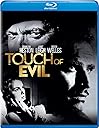
Touch of Evil [Blu-ray]
Product ID: 87348978
Details
- GenreClassics Drama
- FormatBlu-ray NTSC
- Contributor(function(f) {
- Initial release date2018-10-16
- LanguageEnglish
Desertcart purchases this item on your behalf and handles shipping, customs, and support to Australia.
Directed by Orson Welles, Touch of Evil is a film noir masterpiece whose Hollywood backstory is as unforgettable as the movie itself. Starring Charlton Heston, Janet Leigh and Orson Welles, this dark portrait of corruption and morally compromised obsessions tells the story of a crooked police chief who frames a Mexican youth as part of an intricate criminal plot. Featuring three versions of the film – the Preview version, the Theatrical version and the Reconstructed version based on Orson Welles' original vision, Touch of Evil is a "a stylistic masterpiece!" (Leonard Maltin's Classic Movie Guide) that stands the test of time. Review: TOUCH OF EVIL [1958] [Limited Edition] [Blu-ray + Digital HD with UltraViolet] - TOUCH OF EVIL [1958] [Limited Edition] [Blu-ray + Digital HD with UltraViolet] A Stylistic Masterpiece! Directed by Orson Welles, ‘Touch of Evil’ is a film noir masterpiece whose Hollywood backstory is as unforgettable as the movie itself. Starring Charlton Heston, Janet Leigh and Orson Welles, this dark portrait of corruption and morally compromised obsessions tells the story of a crooked police chief who frames a Mexican youth as part of an intricate criminal plot. Featuring three versions of the film – the Preview Version, the Theatrical Version and the Reconstructed Version based on Orson Welles’ original vision, Touch of Evil is a “a stylistic masterpiece!” (Leonard Maltin’s Classic Movie Guide) that stands the test of time. FILM FACT: The film opens with a three-minute, twenty-second tracking shot widely considered by critics as one of the greatest long takes in cinema history. In 1993, ‘Touch of Evil’ was selected for preservation in the United States National Film Registry by the Library of Congress as being "culturally, historically, or aesthetically significant". Cast: Charlton Heston, Janet Leigh, Orson Welles, Joseph Calleia, Akim Tamiroff, Joanna Cook Moore, Ray Collins, Dennis Weaver, Val de Vargas, Mort Mills, Victor Millan, Lalo Rios, Phil Harvey, Joi Lansing, Harry Shannon, Rusty Wescoatt, Wayne Taylor, Ken Miller, Raymond Rodriguez, Arlene McQuade, Dan White, Zsa Zsa Gabor, Marlene Dietrich, Mercedes McCambridge, Keenan Wynn and Joseph Cotton (Uncredited) Director: Orson Welles Producers: Albert Zugsmith and Rick Schmidlin (1998 restoration and director's cut) Screenplay: Orson Welles, Franklin Coen and Paul Monash (Uncredited) Composer: Henry Mancini Cinematography: Russell Metty, ASC Video Resolution: 1080p [Black-and-White] Aspect Ratio: 1.85:1 Audio: 2.0 DTS-HD Master Audio Mono and English: 2.0 Dolby Digital Audio Mono Subtitles: English SDH, Spanish and French Running Time: 111 minutes; 96 minutes and 99 minutes Region: All Regions Studio: Universal Studios Andrew’s Blu-ray Review: Honeymooning with American wife Susan Vargas [Janet Leigh] in the frontier town of Los Robles, Mexican special narcotics investigator Mike Vargas [Charlton Heston] finds business interrupting pleasure when a car bomb kills the town's boss. Required to investigate, Vargas finds himself up against Hank Quinlan [Orson Welles], a local detective with a reputation for getting his man by fair means or foul. Resentful of Mike Vargas' authority in the case, Hank Quinlan decides to tamper with evidence to ensure that a perpetrator is found. What's more, Hank Quinlan leans on local racketeer Joe Grandi, to ensure that Mike and Susan's stay in Los Robles is a most unpleasant one. Orson Welles' glorious, if temporary, return to the Hollywood fray after years of studio neglect is one of his richest and most rewarding pictures. Adapted by Orson Welles himself, from a shelved Paul Monash script based on a minor novel by Whit Masterson (which Orson Welles famously never read), it's a supremely confident and stylish work. From the legendary opening tracking shot, still technically mesmerising with Russell Metty's black and white photography creates a strange chiaroscuro, noir landscape (though a straggler of the genre, the film stands as one of its finest entries) in which is quintessential Orson Wellesian themes of evil, corruption, and moral ambiguity loom large. Orson Welles further evaded studio control by shooting much of the picture on location. He had originally asked to make the film in Tijuana, but the executives had feared that was too far from Hollywood for them to call the shots. Instead, he proposed shooting in Venice, California, for a few days. Once he got there, however, he settled in for most of the remaining shoot. By then, the executives were thrilled with each day's rushes, so they pretty much left him alone. Throughout filming, Orson Welles tweaked the script to get each scene just right. Usually he started his re-writes as soon as the day's (or night's) shooting was done and finished his re-writing in time for the next day's work. Nobody could tell when he was sleeping. The most famous sequence in ‘Touch of Evil’ was the lengthy tracking shot that opens the film. The three-minute-plus shot opens with an unseen figure planting a bomb in a car, follows the car through the border town's streets, picks up Heston and wife Janet Leigh as they cross the border and ends as they kiss, and the bomb explodes off-screen. Welles spent an entire night getting the shot just right. When the customs officer questioning Heston and Leigh kept flubbing his lines, Welles told him to mouth the words. They could dub the right lines in later. They finally got the shot at the last possible moment - the sky was just turning pink in the east. A fine cast more than match the coruscating material: Charlton Heston untypically restrained in Mexican garb strikes the right note of outrage in the face of judicial perversion and there is fine support not only from Janet Leigh but strong contributions from Marlene Dietrich, a young Dennis Weaver, and Joseph Celleia as Hank Quinlan's devoted partner. Orson Welles however towers over the proceedings, on-screen and off. Hank Quinlan is a grotesque, hauntingly recognisable creation, embittered by the past and forever doomed to seek former glories and is totally masterful! Although ‘Touch of Evil’ was largely neglected in the U.S., the picture's European release was met with critical raves. It even won Best Picture at the Brussels Film Festival. That didn't change any minds at Universal, where the film was written off as a loss. But over the years, ‘Touch of Evil’ continued to find its audience through television and film society screenings which eventually sparked an interest among several of the film's admirers to restore it. The process began in the early 70s when Robert Epstein of the UCLA Film and Television requested a print to show at UCLA for the studio. When the film was screened it ran 108 min. and he believed he found Welles' lost cut; this was reported in The Hollywood Reporter at the time. But this was only a preview cut with many shots that Welles did not direct. A real turning point came in 1992: producer Rick Schmidlin read an article in Film Quarterly by Jonathan Rosenbaum that used excerpts from a 1957 memo Orson Welles wrote to studio chief Edward Muhl offering editing suggestions for Touch of Evil. As producer Rick Schmidlin brought in Oscar® winning editor Walter Murch who had just won two Academy Awards for ‘The English Patient’ and Orson Welles scholar Jonathan Rosenbaum as consultant to help construct the current 111 minute version. Blu-ray Video Quality – ‘Touch of Evil’ is presented in an aspect ratio 1.85:1 with a stunning 1080p encoded black-and-white image that provides an extremely satisfying high definition picture. Grain is visible along with plenty of detail. Watching this edition offers an experience as close as one can imagine to sitting in a film cinema watching the film being projected. I should note that there are two different transfers to see here. One is for the 1998 Reconstruction, which is radically different throughout the film and would never be able to be seamlessly branched from the others. The second transfer is for both the Theatrical Release version and the longer Preview Version, which simply adds another 13 minutes of footage. Given the two transfers, you may see minor differences here and there as some viewers have noted in various forums. Without getting into the endless discussions of various people’s opinions about the aspect ratio, we understand that this is the proper aspect ratio in which to view the film. Blu-ray Audio Quality – ‘Touch of Evil’ gets an English 2.0 DTS-HD Master Audio Mono mix, for all three versions that presents the dialogue clearly and, in the case of the restored version, provides a variety of music and sound effects at easily discernible levels. This isn’t a surround mix, of course, but it definitely gets the job done in presenting both the words and the world of the film. Blu-ray Special features and Extras: Orson Welles’ Legendary 58 page booklet ‘Touch of Evil’ Memo To The Universal Studio. Dated 5th December 1957. Digitally Re-mastered and Fully Restored from High Resolution 35mm Original Film Element. Reconstructed 1998 Film Version: Re-edited in 1998, this definitive cut of the film is reconstructed to Orson Welles’ original version based on the 58 page Memo to the studio. With additional information we find out that in 1957, Orson Welles completed principal photography on ‘Touch of Evil’ and edited the first cut. Upon screening the film, the Studio felt it could be improved, shot additional scenes and re-edited it. Orson Welles viewed this new version and within hours a passionate 58 page Memo requesting editorial changes. This particular film version represents and attempt to honour those requests and make ‘Touch of Evil’ the film Orson Welles envisioned it to be, and stated that, “I close this Memo with a very earnest plea that you consent to this brief visual pattern to which I gave so many long hard day’s work.” – Orson Welles. Theatrical 1958 Film Version: This version of the film was seen by the U.S. audiences when it was released in cinemas in 1958. 1976 Preview Film Version: Created prior to the cinema version, this cut of the film incorporates some of Orson Welles’ requests and was re-discovered by Universal Pictures in 1976. Audio Commentary: Reconstructed 1998 Version Commentary with Charlton Heston, Janet Leigh, and Reconstruction Producer Rick Schmidlin: The two stars of the film share their memories of working with Welles, while Rick Schmidlin alternates between pointing out specific changes and prompting the actors with questions about their experience. Some of the stories from Charlton Heston and Janet Leigh are repeated in the two documentaries, but with their memories prodded by Rick Schmidlin, they relate additional detail that makes this track especially totally informative and entertaining. On top of all that it is to my mind the definite audio commentary out of the all the audio commentaries to listen to. Audio Commentary: Reconstructed 1998 Version Commentary with Reconstruction Producer Rick Schmidlin: In his solo commentary, Rick Schmidlin recounts in great detail the lengthy history of his efforts to interest Universal Studio in reconstructing the film in accordance with Orson Welles's Memo and his subsequent work with Editor Walter Murch on the 1998 reconstruction version. This is also a total bonus, as Rick Schmidlin gives us so much more information about his involvement with the Reconstructed 1998 Version audio and being solo without Charlton Heston and Janet Leigh in the studio with him, he is able to really get into a full flow of fascinating information. Again this is a real tour-de-force audio commentary not to be missed. Audio Commentary: Theatrical 1958 Version Commentary with Writer/Filmmaker F.X. Feeney: You get to hear that F.X. Feeney is a massive long-time [obsessed] fan of the Theatrical 1958 Version, even as initially released. F.X. Feeney is an ideal guide to its themes, nuances and visual strategies of this 96 minutes film version. Although he notes various plot holes that are addressed in the Reconstructed Version, he tries to make a respectable case for the efficacy of the 1958 Theatrical Version. But to me it is my least favourite version, as far too much was edited out of the 1958 version and is a very disjointed presentation and you lose the plot, as there are too many holes. Audio Commentary: 1976 Preview Version Commentary with Orson Welles Historians Jonathan Rosenbaum and James Naremore: This is also a very informative audio commentary by two massive fans of the film, but despite it provides very little information about the Preview Version itself or any comparison between it and the 1958 Theatrical Version. Instead, the two commentators focus the film's themes and Orson Welles's underlying concerns, subjects they are uniquely qualified to address. But despite this, it is a must hear audio commentary and will keep you totally entertained and amused by all their comments throughout this 1976 Preview Film Version. Feature Documentary: Bringing Evil To Life [2008] [480i] [4:3] [20:58] With this brilliant retrospective documentary, features Robert Wise [Filmmaker]; Allen Daviau [Cinematography]; Peter Bogdanovich [Filmmaker]; Charlton Heston [Ramon Miguel (Mike) Vargas]; Janet Leigh [Susan Vargas]; Dennis Weaver [The Night Man]; Bob O’Neil [Picture Restoration] and Valentin De Vargas [Pancho]. This feature discusses the original production of the film and what happened in post-production after Orson Welles left to pursue another project. (Charlton Heston is admirably frank about the consequences of that action, noting that Orson Welles committed a major no-no and never got to direct a studio picture again in the United States.) (This feature was clearly prepared around the same time as the cast commentary, with contemporary interview footage of both Charlton Heston and Janet Leigh.) Feature Documentary: Evil Lost and Found [2008] [480i] [4:3] [17:04] With this behind-the-scene documentary with a look at the reconstruction of ‘Touch of Evil’ and the 3 versions of the film. This is a continuation of the above documentary “Bringing Evil To Life” and features Janet leigh [Susan Vargas]; Bob O’Neil [Picture Restoration]; Charlton Heston [Ramon Miguel (Mike) Vargas]; Rick Schmidlin [Producer of Editorial Change]; Peter Bogdanovich [Filmmaker]; Jonathan Rosenbaum [Consultant]; Walter Murch [Editor]; George Lucas [Filmmaker]; Curtis Hanson [Filmmaker] and Robert Wise [Filmmaker]. This feature discusses the work done by Walter Murch with Rick Schmidlin, Jonathan Rosenbaum and others to follow the Welles’ memo in re-editing the film. There is some repetition with the first featurette, but this is still all helpful material. But with this particular documentary, at the end we get a personal video tour with Curtis Hanson, who is in Windward Pacific in Venice California and points out the specific building locations used in the Orson Welles ‘Touch of Evil’ to give the impression that we was at a specific Mexican Border Town. We are also informed that the town was built and developed by Abbot Kinney (1850 – 1920) and when oil was discovered, the place finally fell into disrepair. This is a brilliant extra bonus to this specific Evil Lost and Found documentary. A must view. Theatrical Trailer: This is the Original Trailer for ‘Touch of Evil’ [1958] [480i] [4:3] [2:08] This is of very bad quality and such a shame they could not of found a more pristine copy and especially in the original 1.85:1 aspect ratio. Finally, Orson Welles' 'Touch of Evil' is a genuinely remarkable motion picture that displays one stroke of cinematic genius after another, a brilliant piece of work with an interesting backstory to match. Starring Charlton Heston, Janet Leigh, and Orson Welles, the crime thriller is a deliciously lurid tale of corruption, murder, and the morally compromised, which still stands as a stunning, stylized noir masterpiece. The Blu-ray arrives with spectacular picture, strong audio and satisfying bonus features. All in all, this is a classic masterpiece that rightly belongs in any respectable cinephile's ultimate collection. But one interesting fact I want to bring to your attention and in all the Audio Commentaries, is that they are stunned by Marlene Dietrich performances and how the actors would kill to be in the film with her. But they also love Marlene Dietrich classic comment to Orson Welles in saying, "Your future is all used up," plus the final scene at the end of the film when Marlene Dietrich turns round and says, “Adios.” Highly Recommended! Andrew C. Miller – Your Ultimate No.1 Film Aficionado Le Cinema Paradiso United Kingdom Review: UNIVERSAL FINALLY GIVES WELLES' "TOUCH OF EVIL" RESPECT WITH A STELLAR BLU-RAY PICTURE - It's ironic that Universal released both "Double Indemnity"(1944) and "Touch of Evil"(1958) on the same day last week because the former is considered the first of the great film noir films while the latter is considered one of the last of this unique film genre. That's the way it should be as these two great films compliment each other and are the perfect bookends to all the film noir films that came in-between these years. "Double indemnity" is considered a classic of the film noir genre but the same could not be said for "Touch of Evil" when it first came out in 1958. What Universal released to theaters in that year was not the version that Orson Welles conceived. He wrote a 58 page memo to the studio(which is included as a booklet with this new Blu-ray) suggesting that changes be made to make the story flow better. His requests were pretty much ignored and he never made another film in Hollywood. In 1998, film historian Rick Schmidlin found the memo and persuaded Universal to fund a restoration. Re-released in 1998, "Touch of Evil" is now considered a classic and that is certainly brought out is this stunning new Blu-ray from Universal. Viewers have the option of watching all three versions of the film: the "reconstructed version"(111 minutes) from 1998, the "original theatrical version"(96 minutes) from 1958 and the "preview version"(109 minutes) from 1976. This Blu-ray review is for the "reconstructed version" and it looks absolutely glorious on Blu-ray. Welles was notorious for using deep focus photography in the films he directed and he worked with great cinematographers over the years. Russell Metty was the cinematographer for "Touch of Evil" and although filmed in black and white, details are more prominent now than they were in the standard DVD, especially in the close-ups. The story is complicated and it may take more than one viewing to understand what's going on, but it has all the elements of classic film noir including murder, betrayal, and above all corruption. It might not be to everyone's liking but after repeated viewings it grows on you. Metty's nighttime shots of the Mexican border-town (actually Venice, Calif.) are given new life on Blu-ray. Blacks, grays and whites are balanced throughout and shadows(there are lots of them) are more prominent. In addition to the main stars(Charlton Heston, Janet Leigh and Orson Welles)who give great performances, the supporting players give exceptional performances as well including Akim Tamiroff, Joseph Calleia, Dennis Weaver and the great Marlene Dietrich who has the best lines in the film. Joseph Cotton and Mercedes McCambridge even show up in un-credited roles. The audio has been improved also with dialogue being easily understood even when the actors are speaking at the same time. "Touch of Evil" contains the following subtitles: English SDH, French and Spanish. Audio includes: English DTS HD Master Audio 2.0 Mono, English Dolby Digital 2.0. In addition to the three versions of the film, bonus features include two documentaries and four commentaries. The packaging for this new Blu-ray presentation is different too. "Touch of Evil" comes in a solid standard Blu-ray case(not one of the eco-cutout cases) which is housed in a nice slipcase for added protection. Although it might not rank with "Double Indemnity" as classic film noir, "Touch of Evil" certainly comes close in this new Blu-ray from Universal. It should be essential to any film collectors library and comes highly recommended.




| Contributor | Akim Tamiroff, Albert Zugsmith, Charlton Heston, Dennis Weaver, Janet Leigh, Joseph Calleia, Marlene Dietrich, Orson Welles, Zsa Zsa Gabor Contributor Akim Tamiroff, Albert Zugsmith, Charlton Heston, Dennis Weaver, Janet Leigh, Joseph Calleia, Marlene Dietrich, Orson Welles, Zsa Zsa Gabor See more |
| Customer Reviews | 4.6 out of 5 stars 1,980 Reviews |
| Format | Blu-ray, NTSC, Subtitled |
| Genre | Classics, Drama, Mystery & Suspense |
| Language | English |
| Runtime | 1 hour and 51 minutes |
A**R
TOUCH OF EVIL [1958] [Limited Edition] [Blu-ray + Digital HD with UltraViolet]
TOUCH OF EVIL [1958] [Limited Edition] [Blu-ray + Digital HD with UltraViolet] A Stylistic Masterpiece! Directed by Orson Welles, ‘Touch of Evil’ is a film noir masterpiece whose Hollywood backstory is as unforgettable as the movie itself. Starring Charlton Heston, Janet Leigh and Orson Welles, this dark portrait of corruption and morally compromised obsessions tells the story of a crooked police chief who frames a Mexican youth as part of an intricate criminal plot. Featuring three versions of the film – the Preview Version, the Theatrical Version and the Reconstructed Version based on Orson Welles’ original vision, Touch of Evil is a “a stylistic masterpiece!” (Leonard Maltin’s Classic Movie Guide) that stands the test of time. FILM FACT: The film opens with a three-minute, twenty-second tracking shot widely considered by critics as one of the greatest long takes in cinema history. In 1993, ‘Touch of Evil’ was selected for preservation in the United States National Film Registry by the Library of Congress as being "culturally, historically, or aesthetically significant". Cast: Charlton Heston, Janet Leigh, Orson Welles, Joseph Calleia, Akim Tamiroff, Joanna Cook Moore, Ray Collins, Dennis Weaver, Val de Vargas, Mort Mills, Victor Millan, Lalo Rios, Phil Harvey, Joi Lansing, Harry Shannon, Rusty Wescoatt, Wayne Taylor, Ken Miller, Raymond Rodriguez, Arlene McQuade, Dan White, Zsa Zsa Gabor, Marlene Dietrich, Mercedes McCambridge, Keenan Wynn and Joseph Cotton (Uncredited) Director: Orson Welles Producers: Albert Zugsmith and Rick Schmidlin (1998 restoration and director's cut) Screenplay: Orson Welles, Franklin Coen and Paul Monash (Uncredited) Composer: Henry Mancini Cinematography: Russell Metty, ASC Video Resolution: 1080p [Black-and-White] Aspect Ratio: 1.85:1 Audio: 2.0 DTS-HD Master Audio Mono and English: 2.0 Dolby Digital Audio Mono Subtitles: English SDH, Spanish and French Running Time: 111 minutes; 96 minutes and 99 minutes Region: All Regions Studio: Universal Studios Andrew’s Blu-ray Review: Honeymooning with American wife Susan Vargas [Janet Leigh] in the frontier town of Los Robles, Mexican special narcotics investigator Mike Vargas [Charlton Heston] finds business interrupting pleasure when a car bomb kills the town's boss. Required to investigate, Vargas finds himself up against Hank Quinlan [Orson Welles], a local detective with a reputation for getting his man by fair means or foul. Resentful of Mike Vargas' authority in the case, Hank Quinlan decides to tamper with evidence to ensure that a perpetrator is found. What's more, Hank Quinlan leans on local racketeer Joe Grandi, to ensure that Mike and Susan's stay in Los Robles is a most unpleasant one. Orson Welles' glorious, if temporary, return to the Hollywood fray after years of studio neglect is one of his richest and most rewarding pictures. Adapted by Orson Welles himself, from a shelved Paul Monash script based on a minor novel by Whit Masterson (which Orson Welles famously never read), it's a supremely confident and stylish work. From the legendary opening tracking shot, still technically mesmerising with Russell Metty's black and white photography creates a strange chiaroscuro, noir landscape (though a straggler of the genre, the film stands as one of its finest entries) in which is quintessential Orson Wellesian themes of evil, corruption, and moral ambiguity loom large. Orson Welles further evaded studio control by shooting much of the picture on location. He had originally asked to make the film in Tijuana, but the executives had feared that was too far from Hollywood for them to call the shots. Instead, he proposed shooting in Venice, California, for a few days. Once he got there, however, he settled in for most of the remaining shoot. By then, the executives were thrilled with each day's rushes, so they pretty much left him alone. Throughout filming, Orson Welles tweaked the script to get each scene just right. Usually he started his re-writes as soon as the day's (or night's) shooting was done and finished his re-writing in time for the next day's work. Nobody could tell when he was sleeping. The most famous sequence in ‘Touch of Evil’ was the lengthy tracking shot that opens the film. The three-minute-plus shot opens with an unseen figure planting a bomb in a car, follows the car through the border town's streets, picks up Heston and wife Janet Leigh as they cross the border and ends as they kiss, and the bomb explodes off-screen. Welles spent an entire night getting the shot just right. When the customs officer questioning Heston and Leigh kept flubbing his lines, Welles told him to mouth the words. They could dub the right lines in later. They finally got the shot at the last possible moment - the sky was just turning pink in the east. A fine cast more than match the coruscating material: Charlton Heston untypically restrained in Mexican garb strikes the right note of outrage in the face of judicial perversion and there is fine support not only from Janet Leigh but strong contributions from Marlene Dietrich, a young Dennis Weaver, and Joseph Celleia as Hank Quinlan's devoted partner. Orson Welles however towers over the proceedings, on-screen and off. Hank Quinlan is a grotesque, hauntingly recognisable creation, embittered by the past and forever doomed to seek former glories and is totally masterful! Although ‘Touch of Evil’ was largely neglected in the U.S., the picture's European release was met with critical raves. It even won Best Picture at the Brussels Film Festival. That didn't change any minds at Universal, where the film was written off as a loss. But over the years, ‘Touch of Evil’ continued to find its audience through television and film society screenings which eventually sparked an interest among several of the film's admirers to restore it. The process began in the early 70s when Robert Epstein of the UCLA Film and Television requested a print to show at UCLA for the studio. When the film was screened it ran 108 min. and he believed he found Welles' lost cut; this was reported in The Hollywood Reporter at the time. But this was only a preview cut with many shots that Welles did not direct. A real turning point came in 1992: producer Rick Schmidlin read an article in Film Quarterly by Jonathan Rosenbaum that used excerpts from a 1957 memo Orson Welles wrote to studio chief Edward Muhl offering editing suggestions for Touch of Evil. As producer Rick Schmidlin brought in Oscar® winning editor Walter Murch who had just won two Academy Awards for ‘The English Patient’ and Orson Welles scholar Jonathan Rosenbaum as consultant to help construct the current 111 minute version. Blu-ray Video Quality – ‘Touch of Evil’ is presented in an aspect ratio 1.85:1 with a stunning 1080p encoded black-and-white image that provides an extremely satisfying high definition picture. Grain is visible along with plenty of detail. Watching this edition offers an experience as close as one can imagine to sitting in a film cinema watching the film being projected. I should note that there are two different transfers to see here. One is for the 1998 Reconstruction, which is radically different throughout the film and would never be able to be seamlessly branched from the others. The second transfer is for both the Theatrical Release version and the longer Preview Version, which simply adds another 13 minutes of footage. Given the two transfers, you may see minor differences here and there as some viewers have noted in various forums. Without getting into the endless discussions of various people’s opinions about the aspect ratio, we understand that this is the proper aspect ratio in which to view the film. Blu-ray Audio Quality – ‘Touch of Evil’ gets an English 2.0 DTS-HD Master Audio Mono mix, for all three versions that presents the dialogue clearly and, in the case of the restored version, provides a variety of music and sound effects at easily discernible levels. This isn’t a surround mix, of course, but it definitely gets the job done in presenting both the words and the world of the film. Blu-ray Special features and Extras: Orson Welles’ Legendary 58 page booklet ‘Touch of Evil’ Memo To The Universal Studio. Dated 5th December 1957. Digitally Re-mastered and Fully Restored from High Resolution 35mm Original Film Element. Reconstructed 1998 Film Version: Re-edited in 1998, this definitive cut of the film is reconstructed to Orson Welles’ original version based on the 58 page Memo to the studio. With additional information we find out that in 1957, Orson Welles completed principal photography on ‘Touch of Evil’ and edited the first cut. Upon screening the film, the Studio felt it could be improved, shot additional scenes and re-edited it. Orson Welles viewed this new version and within hours a passionate 58 page Memo requesting editorial changes. This particular film version represents and attempt to honour those requests and make ‘Touch of Evil’ the film Orson Welles envisioned it to be, and stated that, “I close this Memo with a very earnest plea that you consent to this brief visual pattern to which I gave so many long hard day’s work.” – Orson Welles. Theatrical 1958 Film Version: This version of the film was seen by the U.S. audiences when it was released in cinemas in 1958. 1976 Preview Film Version: Created prior to the cinema version, this cut of the film incorporates some of Orson Welles’ requests and was re-discovered by Universal Pictures in 1976. Audio Commentary: Reconstructed 1998 Version Commentary with Charlton Heston, Janet Leigh, and Reconstruction Producer Rick Schmidlin: The two stars of the film share their memories of working with Welles, while Rick Schmidlin alternates between pointing out specific changes and prompting the actors with questions about their experience. Some of the stories from Charlton Heston and Janet Leigh are repeated in the two documentaries, but with their memories prodded by Rick Schmidlin, they relate additional detail that makes this track especially totally informative and entertaining. On top of all that it is to my mind the definite audio commentary out of the all the audio commentaries to listen to. Audio Commentary: Reconstructed 1998 Version Commentary with Reconstruction Producer Rick Schmidlin: In his solo commentary, Rick Schmidlin recounts in great detail the lengthy history of his efforts to interest Universal Studio in reconstructing the film in accordance with Orson Welles's Memo and his subsequent work with Editor Walter Murch on the 1998 reconstruction version. This is also a total bonus, as Rick Schmidlin gives us so much more information about his involvement with the Reconstructed 1998 Version audio and being solo without Charlton Heston and Janet Leigh in the studio with him, he is able to really get into a full flow of fascinating information. Again this is a real tour-de-force audio commentary not to be missed. Audio Commentary: Theatrical 1958 Version Commentary with Writer/Filmmaker F.X. Feeney: You get to hear that F.X. Feeney is a massive long-time [obsessed] fan of the Theatrical 1958 Version, even as initially released. F.X. Feeney is an ideal guide to its themes, nuances and visual strategies of this 96 minutes film version. Although he notes various plot holes that are addressed in the Reconstructed Version, he tries to make a respectable case for the efficacy of the 1958 Theatrical Version. But to me it is my least favourite version, as far too much was edited out of the 1958 version and is a very disjointed presentation and you lose the plot, as there are too many holes. Audio Commentary: 1976 Preview Version Commentary with Orson Welles Historians Jonathan Rosenbaum and James Naremore: This is also a very informative audio commentary by two massive fans of the film, but despite it provides very little information about the Preview Version itself or any comparison between it and the 1958 Theatrical Version. Instead, the two commentators focus the film's themes and Orson Welles's underlying concerns, subjects they are uniquely qualified to address. But despite this, it is a must hear audio commentary and will keep you totally entertained and amused by all their comments throughout this 1976 Preview Film Version. Feature Documentary: Bringing Evil To Life [2008] [480i] [4:3] [20:58] With this brilliant retrospective documentary, features Robert Wise [Filmmaker]; Allen Daviau [Cinematography]; Peter Bogdanovich [Filmmaker]; Charlton Heston [Ramon Miguel (Mike) Vargas]; Janet Leigh [Susan Vargas]; Dennis Weaver [The Night Man]; Bob O’Neil [Picture Restoration] and Valentin De Vargas [Pancho]. This feature discusses the original production of the film and what happened in post-production after Orson Welles left to pursue another project. (Charlton Heston is admirably frank about the consequences of that action, noting that Orson Welles committed a major no-no and never got to direct a studio picture again in the United States.) (This feature was clearly prepared around the same time as the cast commentary, with contemporary interview footage of both Charlton Heston and Janet Leigh.) Feature Documentary: Evil Lost and Found [2008] [480i] [4:3] [17:04] With this behind-the-scene documentary with a look at the reconstruction of ‘Touch of Evil’ and the 3 versions of the film. This is a continuation of the above documentary “Bringing Evil To Life” and features Janet leigh [Susan Vargas]; Bob O’Neil [Picture Restoration]; Charlton Heston [Ramon Miguel (Mike) Vargas]; Rick Schmidlin [Producer of Editorial Change]; Peter Bogdanovich [Filmmaker]; Jonathan Rosenbaum [Consultant]; Walter Murch [Editor]; George Lucas [Filmmaker]; Curtis Hanson [Filmmaker] and Robert Wise [Filmmaker]. This feature discusses the work done by Walter Murch with Rick Schmidlin, Jonathan Rosenbaum and others to follow the Welles’ memo in re-editing the film. There is some repetition with the first featurette, but this is still all helpful material. But with this particular documentary, at the end we get a personal video tour with Curtis Hanson, who is in Windward Pacific in Venice California and points out the specific building locations used in the Orson Welles ‘Touch of Evil’ to give the impression that we was at a specific Mexican Border Town. We are also informed that the town was built and developed by Abbot Kinney (1850 – 1920) and when oil was discovered, the place finally fell into disrepair. This is a brilliant extra bonus to this specific Evil Lost and Found documentary. A must view. Theatrical Trailer: This is the Original Trailer for ‘Touch of Evil’ [1958] [480i] [4:3] [2:08] This is of very bad quality and such a shame they could not of found a more pristine copy and especially in the original 1.85:1 aspect ratio. Finally, Orson Welles' 'Touch of Evil' is a genuinely remarkable motion picture that displays one stroke of cinematic genius after another, a brilliant piece of work with an interesting backstory to match. Starring Charlton Heston, Janet Leigh, and Orson Welles, the crime thriller is a deliciously lurid tale of corruption, murder, and the morally compromised, which still stands as a stunning, stylized noir masterpiece. The Blu-ray arrives with spectacular picture, strong audio and satisfying bonus features. All in all, this is a classic masterpiece that rightly belongs in any respectable cinephile's ultimate collection. But one interesting fact I want to bring to your attention and in all the Audio Commentaries, is that they are stunned by Marlene Dietrich performances and how the actors would kill to be in the film with her. But they also love Marlene Dietrich classic comment to Orson Welles in saying, "Your future is all used up," plus the final scene at the end of the film when Marlene Dietrich turns round and says, “Adios.” Highly Recommended! Andrew C. Miller – Your Ultimate No.1 Film Aficionado Le Cinema Paradiso United Kingdom
M**L
UNIVERSAL FINALLY GIVES WELLES' "TOUCH OF EVIL" RESPECT WITH A STELLAR BLU-RAY PICTURE
It's ironic that Universal released both "Double Indemnity"(1944) and "Touch of Evil"(1958) on the same day last week because the former is considered the first of the great film noir films while the latter is considered one of the last of this unique film genre. That's the way it should be as these two great films compliment each other and are the perfect bookends to all the film noir films that came in-between these years. "Double indemnity" is considered a classic of the film noir genre but the same could not be said for "Touch of Evil" when it first came out in 1958. What Universal released to theaters in that year was not the version that Orson Welles conceived. He wrote a 58 page memo to the studio(which is included as a booklet with this new Blu-ray) suggesting that changes be made to make the story flow better. His requests were pretty much ignored and he never made another film in Hollywood. In 1998, film historian Rick Schmidlin found the memo and persuaded Universal to fund a restoration. Re-released in 1998, "Touch of Evil" is now considered a classic and that is certainly brought out is this stunning new Blu-ray from Universal. Viewers have the option of watching all three versions of the film: the "reconstructed version"(111 minutes) from 1998, the "original theatrical version"(96 minutes) from 1958 and the "preview version"(109 minutes) from 1976. This Blu-ray review is for the "reconstructed version" and it looks absolutely glorious on Blu-ray. Welles was notorious for using deep focus photography in the films he directed and he worked with great cinematographers over the years. Russell Metty was the cinematographer for "Touch of Evil" and although filmed in black and white, details are more prominent now than they were in the standard DVD, especially in the close-ups. The story is complicated and it may take more than one viewing to understand what's going on, but it has all the elements of classic film noir including murder, betrayal, and above all corruption. It might not be to everyone's liking but after repeated viewings it grows on you. Metty's nighttime shots of the Mexican border-town (actually Venice, Calif.) are given new life on Blu-ray. Blacks, grays and whites are balanced throughout and shadows(there are lots of them) are more prominent. In addition to the main stars(Charlton Heston, Janet Leigh and Orson Welles)who give great performances, the supporting players give exceptional performances as well including Akim Tamiroff, Joseph Calleia, Dennis Weaver and the great Marlene Dietrich who has the best lines in the film. Joseph Cotton and Mercedes McCambridge even show up in un-credited roles. The audio has been improved also with dialogue being easily understood even when the actors are speaking at the same time. "Touch of Evil" contains the following subtitles: English SDH, French and Spanish. Audio includes: English DTS HD Master Audio 2.0 Mono, English Dolby Digital 2.0. In addition to the three versions of the film, bonus features include two documentaries and four commentaries. The packaging for this new Blu-ray presentation is different too. "Touch of Evil" comes in a solid standard Blu-ray case(not one of the eco-cutout cases) which is housed in a nice slipcase for added protection. Although it might not rank with "Double Indemnity" as classic film noir, "Touch of Evil" certainly comes close in this new Blu-ray from Universal. It should be essential to any film collectors library and comes highly recommended.
B**R
Touch of Evil (1958)
A film in which Orson Welles plays a corrupt southwest policeman and Charlton Heston is cast as a Mexican investigator undoubtedly deserves its title as the best B-movie of all-time, and ends up earning it. Orson Welles' 1958 feature Touch of Evil remains not only a classic film noir but has been able to maintain its effective narrative edge for over half a century since its initial release. Set in a border town along the United and Mexico the story begins with a blast when an American vehicle coming back from the Mexican side of the border gets blown up from a planted bomb. Due to the crime's proximity to both American and Mexican jurisdiction, the case is taken over by both Ramon Vargas (Charlton Heston) and the seasoned local hero cop Captain Hank Quinlan (Orson Welles). Despite his popular status Quinlan is an obese, racist, recovering alcoholic who has questionable methods of solving cases, usually going off hunches from his `game leg'. Throughout the course of the proceedings Vargas is torn between exposing Quinlan's sketchy detective skills and going to spend time with his wife (Janet Leigh) who is gradually getting mixed up with suspects in another one of Vargas' cases. Though not the first example of the film noir genre, Touch of Evil is one of the very finest and certainly one of the least dated noirs out there today; Welles', unsurprisingly, fires on all cylinders in front of and behind the camera. From the marvelous three plus minute continuous opening tracking shot to the deft usage of parallel editing, Welles is at the top of his directing game. As far as his darkly cynical performance as Quinlan, it ranks high in his prestigious character resume right up there with Charles Foster Kane and Harry Lime. Unlike most film noirs, Touch of Evil was made late enough where film acting was beginning to be a bit closer subtly of modern movies but not to the point where it could qualify as a neo noir. Another achievement of the film is its non-existent expiration date. The skillful camera, clever script, and memorable scenes feel timeless enough to be made today and more importantly have kept the element of suspense and surprise for new audiences who crave a remarkable thriller. The only, infamous, flaw in Touch of Evil is the fact that Heston's allegedly Mexican cop is bereft of a Spanish accent, but that only adds to the movies ironic B-picture spirit. Welles has created another fine masterpiece of film art with the rather underrated Touch of Evil and the fact that a film this old can still feel fresh and suspenseful is a refreshing change of pace from most film noirs and older thrillers in general. From the impressive opening sequence to the unforgettable climax and every twist ad turn in between, Orson Welles' Touch of Evil is an essential for noir junkies, Welles' purists and the average movie lover alike. Grade: A Reviewed by Ben Pieper on March 5th 2012
B**G
Outstanding performance by Orson Welles
Avoid the "Theatrical release" version Be sure you see the "revised" version that attempts to reconstruct director Welles' intended cut. Excellent "Noir" film (in spite of Charlton Heston's casting as a Mexican detective.
B**P
Touch of greatness!
Cinematic giant (literal and figurative) Orson Welles produced, directed and starred in this late 50's film noir classic of corruption, murder, debauchery, betrayal, drugs, and eventual karmic justice in a small town by the Mexican border. Charlton Heston plays Vargas: a Mexican drug law enforcement officer who falls prey to a crafty and corrupt Captain Quinlan, played by Welles, a police captain with more than a few dirty tricks up his sleeve to get what he wants. Marlene Dietrich plays Tana, and assumes a darker persona, (complete with a total subjugation of her famous golden locks), playing a fortune teller/hostess with a melancholic surrender to what her life has become in the dark and dreary border town that is the story's backdrop. Janet Leigh is Heston's new American wife Susie, who comes into contact with the world Vargas knows and accepts all too well. Susie is frightened by what she sees and ultimately becomes a victim of Quinlan's dangerous game. The dialogue is fast and often times overlapping, a sort of trademark of Welles' film style. Action and suspense are crammed into just about every scene. The movie begins with probably the best ever long shot of an impending assassination by car bomb at the Mexican border. The suspense continues with a defenseless Susie's run in with young hoodlums on a mission. The cinematic joyride is only over when Dietrich's character walks off into the horizon. On a historical note, the movie (as many of Welles' movies) was not an initial commercial success, and was actually released as a B movie in the states by the fat heads at Universal, despite the fact that so many well-known players were on the bill (most who tripped over the chance to appear in a movie and be directed by Orson Welles, at either reduced salaries or even uncredited, such as Joseph Cotten, Zsa Zsa Gabor to name a few. Heston insisted on Welles directing). Despite his personal failings (and which genius is ever recorded as not having them) Welles gave the world an artistic vision that is, thankfully, forever preserved on film for future generations to enjoy. This movie is one more contribution to that legacy. A superb example of creativity, with a great storyline, cinematography and acting. Highly recommend it to any film buffs who want to experience a true 'touch of greatness'.
N**R
It's better than Citizen Kane!
A must for every fan of film noir! Get grossed out by the portly Hank Quinlan. See Dennis Weaver as a timid hick presiding over "Bates Motel in Texas". Laugh at Charlton Heston portraying a Mexican cop without an accent. And listen to an early film score by Henry Mancini. This film survived all attempts by studio execs to ruin it, and went on to become a cult classic.
J**N
Touch of Evil: to walk forward without ever really advancing
In 1957, Orson Welles returned from a 10-year long self-imposed exile in Europe to make what would be the last of his Hollywood feature films, Touch of Evil. In Hollywood, he had always been treated as the boy genius in want of a proper comeuppance. And, as a consequence, Welles only ever succeeded in making one film--his first, Citizen Kane--that was not, at some point, sequestered by the studio for re-editing and the insertion of additional over-explicating re-shoots by studio hacks. These hacks functioned rather like the staff painters at the Vatican who defaced Michelangelo's Last Judgement, covering the genitalia of the damned, lest someone forget the actual intent of this great mortal lesson on the flesh. In any case, the studio got a look at the then largely unedited version of the film while Welles was off appearing on the Steve Allen show in New York. They were predictably horrified at the innovative editing, camera and sound work on what the studio had hoped would be a standard B movie, and so, instantly banned Welles from the editing room and hired, somewhat on cue, a hack to shoot and re-shoot bits of the film. Welles was invited to watch the screening of the final version after which he left angry and--some say--in tears. Amazingly, he went directly home, sat down at his typewriter and composed a 58-page letter that outlined how he had intended the film to play. The letter was lost but resurfaced in 1992, inspiring editor and director Walter Murch to undertake a re-editing of the movie in compliance with the specifications and suggestions in the letter. The new version was released in theaters in 1999, incorporating some 50 changes and is now available in the new deluxe DVD edition. For cinemaphiles, Touch of Evil has, perhaps, the finest of all opening sequences. It opens with a close-up of a bomb, which is set to go off in 3 minutes and twenty seconds, the very length, incidentally, of this uncut crane and tracking shot. The camera pulls back, turns, lifts and falls--only to do more of the same until the explosion. In the process, we are introduced to Miguel Vargas, a Mexican detective, and his new wife, Susan. As they wander down the street and across the border, heading for their hotel, they repeatedly cross paths with the car and its ticking contents. The car explodes and the pot is stirred. To the surface comes Hank Quinlan. He's been the sheriff of Los Robles for some thirty years and is treated by locals as a hard but honest enforcer. After thirty years, however, he appears to have swallowed and grown fat with all the city's sins and ambles sweatingly about as a kind of ailing, lame king figure, awaiting the inevitable, younger usurper. And for Quinlan, that would be Miguel Vargas, whose foreign and, perhaps, conflicting celebrity seems a pointed threat. Their conflict, as they attempt to find the bomber, is intercut with scenes tracking Susan's course on that same night and the next day. In Welles original version, these three stories--Miguel's, Quinlans's and Susan's--were of near equal weight, the narrative moving back and forth between them in more or less equally long sequences of 3 minutes. The studio, however, feared for the lesser intelligence of the American public and so, recut the film into longer, more conventional narrative units of some 10 and 15 minutes each, with the subsequent effect of fully subordinating Susan's abduction and torture to Miguel's quest to expose Quinlan's corruption. Editor Walter Murch has attempted, in this latest version, to restore something of the original frenetic cross-cutting but was hampered by what was swept away from the editing floor many, many years ago and having--even in one instance--to retain an uninspired 10-minute re-shoot by a studio hack for the sake narrative continuity. And such was the fate of all previous work that Welles had done for Hollywood--with the miraculous exception of Citizen Cane. Incidentally, Citizen Cane is now commonly considered the first film noir, usurping the title once carried by The Maltese Falcon, released that same year--1941. In it, audiences were introduced to all the themes and stylistic elements that would come to be associated with this favorite film genre--the only genre, if you think about it, in which Welles ever really worked and the genre for which he provided not only the seminal seed, in Citizen Cane, but also the so-called "baroque tombstone" in Touch of Evil. Both films involve a fallen, defeated hero of sorts whose story is only half gathered from a broken, distorted narrative. And while there are very few stylistic elements that they don't share, Touch of Evil is the more fearsomely frenetic. There is that famous opening shot, followed by what must have been the first running hand held shot in a studio fiction. The story is broken into pieces that are presented in a kind of perpetually careening criss-cross in which the principles meet and separate, clash and rebound over and over and over again. It meets--as best as contemporary material can--the criteria for Greek tragedy and would appear to be aiming, somewhat, at the greatest example of that genre--Oedipus Rex. Hank Quinlan is almost always found amongst a group of admirers, hangers-on and indebted politicos who circle him constantly amidst all the visual whirl, acting as a kind of flunky chorus, singing the praises of his past, yipping at his now mean focus on the present crime, looking for a future without him. Quinlan is the creature that metamorphosed into the three-legged version of itself in the evening of its life. He still towers against the sets but struggles to lift his feet from the ground, to sway somewhere, to breathe--engaged in the nightmarish futility of trying to walk forward without ever really advancing. He is grown large, sweaty, ailing, wandering the town on his cane--a symbol of his erupting weakness, his tragic flaw. After 30 years, he oversteps. Quinlan had never taken any money, as many would have, but he planted evidence. And rationalizes it by telling himself, and his partner, "I never framed anybody--unless they were guilty." But Quinlan's very presence in the town is a sin for which no one is quite sober in mind, spirit or soul. Results are made--and made to fit a world that is all slightly askew. Facts are manufactured and then set at weird angles in the vain, psychotic hope that everything will look natural if everything is made to look equally unnatural through the same corrupting lens. And in the end, Quinlan, the planter of evidence, unwittingly plants evidence against himself.
D**Y
Caveat emptor! Defects on the 4K release!!
I purchased the new 4K release with great anticipation having already double dipped on the dvd & bluray. Despite some "deficits" like miscasting Charlton Hestin and some stitled dialogue in parts I LOVE this film, a classic noir with great cinematography. But to my dismay there were several places where there was flicker, stuttering and other anamolies that were actually a downgrade from the earlier bluray edition! And I carefully inspected the disc, no imperfections on the disc surface. Returned it immediately. I love this movie so much I'm tempted to take another chance on it. If I do I will give exact timings on the disc where the imperfections crop up. Try to preview a friend's copy first but I'd recommend holding off on this edition for the time being.
R**R
Sin Problema
Lo compré sin saber si el audio era en castellano por 3 euros y sí el DVD viene con audio en 5 idiomas entre ellos el castellano además de subtitulos en múltiples idiomas incluído "spanish"
L**T
Un chef d'œuvre
L'un des génies du cinéma, Orson Welles, a fait d'une banale histoire policière un chef d'œuvre. Un meurtre a lieu dans une petite ville à la frontière américano-mexicaine. Deux hommes enquêtent, un policier mexicain intègre et un flic américain sans scrupules prêt à n'importe quelle bassesse pour arrêter celui qu'il a désigné comme coupable. Charlton Heston interprète excellemment le policier mexicain et c'est Orson Welles (toujours lui) qui joue le flic américain. Celui-ci vole la vedette, grimé en homme obèse et poisseux. Son interprétation est inoubliable. Janet Leigh, dans le rôle de la femme du policier mexicain, et Akim Tamiroff, dans celui d'un chef de bande minable, complètent le tableau. Orson Welles nous démontre encore une fois que le cinéma peut être un noble art et pas seulement une entreprise commerciale. Je le répète, un chef d'œuvre!
J**R
Oldie Crime-drama
Surprised from this absolute Classic, Quality and well acted Movie. A must have, I can fully recommand it.
C**N
il faut comprendre ce film de Welles!
je vais le revoir encore une fois!
J**O
Indispensável
Para verdadeiro cinéfilo e, especialmente para aqueles amantes do Film Noir, esta edição com as três versões da obra-prima de Orson Welles é extasiante, com excelentes extras que contextualizam o filme como um marco na história do cinema.
Trustpilot
1 week ago
1 day ago