Buy anything from 5,000+ international stores. One checkout price. No surprise fees. Join 2M+ shoppers on Desertcart.
Desertcart purchases this item on your behalf and handles shipping, customs, and support to Australia.
⚙️ Command your smart world with 4 channels of unstoppable power!
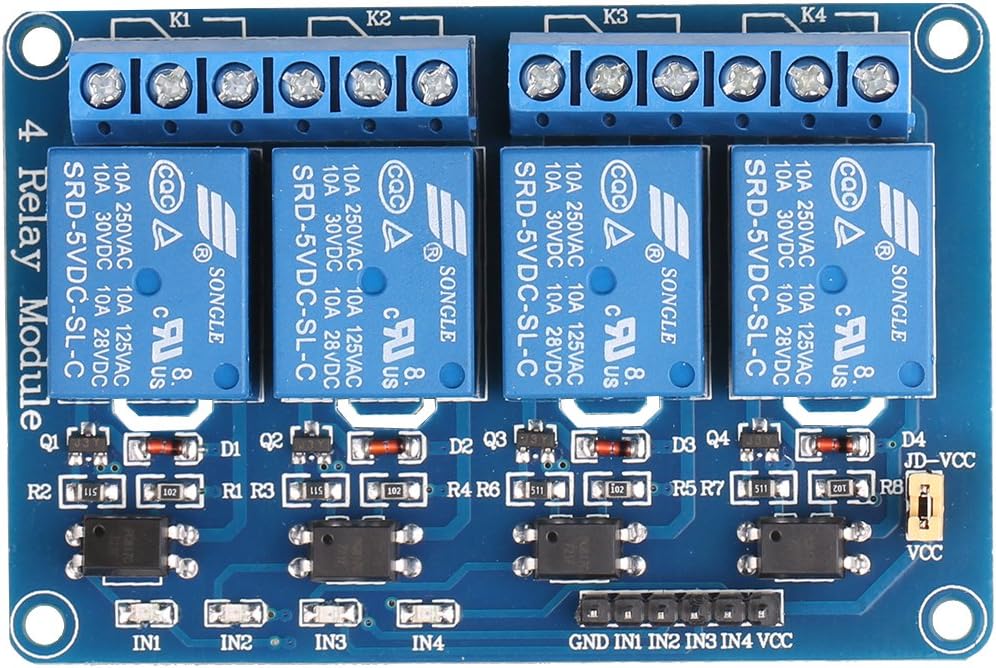
The JBtek 4 Channel 5V Relay Module is a compact, PCB-mountable interface board designed for seamless control of high-current devices up to 10A at 250VAC or 30VDC. Compatible with all major microcontrollers including Arduino and Raspberry Pi, it features four independent relays with LED status indicators and buffered inputs to protect your hardware. Ideal for smart home automation, industrial PLC control, and DIY electronics projects, this module offers plug-and-play convenience with robust performance.
| ASIN | B00KTEN3TM |
| Best Sellers Rank | #383 in Single Board Computers (Computers & Accessories) |
| Brand | JBtek |
| Brand Name | JBtek |
| Coil Voltage | 5 Volts |
| Connector Type | Through Hole |
| Contact Current Rating | 10 Amps |
| Contact Material | Silver, Copper, Or Alloy |
| Contact Type | Form C Or Spdt |
| Current Rating | 10 Amps |
| Customer Reviews | 4.6 out of 5 stars 601 Reviews |
| Item Weight | 0.02 Pounds |
| Manufacturer | JBtek |
| Maximum Switching Current | 10 Amps |
| Minimum Switching Voltage | 5 Volts |
| Model | 4450182 |
| Mounting Type | PCB Mount |
| Operation Mode | Automatic |
| Part Number | RP0009 |
| Specification Met | Ma |
| UPC | 520361134553 |
| Unit Count | 4.0 Count |
M**T
This board + Raspberry Pi + good power supply = A great combination!
Excellent board for Raspberry Pi. Assuming you have a solid power supply, you can run this board off the +5v provided on the pin header (Pin #2). The relay board is fully buffered, meaning that the relay coils are not directly driven from the GPIO pins which protects the Pi and means that this board is plug and play. If you're going to be doing a lot of work with the RasPi, I highly recommend a USB voltmeter/ammeter combo so you can monitor your power usage. At full load, you want to ensure that your voltage on your USB port is as close to 5.0VDC as possible, anything less than 4.65VDC will cause problems with the Pi and stability. Your amperage should never exceed the USB power supply's capability. I use a 2A (2000mA) power supply and with full load (all relays on), the board + Raspberry Pi B+ only gets to .56A (560mA) so I'm well with spec. With all relays off, I pull about .24A (240mA) HOW TO HOOK IT UP: The board has a six pin header labeled GND, IN1, IN2, IN3, IN4, VCC and a two pin jumpered header labelled VCC/JD-VCC. Leave the jumper installed. For GND, you can connect to any of the GND pins on the Pi's header (Pins 6,9,14,20,25,30,34,39). For VCC, connect to pin 2 (+5V). Connect each of the IN pins to a GPIO pin (I used GPIO 8,9,10,11 which are pins 24,19,21,23 respectively). HOW TO CONTROL IT: Use Python (should be available in your RasPi distro) along with the RPI.GPIO library. You'll need to run your scripts with sudo as manipulating the GPIO pins requires root access. You can set the GPIO pin using GPIO.output(PIN, True) to turn off the relay, and GPIO.output(PIN, False) to turn it on. My only nitpick is that the logic is backwards. Driving a GPIO pin high (TRUE), should turn on the relay while driving the GPIO pin low (FALSE) should turn it off, but it's easily fixed in software. Pros: Plug and play, just works. Will be getting more of these. You don't have to worry about building interface circuits, transistors, load calculations down to the mA or anything overly complicated. Basic research into the GPIO library for Python, a couple of GPIO pinouts for the RasPi and I was up and running within minutes. Cons: Logic is backwards, you have to send a GPIO pin LOW to turn on the relay but this is a very minor thing and can be easily fixed in software. Verdict: If you are looking to be able to control equipment using a Raspberry Pi, this is the board to use.
D**.
Another part of a project- works great though.
Bought these for a Raspberry Pi project. Haven't finished yet but this part itself is solid, well built, and ready for business. Will probably be buying a lot more if my product works the way I expect. Buy this if you need it.
C**H
Great little relay module
Great little relay module. Wired it right up and it worked on the first firing. This is the first time I've ever used a multi-channel relay board with an Arduino. The build seemed to comparable to brand-name Arduino card. It's mechanical so there's a click -- you can hear it in the video. All pins were well marked, each channel has its own SMD to let you know when it's active. Terminals screwed down tight. Nothing about it was an issue. I saw some complaints before I ordered it so I was a little nervous but most of them regarded the lack of documentation. It does require a certain knowledge base. There's an Instructable: [...] I'm probably going to order a few more just to have on hand.
A**L
No documentation but otherwise solid board
1 star off for no documentation but otherwise a very cost effective relay board. Provides optical isolation and some degree of physical isolation. I would judge this board suitable for light-duty AC Mains usage. The unit works well with my Raspberry Pi 2 and Pi 3. I will be buying more. Addendum for Pi users. When the Pi first boots the GPIO pins are not yet defined as outputs. The LEDs on the relay board are dimly lit which suggests there are pull-down resistors in operation. However, once you define the GPIO pins as outputs the relays immediately switch on. You can turn off the relays by sending the GPIO output high (GPIO.output(xx, True) where xx is the corresponding pin number). To resolve these issues I decided to add inverters between the GPIO pins and the relay card. For this I chose a quad, 2-input schmitt NAND gate device (4093B). I also added pull-down resistors (47k ohm) to the 4093B inputs because when you cleanup the GPIO library (under Python) or shutdown the Pi, the GPIO pins are floating - this leads to undesirable relay chatter without the pull-downs. You can power the 4093B from the 3.3V power supply on the Pi's interface. You can probably substitute a 4011 Quad NAND for the 4093 but I haven't tried it. The picture shows my inverter card which solders direct to the relay card. Using GPIO pins 23 through 26 the code to initialize then turn on relays 1 and 3 would look something like this: import RPi.GPIO as GP GP.setmode(GP.BCM) GP.setup([23,24,25,26], GP.OUT) GP.output([23,24,25,26], [True, False, True, False]) ... to turn on / off relay 2 would be: GP.output(24, True) GP.output(24, False) ... GP.cleanup()
A**L
Excellent product, the relay is indeed toggled when the input is low
That is quite the quirk but it works fine when you consider for it. I use this with a Raspberry Pi that drives the 5V power input, one of the relay inputs, and the ground terminal. The relay controls a 12V power supply connected to a solenoid. No issues, and no extra circuitry is necessary to protect the Raspberry Pi. I just send a low signal to the corresponding GPIO when I turn on my program. At no point does the relay do anything unintentional with that setup. Good job JBtek!
A**R
LOTS OF MISINFORMATION EXISTS IN REVIEWS, PLEASE READ
Making the documentation myself: As there is no documentation, I was very skeptical of this unit trying to sink too much current to my RasPi's GPIO pins (which can only sink/source a max of 16mA per pin). Reading the datasheets for the individual components "confirmed" this believe by the Optocoupler (817C) showing normal operating current of 20mA - yikes! I crunched the numbers and took some readings from my relay module in use and found that the unit only sinks ~2.1mA on the IN'X' pins, well within the tolerance of the RasPi (most Arduinos can sink/source 40mA or so, so even less of a problem there). The reason why is there is a 1k ohm resistor in series with the optocoupler and an LED, so basically 2 LEDs and a 1k resistor (the input side of the Optocoupler is just an LED). Why did they make the optocoupler run at suboptimal current? It enables the relay to be de-energized when using 3.3V as is common on Arduino and is the only voltage the RasPi's GPIO can handle. READ HERE FOR HOW TO HOOK THIS BAD BOY UP THE RIGHT WAY (WITHOUT BLOWING UP YOUR PI OR ARDUINO): Arduino: Most Arduinos can handle I/O DC current of up to 40mA (This relay module only draws 2.1mA from the I/O pin). You probably won't encounter a microcontroller that cannot handle this current (if you do, that means you are probably an embedded engineer and this guide isn't for you). Some Arudinos can operate at 3.3V (not from USB), if this is your case then you will need a separate 5V circuit to power the relay module. RasPi: Raspberry Pi's are a bit more limited I/O wise than their Arduino brethren, only being able to take I/O DC current up to 16mA. Again, this is still well within the limits. We are using the Raspberry Pi's power bus, which the supported current is dependant on the USB powersupply you have chosen - if you are using a 2A charger like you should be, you won't encounter any issues. Relay Board: There are two rows of input pins (GND IN1 IN2 IN3 IN4 VCC) and (JD-VCC VCC) with the latter coming with a jumper bridging the pins (keep the jumper on!). Connect a wire from GND on your device to GND on the relay module. Connect a wire from the 5V pin on your micro to the VCC pin that is adjacent to IN4 (not the one next to JD-VCC!). Also note the 5V pin I mentioned is the actual 5V rail of the micro, not the GPIO or I/O pin that you are going to be using to trigger the relay. Finally hook the GPIO or digital I/O pin up to IN1 and set the pin to 'low' or 0V in the software to activate and 'high' or 3.3V-5V to deactivate. Special Considerations: If your board cannot source ~60mA from the 5V rail or if your board only runs at a maximum of 3.3V you have to use a secondary power source to power the relay.
C**D
Worked great!
This is a solid board that is easy to use. It can be triggered by either 3.3V or 5V Arduinos and probably most other controllers. (3.3V setup is different than 5V setup) I used this board with an e-cig cartridge and high amp batteries to create a steampunk hat that puffs "steam". Simple Setup (using Arduino UNO): Connect the VCC to the 5V power supply Connect the GND to the ground on the controller Connect IN1-4 to DIO pins on the controller Leave the JD-VCC to VCC jumper Connect your common to the center pole on the relay and your feed line to the left pole for Normally Open (off) and right pole for Normally Closed (on). Program your controller to digitalWrite(pin, LOW) when you want the relays to switch. Pros: Simple design 10A relays are good for most requirements Compact Cons: None
J**E
Very easy to operate..note: Activates on 'low' signal
I needed to control 4 manual switches, and hooked this up to an arduino and then soldered it to each switch. It has worked great, and I was really happy with how clean the wiriing ended up. Since all 4 are on one board, you only need one power/ground connection. The rest were very straightforward....simply hook a GPIO to each of the ports and off you go. One thing that tripped me up is that it activates when you send a LOW vs. HIGH. One other thing that I thought was really really nice is that there is a built in LED indicator of which ones are activated and which aren't. Overall I love how simple this was and will probably get more for future relay work
C**N
Buen producto
Funciona perfecto
C**E
falta informacion tecnica
la tarjeta no trae nada de información, aunque puede ser intuitiva la manera de conectar, siempre es útil que se proporciona
Trustpilot
1 week ago
1 day ago