Buy anything from 5,000+ international stores. One checkout price. No surprise fees. Join 2M+ shoppers on Desertcart.
Desertcart purchases this item on your behalf and handles shipping, customs, and support to Australia.
🔥 Seal the leaks, save the bucks, and flex your eco-savvy 🏡
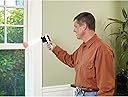
The BLACK+DECKER TLD100 Thermal Leak Detector uses an advanced infrared sensor and color-changing LED to quickly identify temperature variances around your home, helping you locate drafts and insulation gaps. With an easy-to-read LCD displaying temps in Fahrenheit or Celsius, plus an ergonomic grip and a practical 5-step guide, it empowers homeowners to cut heating and cooling costs by up to 20%. Its versatility extends to automotive and appliance diagnostics, making it a smart, multi-use tool backed by a 2-year warranty.


| ASIN | B0044R87BE |
| Alarm | Visual |
| Best Sellers Rank | #365,491 in Tools & Home Improvement ( See Top 100 in Tools & Home Improvement ) #177 in Gas Detectors & Alarms #1,209 in Temperature & Humidity Measurement |
| Brand | BLACK+DECKER |
| Built-In Media | BLACK+DECKER Thermal Leak Detector (TLD100) |
| Color | Black |
| Customer Reviews | 4.4 out of 5 stars 5,222 Reviews |
| Global Trade Identification Number | 00885911106337 |
| Item Type Name | BLACK+DECKER Thermal Leak Detector (TLD100) |
| Item Weight | 0.65 Pounds |
| Manufacturer | Black & Decker |
| Manufacturer Warranty Description | 2 Years |
| Mfr Part Number | TLD100 |
| Model Number | TLD100 |
| Number of Items | 1 |
| Operating Humidity | 50 percent |
| Power Source | Battery Powered |
| Product Style | modern |
| Style | modern |
| UPC | 885911106337 |
| Unit Count | 1.0 Count |
T**Z
Works Great
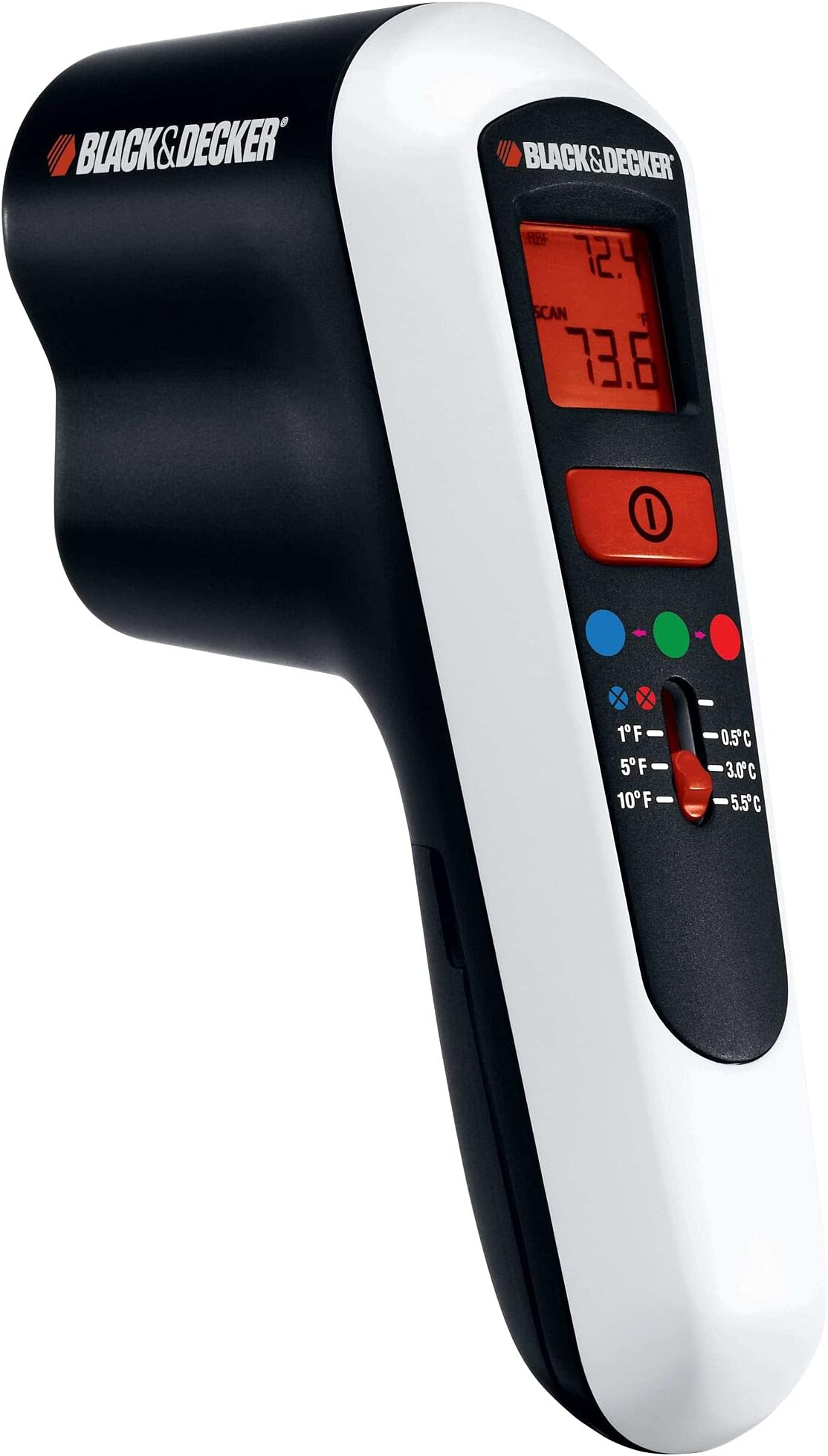
First off, this is a thermal leak detector, not a thermal thermometer. As a thermal leak detector, it does exactly what it says it does. First, you set your reference temperature. You do this by first deciding what variance from your reference temperature you want to measure [+/- 1, 5 or 10 degrees F or .5, 3 or 5.5 degrees C]. Then point the device at your reference point, normally an interior wall. Press the button which locks in your reference temperature. Then simply point the device at whatever area of the structure you want to test. The detector will both display the scan temp, to a tenth of a degree, and the reference temp. In addition, the light beam will show green if +/- the variance you set, blue if below your variance [colder] or red if above your variance temp [hot]. For example, reference temperature is 68F. Point at an outside window frame on a cold day. If cold air is leaking in, and your variance is +/- 5F, then if the leaking air is colder than 63F [68F less 5F], you'll see a blue light projected on the window frame. Now point the device at an electrical device of some sort. If the device is "hot", say 74F or higher [68F + 5F] the light will shine red on the object. This color feature is great when you are testing because you don't have to constantly be looking at the scan temp on the readout, though it's there if you want it. It will work on the glass of windows but you won't see the light except at night. Overall, in my opinion, a great buy at a great price for the average user. I am not familiar with any other thermal leak detectors, but for the average homeowner, a great addition to one's tester box.
S**E
Does what it claims...
I've used thermal guns before but this 3 color light indicator is way cool. It makes checking temp delta's very quick. With the old gun (with laser pointer), it was, point at the area you wanted to test and then look at the meter, repoint the meter to a new location and look at the meter again. With this TLD100, it was just move the light around the area you are checking and the only time you have to actually look at the meter is when the color changes. It completely eliminates this looking back and forth at the target, then the meter, then the target, then the meter,... A comparison would be the difference between using a box end wrench or a rachet wrench to remove bolts. It makes the process much simpler and faster. I bought my unit at the wrong time of year when the outside temp was, at maximum, only 30 degrees different then the inside temp so even though I found some leaks, they were minor. My house is about 40 years old and since I bought it a few years ago, I installed storm doors and had added insulation to the attic. All the windows and doors are relatively new and from what I can tell, this house is relatively tight. Even though I didn't find any major problems, it's gives a certain peace of mind to know that everything is okay. This summer when the temps hit the 90's, I'll retest. The bottom line is that for home use and price, this is a very good meter. As some posters have pointed out, there are more accurate meters available and IR camera's that have far more versitility, but for what they cost, it would be much cheaper to not fix your leaks and just pay for the extra energy costs. Addendum: I've owned this product for a while now. When I first got it, it took under a minute to figure out how to use it. The concept behind it is very simple and very well done. At first, to my chagrin, my house seemed very tight and I found no hot or cold spots of any significance. I almost felt like I wasted my money, but there is a certain amount of consolation knowing that everything is in order. Recently, I bought a whole house fan, but my attic access was too small to get it into the attic, so I enlarged the opening. I knew that I would have to insulate the cover to the new opening, but before I got around to it I used this product to see what to expect. It was a warm day and I had the air on at about 77 degrees. When I pointed the meter at the new attic cover, it was reading almost 100 degrees. What that meant was that I had a radiating surface of about 7 square feet at 23 degrees over the interior of the house temperature. Looking toward the future when the winter would come, I could have a temperature differential of over 100 degrees during very cold days. In the summer when the temperature gets into the mid 90's or more, my attic temp exceeds 140 degrees. This would give me a temperature differential of over 65 degrees. I figure that this knowledge alone would pay for the meter in short order. Anyway, I really like having this meter and contrary to what some posters have said about it's accuracy, it's the delta (temp difference) that is the most important thing to be concerned about in this case.
K**R
Basically an infrared thermometer, but very useful for its intended purpose
For the price, this leak detector is an excellent tool for a DIYer looking to improve insulation in their house. The device is basically an infrared thermometer. The difference with the leak detector is that it compares temperatures, and lights up the wall in different colors based on the comparison. Here's how it works: 1 - point the detector at a wall that you know is insulated, and turn on the detector 2- upon turning on, the detector measures the temperature of the wall, and remembers that temperature 3- now you move around the room/house, pointing at different parts of the wall, near windows, doors, etc. 4- the detector constantly reads temperature and compares to that initial wall reading 5- A green colored spot is projected onto the wall where you are pointing the detector.... if the temperature differs by a certain amount, the spot turns blue (colder) or red (hotter). 6- a 3-position switch lets you decide whether you want the spot to change color for 1 degree F difference, 5 degrees F difference, or 10 degrees F. This detector did not just point out the obvious problem spots (like door jams, near windows). You really don't need a detector to figure out those spots. This detector highlighted large differences on the *same wall,* where it turned out that insulation was lacking or had fallen off. I deducted one star for the accuracy of the temperature reading. I have another infrared thermometer which I know to be accurate, so I compared readings. This leak detector was a few degrees off from the other detector. That said, this leak detector still calculated the correct difference in temperature, which is its main functionality. If you want a very accurate temperature reading, get a dedicated thermometer. Others have commented on the box size - it seemed pretty appropriately packaged to me. The detector is a rather odd shape, so the box had a fair amount of empty spaces. Nevertheless, the device is packaged well. Build quality is fine. The whole device is plastic, with a battery door that pops open in the grip. For the price, I have zero complaints with build quality. In summary, this device is handy and serves its intended purpose very well.
N**R
LOVE this Detector!
I had been watching this detector for over 8 months and when the price dropped a few bucks, I jumped on it! I am currently in the planning stages of refurbishing all of my original wood double hung wood windows in my 90 year old house. I knew that having this detector prior to the insulating and repair of the windows would give me a good starting point to actually quantify the improvements. Unfortunately, by the time the detector went on sale, it was spring. I look forward to getting good data on my windows in their current state (this winter) and then being able to compare the data after the windows are repaired. I'm also a mechanical engineer and often go on the road to customer sites to help with machine startups. I often deal with steam supply and thought to bring this tool with me to test it out on the piping. It works wonderfully! It's not a calibrated instrument that you would expect from a $300 thermal gun, but it beat the pants off the customer's gun with just the laser light alone. The customer's gun only had a tiny laser dot which was near impossible to see. This Black & Decker gun has a large spotlight that is very easy to see and direct and the digital readout is large and well lit. I knew it wouldn't be highly accurate but it was always within 10 degrees of the calibrated gun's readout (and we're talking approx. 250-275 degrees Fahrenheit). Also, I had no idea, but I actually got a readout of over 300 degrees F with this Black & Decker Gun! A definite MUST HAVE! I love this gun and can't believe the quality and range of uses for the money! If you're thinking of getting one of these, buy this one!
A**G
Great tool for DIY home energy audit - and fun too!!
I learned about this product while reading an MSN Real Estate article on home energy audits: [...]. The candle method was not doing it for me, so I upgraded to the B&D TLD100. I ordered on a Wednesday via next day shipping (Amazon Prime) and got it the next day. When I tried it out later that Thursday evening, I found out that the blue LED light was out and I thought that I was going to have to go directly to Black and Decker for a repair. I contacted Amazon.com customer service that evening and they shipped another one out to me for delivery Saturday morning and provided me with a return label for the defective unit. The customer service rep was helpful and the process was easy. The replacement device worked perfectly and I was back in business. There is a switch that allows you to choose your temperature threshold. Are you looking for small 1 degree changes, 5 degree changes, or larger 10 degree changes? Set the threshold and start with the unit "off." You point it at a reference point and hit the big "on" button. If you pick the 5 degree threshold as a reference point, anything that you point at that is within 5 degrees will have a green LED light illuminating the spot. If it's at least 5 degrees colder, the LED will illuminate the area blue and if it is at least 5 degrees warmer, it will be red. The display also shows you the reference point temperature and the temperature of the spot you are pointing at. This was fun! Much more fun than walking around with a candle, dripping hot wax, trying to see if the flame is flickering. Please note that the thermal leak detector does not come with a battery, so you'll need to have a 9 volt battery on hand. Also, the switch to change the device from Fahrenheit to Celsius is near the battery.
N**K
wanted to like it
I'd wanted this for so long and then it was a disappointment. Maybe my needs weren't a good fit for it because it seems to be effective for others. When I used it on windows where I could feel there was some cold air coming in, it would be a few degrees lower, as you'd expect. So didn't tell me much. And the number jumped around too much to be finely accurate. The cone in which the rays or whatever shoot out probably makes a huge difference; the aiming device should help you keep that consistent. The final straw before I returned it was when I could feel gusts of cold air in my basement coming out from around a wooden panel board that wasn't doing jack, and this thing was acting exactly like it did every other time, showing a degree or two colder. And I'm not sure how it got its reference value. I read the instructions, but as soon as you turn it on, it grabs a reference value, so I guess the lesson is to be aiming it at the right spot when you turn it on.
C**Y
A great tool for finding heating or cooling leaks - or just measuring temperatures
I wanted a remote-measuring thermometer for checking my home for hot spots (in summer) or cool spots (in winter). This one is great! It couldn't be simpler to use, and it's very accurate. It projects a green, red or blue spot onto the wall or other surface being measured. The green spot represents the baseline temperature of a wall or other surface measured when the unit is powered on. The spot turns to red when scanning a surface that is hotter than the baseline temp, or blue when scanning a surface cooler than the baseline temp. The colored spot makes it really quick and easy to scan for hot and cold areas, since you don't need to pay close attention to the actual temperature reading until you find a zone of interest. At first I thought that the colored spot might just be a gimmick, but, in practice, I have found it to be a really useful feature. My background is in science and engineering, so I appreciate instruments that are accurate and work well. I checked this thermometer against several others that I know are accurate and it consistently agrees with the others +/- 2 degrees or better. This is within the specs for this device, and pretty good for under $30. Be aware though, that this unit remotely measures the temperature of surfaces, so it is not a good choice for medical use, for cooking and for other jobs where you need to measure internal temperatures. That said, it will measure the temperature of your skin pretty accurately. It will not accurately measure the temperature of shiny or transparent surfaces, but you can stick a piece of masking tape or duct tape on the surface and measure that. It's so sensitive that it will easily measure the residual heat left by my bare foot standing on a cool wood floor. Leave your foot in place for a minute or so, so that the temperature of the floor is increased by your warm foot. Move your foot away, then measure the temperature at the spot where your foot was, and the surrounding floor. The red LED light will light up when the thermometer is aimed at the outline of your foot, but will turn to green for the surrounding area. (Note: this probably will not work for concrete floors, since they will not warm up enough). You start by aiming the unit at a reference surface, such as a wall, to establish a baseline temperature. (Note: a switch in the battery compartment sets either Farenheit or Celsius for the readings) Then you can select one of three ranges: +/- 1F*, +/- 5F* or +/- 10F*. (.5, 3.0, 5.5 C) I like to start out with 10F*, since that will quickly let you zero in on any serious hot or cold spots. Spend your time fixing those spots first, and you'll get the best bang for your buck. After those spots are fixed, or if you don't find any in the ten-degree range, then move to the 5-degree range and repeat. Aside from its real value in finding and fixing thermal leaks, this thing is a heck of a lot of fun just to play with. My grandkids had fun searching for hot and cold things around the house. On the 5-degree setting, you'll find that just about anything that runs on electricity and stays on all the time (clocks, power cubes, etc.) will turn the LED to red. A/C ducts will turn the LED to blue if cool air is coming out.
J**Y
Nice gadget for home owner's toolbox.
The TLD100 works just like advertised. It is nice to have three settings (1, 5, and 10 degrees F) to differentiate the swings in temperature. So far it seems quite focused even though pointing at a person's forehead does not give a 98.6 reading. When checking from outside around an exterior door with known weather stripping problems it found all the known leaks but showed no problems around other edges. Even works on windows better than I had expected. It has a nice professional feel even if not as accurate, or expensive, as the high end laser based units. But those units, at least the ones I have seen, do not offer the lighted indication of this unit. For me as a homeowner it is a lot easier to see the light as I look at where I am looking for leaks, not at both the laser spot and temperature meter. If you need something to do some weatherproofing of your home, get this unit, just remember to get 9-volt batteries.
A**.
A friend in need
This is a great detector, with changing lifestyles a must have home instrument
R**P
Fijn apparaat om warmtelekken / koude zones op te sporen
Warmtelekken zijn goed op te sporen .met dit handige apparaat. Je meet eerst een referentietemperatuur, waarna je de temperaturen in de omgeving meteen met rood ( warmer), groen (gelijk) of blauw ( kouder) kunt aflezen. Eenvoudige bediening.
A**R
Good
Nice product
S**A
Semplice e utile
Esperienza ottima. Perfetto per individuare spifferi dagli infissi, con una buona precisione e di facile utilizzo. Segnala con cambiamenti di colore del fascio luminoso la differenza di temperatura sulle superfici rispetto a quella di riferimento. Buon rapporto qualità/prezzo. Imballaggio impeccabile.
J**L
Bien
Muy fácil de usar, apuntar y disparar. Parece fiable, y con mirar el color del foco ya se sabe si la temperatura es inferior o superior, sin tener que mirar la pantalla.
Trustpilot
3 days ago
2 months ago