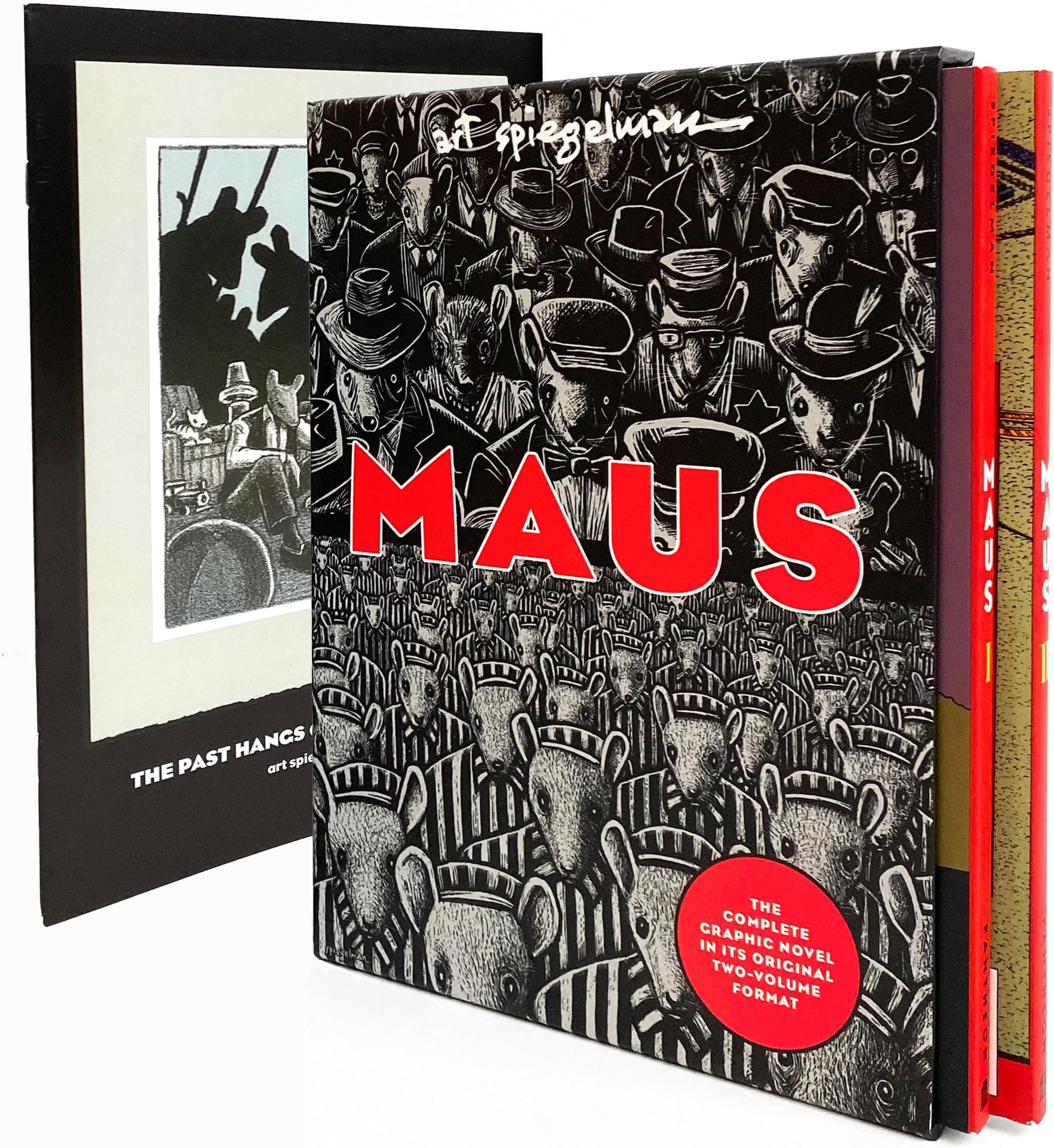

Maus I & II Paperback Box Set [Spiegelman, Art] on desertcart.com. *FREE* shipping on qualifying offers. Maus I & II Paperback Box Set Review: Sobering Read, excellent print - Amazing read. Captivating story excellent illustrations. The box set is also very good quality and the booklet inside was a special touch. Definitely would recommend Review: An Approachable Masterwork on the Holocaust, Plus Lessons About Grown-Up Parent-Child Relationships - Economist Greatest Books of All Time List #407 I've been aware of Maus for a while, but never read it until it came up on the Economist GBOAT list. I'm sure my thoughts below will echo those from the book's legions of fans. *Brief Synopsis: Art Spiegelman, known for making serious/adult comic books, undertook this project to relate the story of his father Vladek's life as a survivor of the Jewish Holocaust and his (Art's) own complicated relationship with his father as an aging and miserly curmudgeon. A big innovation here is that Spiegelman turns all the characters/historical figures into animals, with all Jews illustrated as mice, Germans as cats, Poles as pigs, Americans as dogs, etc. Vladek's story describes the life of Jews in Nazi-occupied Poland from the invasion in 1939, to the ghettos and work camps, and all the way to (and, in Vladek's case, through) the Auschwitz concentration camp. The tale is sickening and graphic (as required by the subject matter), as Vladek relates the many, many times when his life was in jeopardy and his friends and family members died due to starvation, sickness, violence, and/or the gas chambers. In parallel with Vladek's backward-looking story, Art also relates the unfolding "real time" story of his efforts to extract the story from his then-elderly father living in New York. Vladek's neurotic and miserly tendencies drive Art and Vladek's other family members up the wall, and Art struggles to faithfully portray his struggles with his father while also striving to avoid playing into antisemitic slurs and stereotypes. *On the Holocaust: As a matter-of-fact relation of one Polish Jew's survival of the Holocaust (accompanied by understated-yet-powerful and surreal artwork on every page), the narrative is really compelling and educational. The whole story shows the tightening of the Nazi noose around the necks of Jews and how the growing tide of restrictions and racism created a "frog cooking in the pot slowly" effect that eventually left nearly all of them without an escape route. Like all Holocaust histories, it's both a relation of unspeakable horrors (there were multiple times, especially when Vladek related the graphic and brutal fates of Jewish children, when I felt compelled to cry out "O God, where art Thou?") and a cautionary tale. I was often forcibly reminded of Terry Pratchett's assessment in "Small Gods": "There are hardly any excesses of the most crazed psychopath that cannot be easily duplicated by a normal, kindly family man who just comes into work every day and has a job to do." Those "excesses" on the part of the Nazis regularly resulted in literal piles of bodies strewn across the several pages of this novel. The book also drives home an important point, through an exchange Art shares with his therapist, that surviving the concentration camps was, much more often than not, the result of pure chance rather than merit. Though Vladek constantly wheels and deals throughout the book (e.g., trading favors and food in ghetto and camp black markets, constructing safety bunkers to hide family members, peddling his services and know-how as bribes for favorable treatment for his family), he also regularly relates the many, many instances of luck when he was overlooked or passed over while others were sent to die. Two quotes that particularly stood out to me included: (in the context of trading favors and giving bribes) "If you want to live, it's good to be friendly.", and (when he passed through a Swiss town after Auschwitz and realized everyday life continued for so many) "And I saw, it's not everywhere, my hell. It's still life things going on." *On Parenthood and Sonhood: The book also relates the tangible, hair-pulling frustration that can arise in the child-parent relationship as a stuck-in-their-ways parent approaches the caregiving years. Vladek's traumatic experiences clearly play an outsize role in his neuroses, but there's something poignant and universal about the way Art constantly struggles with his feelings of frustration as he seeks independence and distance from his father's own prejudices while also feeling the guilt and wondering if he should be more supportive and understanding. This book is certainly a masterpiece. I'll share it with my children to teach them about the Holocaust, and also continue to look to it myself as an insightful take on the child-parent relationship in later life.

| ASIN | 0679748407 |
| Best Sellers Rank | #3,773 in Books ( See Top 100 in Books ) #6 in Educational & Nonfiction Graphic Novels #15 in Jewish Holocaust History #171 in Memoirs (Books) |
| Customer Reviews | 4.7 4.7 out of 5 stars (2,652) |
| Dimensions | 6.75 x 1.3 x 9.5 inches |
| Edition | Reprint |
| ISBN-10 | 9780679748403 |
| ISBN-13 | 978-0679748403 |
| Item Weight | 2 pounds |
| Language | English |
| Print length | 300 pages |
| Publication date | October 19, 1993 |
| Publisher | Pantheon |
K**O
Sobering Read, excellent print
Amazing read. Captivating story excellent illustrations. The box set is also very good quality and the booklet inside was a special touch. Definitely would recommend
M**G
An Approachable Masterwork on the Holocaust, Plus Lessons About Grown-Up Parent-Child Relationships
Economist Greatest Books of All Time List #407 I've been aware of Maus for a while, but never read it until it came up on the Economist GBOAT list. I'm sure my thoughts below will echo those from the book's legions of fans. *Brief Synopsis: Art Spiegelman, known for making serious/adult comic books, undertook this project to relate the story of his father Vladek's life as a survivor of the Jewish Holocaust and his (Art's) own complicated relationship with his father as an aging and miserly curmudgeon. A big innovation here is that Spiegelman turns all the characters/historical figures into animals, with all Jews illustrated as mice, Germans as cats, Poles as pigs, Americans as dogs, etc. Vladek's story describes the life of Jews in Nazi-occupied Poland from the invasion in 1939, to the ghettos and work camps, and all the way to (and, in Vladek's case, through) the Auschwitz concentration camp. The tale is sickening and graphic (as required by the subject matter), as Vladek relates the many, many times when his life was in jeopardy and his friends and family members died due to starvation, sickness, violence, and/or the gas chambers. In parallel with Vladek's backward-looking story, Art also relates the unfolding "real time" story of his efforts to extract the story from his then-elderly father living in New York. Vladek's neurotic and miserly tendencies drive Art and Vladek's other family members up the wall, and Art struggles to faithfully portray his struggles with his father while also striving to avoid playing into antisemitic slurs and stereotypes. *On the Holocaust: As a matter-of-fact relation of one Polish Jew's survival of the Holocaust (accompanied by understated-yet-powerful and surreal artwork on every page), the narrative is really compelling and educational. The whole story shows the tightening of the Nazi noose around the necks of Jews and how the growing tide of restrictions and racism created a "frog cooking in the pot slowly" effect that eventually left nearly all of them without an escape route. Like all Holocaust histories, it's both a relation of unspeakable horrors (there were multiple times, especially when Vladek related the graphic and brutal fates of Jewish children, when I felt compelled to cry out "O God, where art Thou?") and a cautionary tale. I was often forcibly reminded of Terry Pratchett's assessment in "Small Gods": "There are hardly any excesses of the most crazed psychopath that cannot be easily duplicated by a normal, kindly family man who just comes into work every day and has a job to do." Those "excesses" on the part of the Nazis regularly resulted in literal piles of bodies strewn across the several pages of this novel. The book also drives home an important point, through an exchange Art shares with his therapist, that surviving the concentration camps was, much more often than not, the result of pure chance rather than merit. Though Vladek constantly wheels and deals throughout the book (e.g., trading favors and food in ghetto and camp black markets, constructing safety bunkers to hide family members, peddling his services and know-how as bribes for favorable treatment for his family), he also regularly relates the many, many instances of luck when he was overlooked or passed over while others were sent to die. Two quotes that particularly stood out to me included: (in the context of trading favors and giving bribes) "If you want to live, it's good to be friendly.", and (when he passed through a Swiss town after Auschwitz and realized everyday life continued for so many) "And I saw, it's not everywhere, my hell. It's still life things going on." *On Parenthood and Sonhood: The book also relates the tangible, hair-pulling frustration that can arise in the child-parent relationship as a stuck-in-their-ways parent approaches the caregiving years. Vladek's traumatic experiences clearly play an outsize role in his neuroses, but there's something poignant and universal about the way Art constantly struggles with his feelings of frustration as he seeks independence and distance from his father's own prejudices while also feeling the guilt and wondering if he should be more supportive and understanding. This book is certainly a masterpiece. I'll share it with my children to teach them about the Holocaust, and also continue to look to it myself as an insightful take on the child-parent relationship in later life.
K**R
So important to read
Beautiful
K**S
Memory excavations
Boy, can I be a dope sometimes! I've resisted reading Art Spiegelman's Maus for years. There was something about the holocaust turned into a comic that set my teeth on edge. It wasn't that I didn't know that lots of people whom I respect thought Spiegelman's work a masterpiece, or that several of my fellow professors had actually used Maus as a text in various courses (much less that the book won a Pulitzer!). It was just that I couldn't bring myself to reconcile the theme (genocide) with the genre (comics). Well, I was a dope. I've learned a lot about the genre since then (although I wish we had more appropriate titles for it than "comics" or "graphic novel"), and I've discovered that the genre is perfectly capable of handling heavy themes (Harvey Pekar and Joyce Brabner's Our Cancer Year or Joe Sacco's books on Bosnia and Palestine are perfect examples). So I've spent the last week reading Spiegelman's Maus. Oh my. Who could've imagined that the unclassifiable tragedy of the holocaust could've been so poignantly, so thoughtfully, expressed? The story line and the drawings are incredible, succeeding in saying entire volumes in the abbreviated way characteristic of this genre. It astounds me that so much can be said in just a few words and "simple" drawings. No doubt years of thought and mountains of draft went into such craftsmanship. One is reminded of how much effort it takes to write good poetry. One of the best features of Maus is that Spiegelman, in telling the story of his parents' ordeal through the story of his troubled relationship with his survivor father, keeps the holocaust in the present instead of relegating it to a distant past. The father Vladek's memories of the horrific past bleed into the normalcy of the present. One of the most chilling examples of this temporal fluidity is found in Volume 2 (p. 79). Vladek, Art, and Art's wife Francoise are driving through some wooded areas on their way to a supermarket. Vladek is telling the story of four young girls who were hanged at Auschwitz. One of the panels comprising this segment is an overhead shot of the car containing Vladek, Art, and Francoise as they drive under a canopy of tree branches. From the branches we see four sets of legs and feet dangling. The legs have the characteristic striped pants of Auschwitz inmates. The power of Vladek's memory invades the present. And indeed this is one of the major themes of the book. Vladek, who infuriates Art with his stinginess, his continuous tension and nervousness, and his constant complaining about everything, is who he is because the horror of the past is always with him. He can't shake it, and neither can his son Art. Indeed, the theme of memory percolates throughout the book: unwanted present memories, yearned for lost memories (exemplified by Vladek's destruction of the diaries written by Art's mother, Anje). That's one of the reasons this book is the masterpiece it is. It isn't just a several-layered story. It's also an implicit archaeology of memory that, layer by layer, uncovers what it means to be a creature capable of both remembering and forgetting.
T**A
A Raw, Powerful Story
Horrifying but so important to read. I think my favorite aspect of the book was how Spiegelman didn’t try to “spruce up” his father’s personality or his father and stepmother’s relationship. His father is presented as is and what he is is a man with prejudices and major flaws of his own. Vladek, while very caring, is also very stingy with money, constantly argues with Mala (his second wife after Spiegelman’s mother died by suicide) and urges Francois to drive away when he sees a black person and argues with Spiegelman and Francois when they are outraged about his racism. And not once did Spiegelman say “wow my dad is awful he definitely didn’t deserve to live through the camps” because the point that is driven home is that EVERYONE and ANYONE, regardless of how “good” or “bad” you were, was being exterminated and nobody deserves what happened to those millions. It’s also clear that despite their turbulent relationship, Spiegelman and his father loved each other very much. It’s such a heartbreaking story and I love that Spiegelman chose to tell it honestly and objectively instead of trying to make his father more palatable in order to turn his story into bland inspiration p*rn (like a certain book with “pajamas” in the title) in hopes of it selling better. I highly recommend it, you won’t be able to put it down once you pick it up!
I**R
Excepcional, um dos trabalhos escritos mais bem feitos da humanidade, as gravuras sao lindissimas, cheia de detalhes, e os jogos com a linguagem são muito inteligentes, a historia que muitos esquecem de contar... o box veio em perfeitas condicoes, muito completo, o livreto complementar, tambem é muito interessante muito bom
A**R
Made me cry
M**E
To read absolutely! I left mine in Europe and I wanted one in Japan! I feel better now!
N**A
I have the Italian version of Maus and I read also the English version of the novel. It is a true story of a survivor of the nazi camp that escaped the killing in the concentration camps in Poland. He tells the story of his life to his son, that is willing to listen to the story his father has to tell him. Very interesting. It is in black and white
B**P
Item was in excellent condition and received it well before the expected arrival date given.
Trustpilot
2 weeks ago
2 months ago