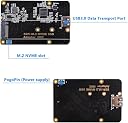
Use case. I'm building a 3-node k3s HA control plane on Raspberry Pi 4B 8GB nodes. Each control-plane node runs etcd, which is sensitive to write latency and intolerant of disk drops, so SD cards and shaky USB enclosures are non-starters. I need a Pi 4B-compatible USB-to-NVMe path that survives sustained random I/O without falling off the bus. That's exactly the bar this HAT cleared — with one important asterisk on the power supply. Read this first if you're on a Pi 4B power supply. With the official Raspberry Pi 4B 15.3W USB-C power supply — the brick that ships in the standard kit — this drive never enumerated on my unit. Wouldn't show up at all. Swapped to the official Raspberry Pi 5 27W USB-C power supply (5V/3A delivered to a Pi 4B since there's no PD negotiation), and the board came up immediately and stayed up through every test below. If you're running a stock Pi 4B on the kit PSU, consider the 27W upgrade as part of the cost of this combo. This might not matter so much if you're running an NVMe that's not as power hungry as the WD SN770 Black. I read one other write up where the reviewer mentioned this and I wish I knew what card they were running. What I tried first, and what failed: - UGREEN USB-NVMe enclosure (Realtek RTL9210, USB ID 0bda:9210). Drive enumerated cleanly at SuperSpeed, then idle-disconnected ~3 minutes later before any I/O ran. dmesg showed "Enable of device-initiated U1/U2 failed" four times at enumeration — turns out to be a well-documented LPM handshake bug between the RTL9210 and the Pi 4B's VL805 xHCI controller. Replug to a different port, same result. - Sabrent USB-NVMe enclosure (also RTL9210, 0bda:9210). Same bridge silicon under a different brand. Got further — passed enumeration, started mkfs.ext4 — and then the xHCI host controller logged a Host System Error mid-format, the kernel marked it dead, and both USB root hubs dropped. Reboot required. VL805 EEPROM was at latest; not a firmware issue. - SSK USB-NVMe enclosure (JMicron 152d:0576). Got past mkfs, started the fio soak, then the same xHCI HC-died pattern killed the bus mid-run. Different bridge family, same outcome on the Pi 4B. [[I'm not going to be reviewing those products as I don't think testing for this use case speaks to their buyers.]] For all three failures vcgencmd get_throttled stayed at 0x0 — power held; the failure was bridge-side, not undervoltage. This board (ASMedia ASM2362, USB ID 174c:2362) is the one that worked. Same WD_BLACK SN770 1TB drive, same Pi 4B. Once I gave the Pi the 27W PSU, this combo passed a 30-minute fio soak (70/30 random 4K mixed read/write, 2 jobs, iodepth 32) end to end. No USB resets, no kernel errors, no throttling. Light benchmarks from the 30-min soak (fio 3.39, 4K random 70/30 mixed, Pi 4B 8GB on the Pi 5 27W PSU, bare board with small stick-on aluminum heatsinks on the SoC, USB controller, and RAM — no case, no fan): - Read: ~16,400 IOPS, ~64 MB/s, p99 latency ~0.46 ms - Write: ~7,000 IOPS, ~27 MB/s - Drive composite temperature held steady at 55C (controller sensor 77C) for the full half hour with the board's bare aluminum heat-spreader; vcgencmd get_throttled clean throughout. The p50 fsync latency wasn't so impressively different on the board compared to the microsd (Amazon Basics 64GB) - 0.98/1.66ms. That's ~60% improvement, but not all I was hoping for on USB 3.0 / microsd speed. Where this setup really shines though is the p99 and p99.9 latency (and beyond). There you see better than 11x and 23x improvement respectively. The max was 8.69ms on this setup vs ~4s on the microsd. Pay attention to these numbers if you're running stateful workloads on your setup. It might matter for Home Assistant even if all you want is reliable performance and don't need the speed. The consistency matters. Keep in mind that these are USB 3.0 numbers, not native-PCIe numbers — you don't get the SN770's full Gen4 ceiling over USB, and that's fine for the etcd workload I'm targeting. It just means my card is overpowered as I can't utilize the extra performance - hey, I got a great deal on recertified drives on ebay and I'll use them in other projects. The point is that the link stays up under sustained queued I/O, which the RTL9210 and JMicron enclosures didn't. The benchmarks don't compare this well to other products with the right bridge. But the compatability of the bridge means a lot. Will I buy more? Yes — at least two more. I need this combo on three Pi 4B control-plane nodes for the HA cluster, and I'm not going to mix bridge chips across nodes once I've got one that works. Bridge silicon matters more than enclosure brand on a Pi 4B; "USB 3.0 to NVMe" without a named chip on the listing is a coin flip on whether it'll soak clean. This one names the chip, the chip works on the right PSU, and the soak gate cleared on the first run that completed setup. I'm more than satisfied with the purchase for the price, so I'm giving this 5/5. However there are some things that I would improve about the product listing: 1. The body says that it's compatible with multiple models, while the Final NOTE says it's only compatible with the Pi 4. 2. It doesn't name the bridge chip. I had some reservations that it could be one I'd already tried, but how to go with the fact that compatability was already considered as it's specialized to the pi 4. 3. The listing doesn't mention that it's USB 3.0, which could confuse people who don't know that Pi 4 doesn't expose PCIe and you'll never get the speed of modern NVMe cards with that. 4. They don't mention the power supply situation I stumble into, which is highly relevant for cards that want more power. 5. The don't list performance benefits. The improvements of USB 3.0 over microsd go far beyond extending disk space. 6. The use cases overstate USB 3.0 performance. This doesn't make your Pi ready to provide a network storage solution / NAS replacement. 7. Doesn't say anything about thermals. It turned out to be fine, even for my drives but I wondered what I'd need to do for cooling. Hope you enjoy this board. It ended a lot of painful searching for me.