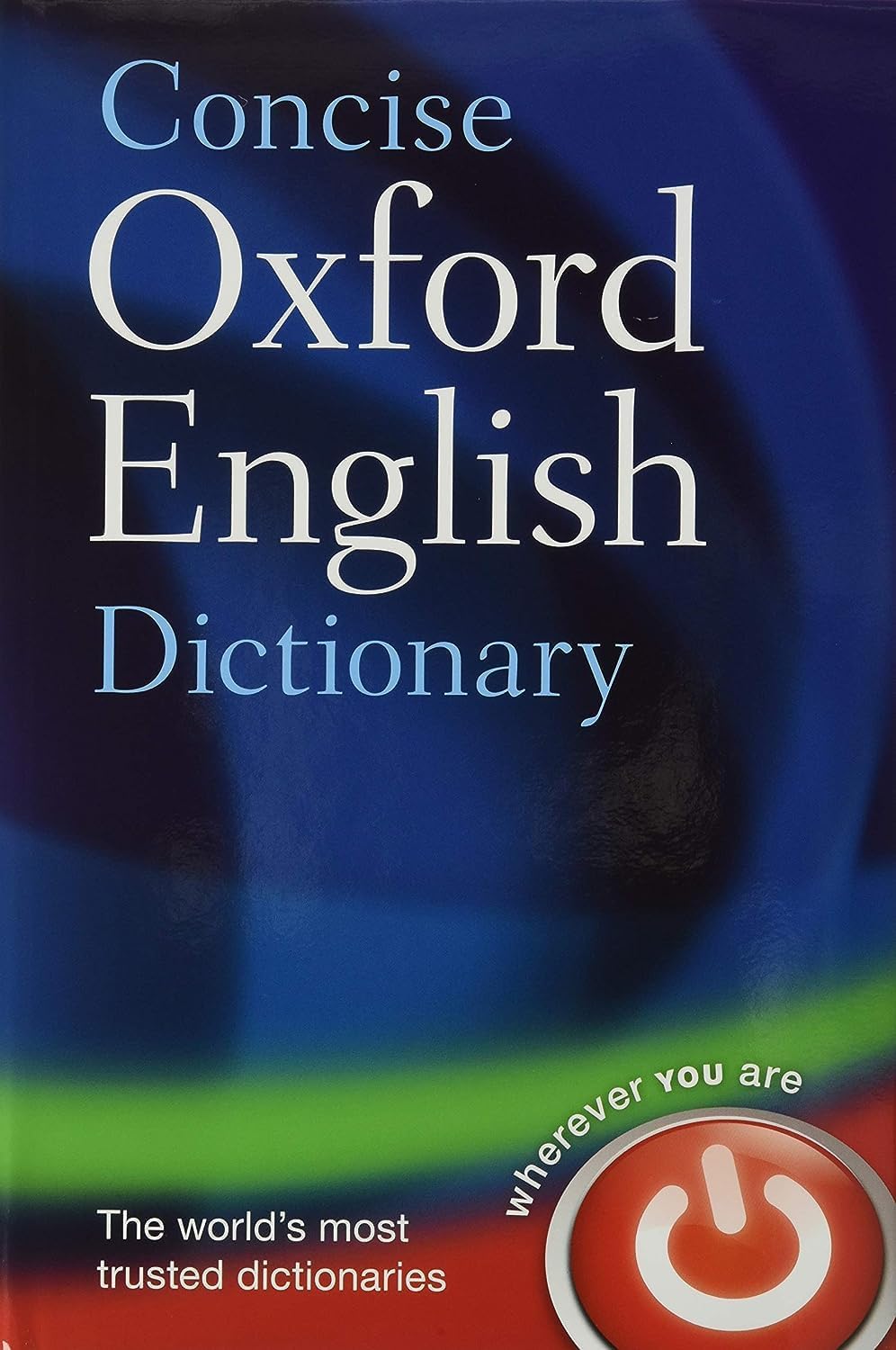

📖 Elevate your vocabulary game with the ultimate modern classic!
The Concise Oxford English Dictionary: Main edition is a highly rated, portable hardcover dictionary featuring over 1,500 pages. It offers modern English coverage including proper nouns, phrases, and abbreviations, plus detailed spelling variants between British and American English. Its improved layout enhances readability without increasing size, making it an essential tool for professionals seeking precise, reliable language reference beyond basic digital definitions.
| Best Sellers Rank | #123,269 in Books ( See Top 100 in Books ) #25 in Dictionaries (Books) #55 in English Dictionaries & Thesauruses |
| Customer Reviews | 4.7 out of 5 stars 1,650 Reviews |
D**T
Excellent purchase, will buy UPDATED VERSION. I JUST WROTE AN EDIT WITH IMPORTANT INFO!!
EDIT: I HAVE PURCHASED THE MOST RECENT DICTIONARY. THERE ARE CLEAR IMPROVEMENTS UPON CLOSE INSPECTION. 1.THE LAYOUT IS VASTLY IMPROVED..2. MY OLD ONE SEEMS DENSLY POPULATED WITH WORDS, BUT THIS EDITION IS EASIER TO READ BECAUSE THE WHOLE PRESENTATION IS DIFFERENT, AS THE SPACING AND GROUPING IS SPACED OUT BETTER.3. THERE IS ADDED INFORMATION IN THE REFERENCE SECTION AND IT INCLUDES MORE INFORMATION THAN MY OTHER EDITION. IT INCLUDES WEIGHTS AND MEASURES FOR EXAMPLE.4. EVEN WITH THE NEW SPACING AND ADDED INFORMATION M ITS NEARLY THE SAME SIZE AS ITS PREDECESSOR. 5. This entire dictionary has been WELL THOUGHT OUT, THE EXTRA SPACING IS A BLESSING, AND THIS EDITION TRUMPS ALL PREVIOUS ONES. A+++++++++ I bought this dictionary in 2015. I love that it’s concise and very portable. I still like to have a dictionary handy because using your phone for definitions/synonyms/ antonyms isn’t always the best. A good dictionary is thorough and I prefer it to basic definitions you get on your phone. I should probably update my dictionary since I’ve had it for 10 years and will make that very necessary, for me, purchase. Oxford’s dictionary comes highly rated, and I highly rate and recommend it for your knowledge’s sake. I highly recommend this item to have in your home because not everything is as well thought out as the Oxford English Dictionary. You won’t regret this purchase! A++++
A**N
The right size dictionary for daily spelling and meaning look-up.
This is a light, compact, well-bound hard-back dictionary for daily use, for checking both spelling and meaning. It very usefully includes proper nouns, which the Oxford dictionaries 50 years ago refused to do. So this is more like a modern "encyclopedic" style of dictionary. This is important because most of the words which I don't understand are proper nouns. However, I should mention that the vast numbers of proper nouns in classical literature are not here. It doesn't define "Peloponnesian", "Solon" or "Uruk" for example. So it's definitely a dictionary for the modern world. This dictionary also includes common phrases and abbreviations as main headings, which once again were forbidden in the old-style Oxford dictionaries. Consequently, this is the ideal dictionary for daily use, to make sense of printed literature and Internet English, and it is ideal for daily writing also. I find that I only rarely have to consult the larger dictionaries for further detail. There are two main things which this compact dictionary does not deliver. One is detailed etymologies, and the other is detailed archaic meanings of words. The etymologies in this " Concise Oxford English Dictionary: Main edition " are a bit light, thin and sketchy, but they do at least tell you which language group a word originates from. Etymology adds depth of meaning to words. Larger dictionaries are required for obtaining serious etymologies to get some real depth of meaning. The archaic meanings of words are not covered very much in this dictionary. So it is not so suitable for understanding literature before the 19th century. For that, once again, you do need the larger dictionaries. The main strength of this dictionary, in my opinion, is its coverage of spelling, particularly the morphological variants of words such as the conjugation of verbs and plurals of nouns, and especially the differences between British and American spelling. Noah Webster decided in about 1828 to very intentionally make American spelling diverge from British spelling, partly for commercial reasons because of the huge appetite of Americans to "improve themselves" by importing costly British dictionaries and grammar books. (This background is explained in " Stories of English " by David Crystal, pages 419-434, and " Collins Dictionary of the English Language ", pages xxiii-xxiv.) This Concise Oxford English dictionary allows me to safely navigate the numerous cross-Atlantic and other spelling variations so that I can keep a consistent style. This makes word-search in documents easier, for example.
D**G
Improved Reference Section
The paper quality of this 2011 centenary 12th edition is better than the 2008 predecessor. It is whiter and the print reads well, so it is comfortable to the eye. The paper is also tougher. The layout of the 10th edition is superior and better spaced, and one can hope future editions can revert to more generous spacing and previous typeface. All three editions mentioned above weigh exactly the same, have similar number of pages but the 2011 edition is about 1 cm thinner, 5.5 cm. This makes it so much easier to grasp, hold and handle. Aesthetically sleeker, it is also harder to drop during usage. Nearly the entire reference section has changed to include useful information, and has welcome additions such as *Lists of Prime Ministers and Presidents of the major countries of the world; *UK Kings and Queens and years of their reign; States of the USA with their capitals; *Weights measures and notations; *The Greek alphabet; *The solar system and the major moons; *The chemical elements, although a classical Periodic Table chart would have been useful. The countries of the world have been put back, along with the attendant capitals, areas, current populations and currency units. The one page list of collective nouns (e.g. "a drunkship of cobblers", a "golzing of taverners", "a covey of ptarmigan",) has been retained. This thin reference section of only 14 pages is located between the letters J and K. The centre section of the 2008 edition contained a few pages of very useful "Foreign Words and Phrases". I would like to see all commonly used Foreign Words and Phrases, incorporated into the main body of the dictionary. Single foreign words, like zeitgeist, schadenfreude (now in lower case), cognoscenti, have largely been incorporated into the body of the 2011 edition, so have phrases like "sui generis" and "raison d'etre". But the absence of commonly encountered phrases such as "ex gratia" and "a capella" is really regrettable. If you need a comprehensive dictionary with 75,000 root words instead of the usual 25,000, you would expect a large number of foreign phrases to pop up regularly in your reading material. Syndicated newspaper columnists are prone to spice up their articles with obscure foreign phrases, which they can legitimately use, if these pompous foreign phrases are consonant with the theme of their articles. I would like to have a dictionary deal with such "foreign phrase" contingencies. The 2008 edition had an interesting centre middle section, which included: *English Uncovered: telling us how Oxford tracks the English language, with interesting information like the 100 most commonly used words ("the" tops the list), words with the most meanings ("set" has 156), and how English is changing. One reading of this essay is enough, and should not be repeated with every edition. *Fascinating words, some of which like "rhinoplasty" have been incorporated into the dictionary as they have ceased to be fascinating. *Guide to Good English: does not belong to a dictionary: nobody buys a dictionary to learn Grammar. These sections have rightfully been removed. The 2011 edition has fewer word usage bubbles, where a tinted bubble explains how words are used. It draws the attention of the user to the differences between "discreet" and "discrete", for instances. For a dictionary, which has to catch up with increasing number of words in actual use, such amplifications on English usage wastes valuable space. This dictionary is clearly not for learners of English. There is the Advanced Learner's English Dictionary by Oxford for this purpose. These "word usage" bubbles look so much like cut and paste jobs from "Fowler's Modern English Usage", a copy of which can be purchased separately. Previous editions did not have these superfluous bubbles, and this experiment in the recent editions must now be considered a failure. The sheer large number of entries in this "Concise" dictionary suggests that this dictionary is for those way, way, way, way, way past the beginner's learning stage of English. With this dictionary, it is hard to hit a dead end searching for a word, even at college level and when reading some exotic "intellectual" essays. The 2011 edition has a one-off 9-page essay on the evolution of the Concise Oxford over 100 years. These 9 celebratory pages will not be relevant in future editions. There are interesting bubbles throughout the dictionary on how the word was defined in the first 1911 edition versus its current 2011 usage. These bubbles would only be relevant in a centenary edition. The space saved would be applied to an ever-expanding vocabulary, and also other important reference material. Your table-top dictionary should have: A. All the words you are likely to encounter in the course of your reading; AND B. Important reference material and tables which I need to refer to occasionally, such as: a. table of military ranks in major armed forces, and service arms b. signs of the Zodiac c. Chinese Zodiac d. Wedding Anniversaries and corresponding materials e. Birthstones f. Counties of the UK g. Books of the Bible h. Braille, i. Morse Code (which I may need in an emergency) j. NATO alphabetical pronouncing code k. Roman numerals l. A political map of the world (this is getting important as events are happening in places most people have never heard of). m. Fibonacci numbers, fractions and corresponding decimals, for those who dabble in the stock market. All the above can easily be accommodated by the 9 pages saved in future non-centenary editions. Incidentally, a table of symbols is hidden on page xxix, in the rather prolix introduction to the dictionary. I welcome the return of the conversion tables. Next time, do not convert 1 square metre or 1 acre to archaic square yards. For real estate use today, the conversion is to square feet. Valuation is done in price per square foot, although your mortgagee bank manager thinks in square metres. A conversion of ounces into grammes is getting very important in a world where gold trading is getting prominent. A conversion of feet and inches into metric is important. When my architect tells me that the kitchen stove is 600 mm height, or that somebody is 1.82 metres tall, I would like to know what it is in old fashioned feet and inches. My BMI is calculated in metric height and weight, not stones, lbs and feet and inches. Oxford needs to thoroughly update its conversion tables to bring it in line with modern usage. The dictionary is made in the UK. The binding is slightly better than previous editions, but the hinges of the hard covers are still atrocious. Oxford has probably sized up the users of this dictionary as people who handle books gently. If a new version comes out every few years, cost is a more important consideration than the toughness of the volume. The physical book is easily the shoddiest dictionary I have ever bought. Politically correct buyers can take some comfort that the manufacture of the book was not outsourced. But for the content, this dictionary is a bargain for its price and really has no peer in its class.
L**N
and I love it, but the CONCISE is accessible and always ...
I own the 20 volume OED, Second Edition (Print), and I love it, but the CONCISE is accessible and always helpful. I keep the OED in my study and the CONCISE by my reading chair. I love it because of the rich history of the OED (The Professor and the Madman: A Tale of Murder, Insanity, and the Making of The Oxford English Dictionary -- a wonderfully delicious book also).
M**.
Great Handy Dictionary in CD-Rom format
This is one of my basic tools for work, use it on a daily basis, I am very found of it, especially being in digital format. The CD Room is great. It is easy to install, runs smoothly, requires little Ram memory and opens and closes at a good speed. I love the choice between standard display (mostly black and white) and the high-contrast one (dark background, coloured text) which is perfect for people with poor sight, and the increase/decrease font size buttons. You can bookmark your favourite entries, listen to the pronunciation of the main words, and copy and/or print the text of any entry. The Concise is very handy.The entries are basic but clear, right to the point, the phonetic transliteration uses the International system, as well as the etymology (origin) of the word and a list of derivative words. This is not basic dictionary, is concise, and sometimes I am happy to find specialised word, or not much in use, or words that have specific meanings when used in legal or religious contexts. This is really helpful. My main disappointment with this product relies on the fact that, although we expect a concise dictionary to be concise we also expect something a bit more elaborate and detailed. For example, the derivative words are not in separate entries, the entries do not have any example of contextualised use of the words or derivatives (unless the use is problematic per se), and there is not phonetic transliteration or pronunciation of the derivatives. All of this are shortcomings to me. With so many online free dictionaries online, some of the Oxford's included, one expects those for sale to supersede the online ones regarding the information and details they provide. Unfortunately, the Concise Oxford on CD-Rom falls a bit short. It is not that is bad, it is that it could be much better. Yet, a great dictionary. Mind The reference section is available in a PDF format file, and it can be found by pressing the "help & other documents" button.
M**A
My Go-to Dictionary
This has become my go-to dictionary. Sturdy. Has all the words I have needed to look up. I like comparing the British English to American. It includes the various forms of a word and its derivitives which is useful. Print is easy to read. Big enough, yet not too heavy to use at my desk on a daily basis. Glad I bought it.
A**O
Look it up!
My husband has always wanted the EOD but each time I tried to find one it was too pricey or software when he wants a book. I found this and the American Oxford on Amazon & surprised him with them. He loves them! It's fun comparing the 2 and he enjoys learning the origins of words. Although his Dad is long gone he still hears him say "Look it up" and he so now he does. It isn't too big to have under the coffee table & pull out quickly for any reference. He also enjoys just sitting and reading through it, there is a lot of history in words.
G**S
This is the Best Dictionary
I own a number of hardcover dictionaries and this is my go to dictionary. The main words are printed in dark print and the definitions are large enough to see. Unlike a couple of other dictionaries I own, this one is not to large to handle. Every word I've looked up has been in this dictionary. Unless you need a dictionary for rare, exotic words this is the dictionary to own.
Trustpilot
2 months ago
1 day ago