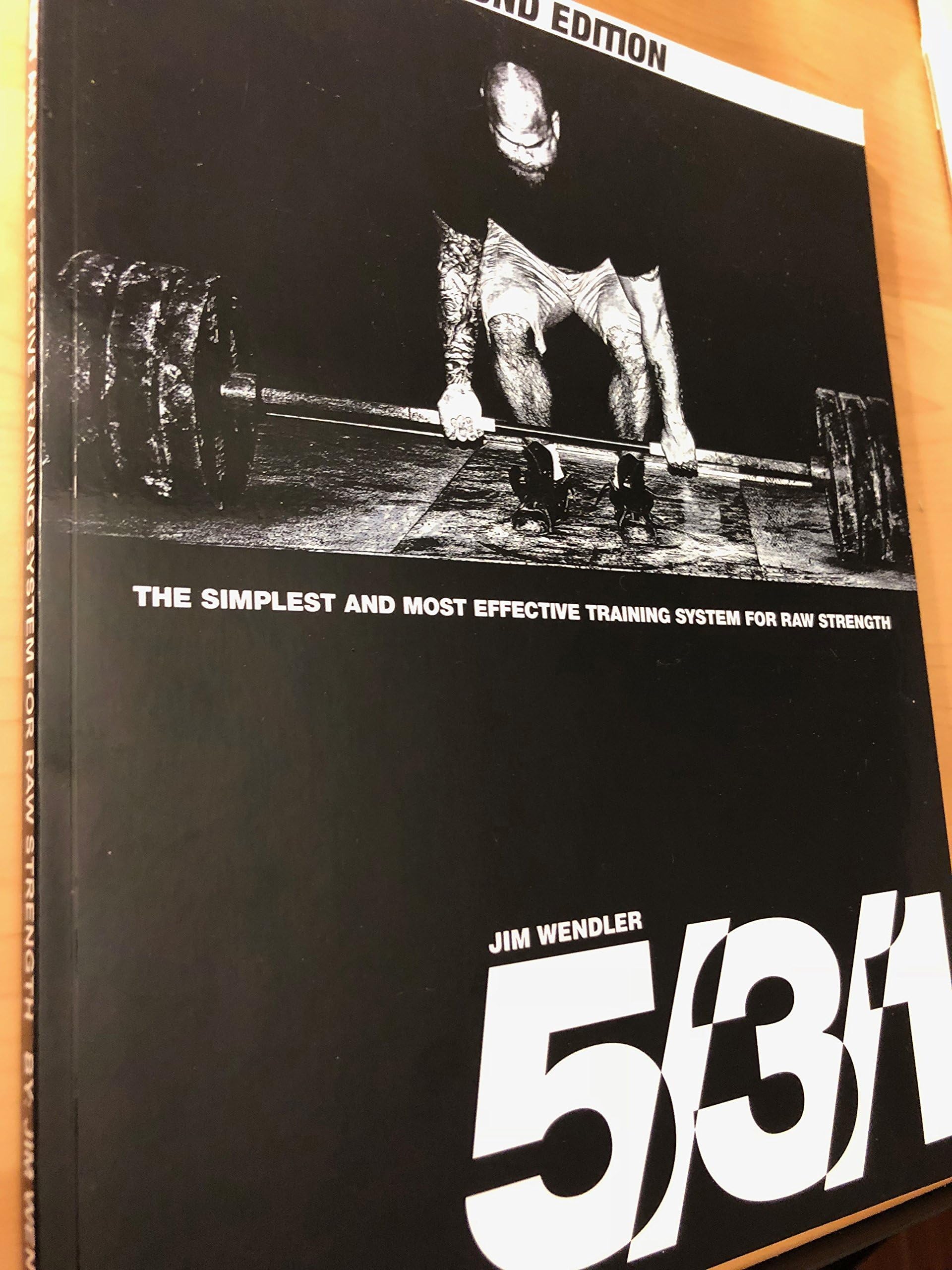
5/3/1: The Simplest and Most Effective Training System for Raw Strength (2nd Edition)
Product ID: 39877576
Desertcart purchases this item on your behalf and handles shipping, customs, and support to Australia.
5/3/1: The Simplest and Most Effective Training System for Raw Strength, 2nd Edition The success of the 5/3/1 Method has been nothing short of extraordinary. For the 3 years, the response towards this simple but brutally effective training system has been overwhelming. This is because it works. And works for just about anyone willing to put in the discipline and work that getting stronger requires Elite level lifters to absolute beginners have all used the 5/3/1 Method; the basic tenets of strength training have and will never change. Big exercises, constant progress, and personal records will never go out of style. High school and college coaches are now using the 5/3/1 with their athletes with amazing success; it is easy to track, implement and will inspire any team to push for themselves to the limit. The 5/3/1 Method is truly for anyone that is looking to get stronger. This is not a fancy training program that requires special equipment or Master's degree - all is required is your dedication to moving more weight than you had ever dreamed. The 5/3/1 2nd Edition features new chapters on programming assistance training for all the big assistance lifts. No more questions on what weights to do and what exercises to choose from. Full body training to increase your squatting and overall strength. Simple and effective ways to eat for size and strength are revealed. Jim also covers how to combine 5/3/1 and Crossfit-style conditioning for maximum benefits and recovery. Finally, rest/pause training for assistance work for building size and strength is programmed for maximum benefit. 136 pages Review: A good program to run if you're a beat up powerlifter - I've been lifting for a while now and, while I'm not exactly a terror under the bar, I've tried a lot of different programs-- Starting Strength, a bunch of 5x5 variations, Texas Method, one lift per day variations, top set/backoff set routines... like I said, a lot. In the past I've had good luck with high volume programs, but they leave me feeling beat up. Now that I'm getting (have already gotten?) older, I just can't handle as much volume as I used to, and when I run something like 5x5, I need to be watchful of accumulated fatigue. When progress grinds to a halt, I need to reduce volume. 5/3/1 is great for this. You can set it up in many different ways, but I use the basic framework when I'm feeling burnt out. The program is super-adaptable and really comes into its own when the reader has a bit of training experience. Yes, a complete novice can follow this program and get quite a bit stronger, but it requires a bit more guidance than something like Starting Strength's novice linear progression (NLP). If you're a rank novice, Starting Strength and 5/3/1 can get you started and keep you going for a long time. If you're a little more advanced, 5/3/1 is worth reading and incorporating into your training. You certainly won't outgrow it-- Jim Wendler is an elite powerlifter and he developed the program for his own use, so it's safe to say it works for even very advanced athletes. This belongs in every strength trainee's library. Read it, digest the information, try it. Review: Worthwhile long term plan - I love buying fitness books; I'm not an expert, never will be (I think I missed my true calling), but I was an overweight guy who lost 60+ pounds about ten years ago by following the programs in the magazines and the internet. I did succeed, but that was more dumb luck than knowledge. After about 18 months to 2 years, I stalled, and I didn't change my physique at all. At 190 pounds, I was weak. I could crank out some pushups, tons of situps, yes, but my first attempt with a real barbell in 2005 was a humbling attempt to bench 125 lbs. From them until 2012, well, I played with medicine balls, dumbbells, chinups, etc. in a sort of haphazard fashion. This second edition has more programming options than the first edition. The first edition, however, has everything you need. The second edition addresses our (meaning us men) for many different options so that we can put our own personal stamp on our training program. I have a whole bookcase of stuff--yes, many of them were cheaper, but only a few (Rippetoe, Dan John) are worth as much as Wendler's 5/3/1. If you love working out and love having a precise plan, Wendler's program is for you. If you would rather "wing-it," and work chest and biceps whenever you feel like it for whatever weight feels "right" until "failure," this book is not for you. Read on if curious; if not, you have my go-ahead to spend your hard-earned money. It is short and sweet: no science or explanations or sales-pitches, just the plan. My only negative remark for Jim: for $25 bucks for each black and white book, hire a proofreader who will ensure your product is professional (some formatting and punctuation issues/typos). The programming in 5/3/1 is not revolutionary; this is not an insult, I've read enough of Wendler's internet articles/posts to tell you that he would agree. What is a revolutionary is the way you determine your poundage. Many workouts tell you to use a "weight that you can lift for X reps." Not here, every lift is planned based on a percentage of your working load (which is 10% less than your 1 rep max). You rotate through four workouts (there are other variations), with each workout focusing on a primary lift to build pure strength: squat, deadlift, bench, and press (overhead). On each lift, you follow a predetermined template; for example, during week one, assuming your press 1RM is 117 lbs, you take 10% less, 105 lbs. You warmup with 40% for 5 reps, 50% for 5 reps, and 60% for 3 reps. Then, it's 5 reps at 65% (70 lbs) and 75% (80 lbs). Now, the fun part: your final set is 5 or more at 85% (90 lbs). By the time you go to week 3, you are going for one or more reps at 95% (100 lbs in our example). Week 4 is a deload: no heavy lifting, no breaking goals or going for as many reps as possible. Then, you start a second round, but you add 5 or 10 lbs to your working load and do it all again. Yes, you have to do some math. I created a spreadsheet, complete with the 1RM calculations, to calculate the prescribed weights for up to a 10 month period (or until you reset). I'm sure a quick Google search will help you find a template. In order to compare "rep maxes," Wendler recommends a formula to calculate your 1RM (the Epley formula), which gives a fair estimate of your 1RM based on your weight and load. In my experience, lifting a "load that feels right" offers very little progress; you need to push past your comfort zone. It might sound simple, but following a predetermined chart removes the guesswork and forces you to "try" to lift a weight that you might not have tried until you were "sure you could lift it." Well, follow the program, and the pounds just keep going up--slow and steady. After the primary lift on each day, you follow up with assistance exercises for mass building (the "sets of 10" you are accustomed to). Dumbbell stuff, chins, rows, lunges-all stuff to keep you well rounded and offer variety for those (like me) with a serious case of exercise ADD. Also, in contrast to many experts who want to build muscle and maximal strength--Wendler recommends "conditioning," hill sprints or similar hard activity to condition your body. I agree that conditioning should be a part of every well-rounded program. Human beings should be strong AND able to move (or walk a flight of steps). Don't skip the "deload" week. I did--it felt too easy to follow a week of easy lifting. I paid for it. I never thought I could be "over-trained"; after all, I'm not an athlete, I'm a father with a job and a hobby that involves lifting my cheap barbell set in my cold garage. Anyway, I followed 5 evolutions (my own term) without de-loading. By the 6th cycle, my whole body hurt, and I was completely unable to beat my PRs (personal records). I was sore, my joints hurt, etc. I was too greedy. I needed to reset the weights back a few cycles and lift twice in 10 day period before things felt right again. Then, I started my second "season" (again, my own term) of 5/3/1. As you can probably tell, I like writing reviews. So, you're probably wondering about my personal experience. Well, I have no intentions of competing (power lifting or bodybuilding), but I sure love competing against the barbell. My lifts have steadily increased over the six months or so that I have followed 5/3/1. My bench max is finally over my body-weight--all because I decided to keep "trying" at the heavier weights instead of just cranking out 'sets of ten.' Also, I am convinced that my improvements came because I made steady, slow progress and because of the periodized workouts (each week a slightly different rep/weight focus). Speaking of body-weight, I'm up to the 224 mark from a low of 188 (in 2005 after losing a bunch). That s six or eight inches on the pants, depending on which country manufactured my garments. I believe that most of my gains came on 5/3/1 during 2012. No complaints, other than some of my jeans just don't fit (the thighs are too tight to be comfortable), and my dress shirts and suit coats are noticeably tight. I had been wearing these clothes for years. I don't measure myself, and it's always hard to tell looking at yourself in the mirror, but the clothing tells the story. The last suit I bought was 2" larger in the chest and an "athletic" cut; the smaller coats are almost uncomfortable and certainly restrictive. I finished with a full "season" of 5/3/1, then messed around with some other stuff for about 3 weeks. I finally decided to go back to 5/3/1, and, sure enough, I felt a "good" soreness/DOMS again and, after only two workouts, realized that I was absolutely starving during the workday. No, not scientific, but it is something to think about. I do my conditioning on lower-body days with limited assistance work. For example, I do some deadlifts (I limit to 10 reps, since I beat myself up with these, which might be because I'm 6'4" and/or because I could use some coaching) and some squats (for reps) followed by conditioning. I work hard: sprints, high-effort jumping rope, box jumpers, heavy-bag work, or some combination of these. I generally stick with the Boring but Big template with the "3-month challenge" twist. (Check out T-nation article for more details). Basically, I bench 5/3/1 style then press for 5 sets of 10 reps. Oh, and I grease-the-groove (Pavel's term) by doing 8 sets of chins/pullups between each set on the upper body days. I vary the assistance work occasionally but not often. I like consistency, which allows me to gauge my progress. I also like the split--one upper body day, one lower body day (alternating), up to four times per week (three is okay two; other templates are suggested for two days per week). This way, I can workout two days in a row or every-other-day to accommodate my unpredictable work schedule. I like "full-body training," but I feel like (in my thirties), I just don't "recover" fast enough to do three full-body days each week. As far as Wendler's writing style, you will enjoy his "honest" writing style. There is no pretension in his writing, just straightforward advice and a plan. I hope my fellow desertcart shoppers found this review to be helpful!
| Best Sellers Rank | #42,633 in Books ( See Top 100 in Books ) #449 in Exercise & Fitness (Books) |
| Customer Reviews | 4.6 out of 5 stars 2,956 Reviews |
Z**L
A good program to run if you're a beat up powerlifter
I've been lifting for a while now and, while I'm not exactly a terror under the bar, I've tried a lot of different programs-- Starting Strength, a bunch of 5x5 variations, Texas Method, one lift per day variations, top set/backoff set routines... like I said, a lot. In the past I've had good luck with high volume programs, but they leave me feeling beat up. Now that I'm getting (have already gotten?) older, I just can't handle as much volume as I used to, and when I run something like 5x5, I need to be watchful of accumulated fatigue. When progress grinds to a halt, I need to reduce volume. 5/3/1 is great for this. You can set it up in many different ways, but I use the basic framework when I'm feeling burnt out. The program is super-adaptable and really comes into its own when the reader has a bit of training experience. Yes, a complete novice can follow this program and get quite a bit stronger, but it requires a bit more guidance than something like Starting Strength's novice linear progression (NLP). If you're a rank novice, Starting Strength and 5/3/1 can get you started and keep you going for a long time. If you're a little more advanced, 5/3/1 is worth reading and incorporating into your training. You certainly won't outgrow it-- Jim Wendler is an elite powerlifter and he developed the program for his own use, so it's safe to say it works for even very advanced athletes. This belongs in every strength trainee's library. Read it, digest the information, try it.
J**A
Worthwhile long term plan
I love buying fitness books; I'm not an expert, never will be (I think I missed my true calling), but I was an overweight guy who lost 60+ pounds about ten years ago by following the programs in the magazines and the internet. I did succeed, but that was more dumb luck than knowledge. After about 18 months to 2 years, I stalled, and I didn't change my physique at all. At 190 pounds, I was weak. I could crank out some pushups, tons of situps, yes, but my first attempt with a real barbell in 2005 was a humbling attempt to bench 125 lbs. From them until 2012, well, I played with medicine balls, dumbbells, chinups, etc. in a sort of haphazard fashion. This second edition has more programming options than the first edition. The first edition, however, has everything you need. The second edition addresses our (meaning us men) for many different options so that we can put our own personal stamp on our training program. I have a whole bookcase of stuff--yes, many of them were cheaper, but only a few (Rippetoe, Dan John) are worth as much as Wendler's 5/3/1. If you love working out and love having a precise plan, Wendler's program is for you. If you would rather "wing-it," and work chest and biceps whenever you feel like it for whatever weight feels "right" until "failure," this book is not for you. Read on if curious; if not, you have my go-ahead to spend your hard-earned money. It is short and sweet: no science or explanations or sales-pitches, just the plan. My only negative remark for Jim: for $25 bucks for each black and white book, hire a proofreader who will ensure your product is professional (some formatting and punctuation issues/typos). The programming in 5/3/1 is not revolutionary; this is not an insult, I've read enough of Wendler's internet articles/posts to tell you that he would agree. What is a revolutionary is the way you determine your poundage. Many workouts tell you to use a "weight that you can lift for X reps." Not here, every lift is planned based on a percentage of your working load (which is 10% less than your 1 rep max). You rotate through four workouts (there are other variations), with each workout focusing on a primary lift to build pure strength: squat, deadlift, bench, and press (overhead). On each lift, you follow a predetermined template; for example, during week one, assuming your press 1RM is 117 lbs, you take 10% less, 105 lbs. You warmup with 40% for 5 reps, 50% for 5 reps, and 60% for 3 reps. Then, it's 5 reps at 65% (70 lbs) and 75% (80 lbs). Now, the fun part: your final set is 5 or more at 85% (90 lbs). By the time you go to week 3, you are going for one or more reps at 95% (100 lbs in our example). Week 4 is a deload: no heavy lifting, no breaking goals or going for as many reps as possible. Then, you start a second round, but you add 5 or 10 lbs to your working load and do it all again. Yes, you have to do some math. I created a spreadsheet, complete with the 1RM calculations, to calculate the prescribed weights for up to a 10 month period (or until you reset). I'm sure a quick Google search will help you find a template. In order to compare "rep maxes," Wendler recommends a formula to calculate your 1RM (the Epley formula), which gives a fair estimate of your 1RM based on your weight and load. In my experience, lifting a "load that feels right" offers very little progress; you need to push past your comfort zone. It might sound simple, but following a predetermined chart removes the guesswork and forces you to "try" to lift a weight that you might not have tried until you were "sure you could lift it." Well, follow the program, and the pounds just keep going up--slow and steady. After the primary lift on each day, you follow up with assistance exercises for mass building (the "sets of 10" you are accustomed to). Dumbbell stuff, chins, rows, lunges-all stuff to keep you well rounded and offer variety for those (like me) with a serious case of exercise ADD. Also, in contrast to many experts who want to build muscle and maximal strength--Wendler recommends "conditioning," hill sprints or similar hard activity to condition your body. I agree that conditioning should be a part of every well-rounded program. Human beings should be strong AND able to move (or walk a flight of steps). Don't skip the "deload" week. I did--it felt too easy to follow a week of easy lifting. I paid for it. I never thought I could be "over-trained"; after all, I'm not an athlete, I'm a father with a job and a hobby that involves lifting my cheap barbell set in my cold garage. Anyway, I followed 5 evolutions (my own term) without de-loading. By the 6th cycle, my whole body hurt, and I was completely unable to beat my PRs (personal records). I was sore, my joints hurt, etc. I was too greedy. I needed to reset the weights back a few cycles and lift twice in 10 day period before things felt right again. Then, I started my second "season" (again, my own term) of 5/3/1. As you can probably tell, I like writing reviews. So, you're probably wondering about my personal experience. Well, I have no intentions of competing (power lifting or bodybuilding), but I sure love competing against the barbell. My lifts have steadily increased over the six months or so that I have followed 5/3/1. My bench max is finally over my body-weight--all because I decided to keep "trying" at the heavier weights instead of just cranking out 'sets of ten.' Also, I am convinced that my improvements came because I made steady, slow progress and because of the periodized workouts (each week a slightly different rep/weight focus). Speaking of body-weight, I'm up to the 224 mark from a low of 188 (in 2005 after losing a bunch). That s six or eight inches on the pants, depending on which country manufactured my garments. I believe that most of my gains came on 5/3/1 during 2012. No complaints, other than some of my jeans just don't fit (the thighs are too tight to be comfortable), and my dress shirts and suit coats are noticeably tight. I had been wearing these clothes for years. I don't measure myself, and it's always hard to tell looking at yourself in the mirror, but the clothing tells the story. The last suit I bought was 2" larger in the chest and an "athletic" cut; the smaller coats are almost uncomfortable and certainly restrictive. I finished with a full "season" of 5/3/1, then messed around with some other stuff for about 3 weeks. I finally decided to go back to 5/3/1, and, sure enough, I felt a "good" soreness/DOMS again and, after only two workouts, realized that I was absolutely starving during the workday. No, not scientific, but it is something to think about. I do my conditioning on lower-body days with limited assistance work. For example, I do some deadlifts (I limit to 10 reps, since I beat myself up with these, which might be because I'm 6'4" and/or because I could use some coaching) and some squats (for reps) followed by conditioning. I work hard: sprints, high-effort jumping rope, box jumpers, heavy-bag work, or some combination of these. I generally stick with the Boring but Big template with the "3-month challenge" twist. (Check out T-nation article for more details). Basically, I bench 5/3/1 style then press for 5 sets of 10 reps. Oh, and I grease-the-groove (Pavel's term) by doing 8 sets of chins/pullups between each set on the upper body days. I vary the assistance work occasionally but not often. I like consistency, which allows me to gauge my progress. I also like the split--one upper body day, one lower body day (alternating), up to four times per week (three is okay two; other templates are suggested for two days per week). This way, I can workout two days in a row or every-other-day to accommodate my unpredictable work schedule. I like "full-body training," but I feel like (in my thirties), I just don't "recover" fast enough to do three full-body days each week. As far as Wendler's writing style, you will enjoy his "honest" writing style. There is no pretension in his writing, just straightforward advice and a plan. I hope my fellow Amazon shoppers found this review to be helpful!
L**E
5/3/1 is a great Powerlifting program, with one caveat
Simple AND effective as the title says. Strength is put down a lot in our society these days. It's not a respected value or characteristic. In popular media, it's made fun of or spun in a negative and dangerous light. For some, strength is a guiding light. I'm happy to see more people and men in particular realize the place strength should occupy in their lives. To be "strong" is a human trait. Universal through time and all cultures. Although it's better if you are an intermediate or advanced lifter, beginners will find this a very helpful program and book to follow for a few months. I personally like this much better than Stronglifts or Starting Strength. The one problem I have with "5/3/1" is the insistence that you MUSt do these Big Lifts to be considered strong. I disagree, mostly, and believe it's best to use all rep ranges, and exercises including machines (gasp!) to become bigger and stronger. Don't take 5/3/1 as the end all be all, like many do with Starting Strength, and instead use it as one of many programs on your journey to becoming bigger and badder.
J**Y
Solid Program
I have been lifting for almost 20 years, and have tried many different approaches. While I don't claim to have impressive strength, I am usually pretty far ahead of most people in commercial gyms. Even with numerous injuries--acute and chronic--over the years of playing sports and training hard, I have no thoughts of giving up my strength and physique pursuits. But there comes a time when just beating yourself to death every workout is not an option anymore. After listening to some interviews with Jim and following his work at EliteFTS for a while, 5/3/1 sounded like a reasonable approach to generate continued strength and conditioning gains. After the first month, I am very pleased with the program. It is straightforward, and the structure makes sense. The 5/3/1 system has already helped my strength in the overhead press, which seems to require more diligence, patience, and dedicated practice than most other lifts. If you're a young or novice lifter, 5/3/1 may seem boring because it doesn't have you doing marathon puke sessions, the hallmark of the early weight room years. You won't be testing your manhood or your pain threshold six days per week. You'll just be making steady gains over time. You have to take the long view to fully appreciate this program. It is a professional approach--the working man's program. It is not for the frat boy who thinks he's going to get in shape the week before spring break. But intelligent lifters willing to use reason and set aside emotion will be happy with the results. The book itself is easy to read, and gives simple explanations of the system and lifting technique. There is some crude language (What do you expect? This is Wendler, after all), so be warned if you're sensitive about that kind of thing. I definitely recommend this book for anyone looking for a solid, well designed program, or just interested in expanding his knowledge of various training systems.
L**H
Best workout book you never knew you needed
I just wanted to say how amazing and helpful this book has been for me for the last couple of years. When I first started lifting I was not eating any carbs and doing absolutely too many exercises. Sure I was cut and slim but I was no strong. I was stuck on a plateau for two years straight with my bench press max at 225, squats at 375, and deadlift at 405. I had began looking around as to why I was getting stuck when I had arrived in Afghanistan I began doing heavy research. I still had not found this yet but I had 1 website that was pretty much letting me know I was not eating enough and I was doing too man sets for those specific muscles groups. It was a very rough and unorganized workout plan that still got me 50 pounds of muscle. Anyways.... I had discovered this book about 2 years ago and my gains literally go through the roof every time I hop on these cycles. It is crazy how well the body responds to this. I had put my wife on this program and by the second month her maxes were: Bench - 165, Squat - 245, Deadlift - 250, Press - 115 She had lost her muffin top along with all the flab on her arms she wanted to get rid of. She was able to do push ups, pull ups, handstand push ups, and dips on her own right around that same time frame. It was extremely easy to get her motivated because she gained strength every single week which was very motivating. As for me I'm 5'6 165 pounds when I'm not training. I have been on this program for the last month and half. My bench press is already up from 315 to 350. My squats are already at 475 coming from 315. My press went from 175 to 235. My deadlifts went from 275 to 405. I failed to mention that I have also gained 20lbs of muscle. Paired with a precise diet you cannot go wrong with this book. He even has diet plans in the book as well. Even what shoes to wear which is the sole reason why I bought my Nike ROMALEOS!!! That has also changed my entire perspective on lifting in running shoes. I think the important part I'm missing here is that I have had no injuries on these rotations. Jim Wendler has successfully defeated overtraining. That last week where you do lower percentages of your max are the best. It is so strange because that week you don't feel as though you trying too hard at all but when you come back that following week some how you've gone up 5-15 pounds in all your lifts. Well it's not some how its that recovery week that lets the deep tissue healing go into effect. I really recommend this book to anyone from beginners to advanced lifters. P.S. There are different versions of this workout to fit all sorts of life styles. I being in the military am pressed for time. Even the time crunching version of the 5/3/1 gave me more than satisfying results. Get this book you will not be disappointed. Oh Its also a short read! Quality over quantity!!
A**R
Zero BS. Refreshing and real.
There is more BS in the fitness and nutrition world than anywhere else in the world - even politics. Whether you're talking to friends, reading a BS post on social media or even being trained by a certified trainer - you're going to be subjected to lies, hearsay and other BS that has zero foundation in reality and absolutely no backing in empirical data or actual research. Then there's Jim Wendler. Possibly the only strength trainer who didn't do a few cycles of steroids, hair removal and tanning before having an expensive photoshoot done in order to sell himself as a fitness guru. All he did was get very strong, put up some huge numbers and train people to also get stronger. Basically, he's a straightforward guy who wants to share with you how to get strong - and nothing else. His volume contains an optimum combination of truth about strength training and explitives. All you have to do is start the program. The first day of each of the four main lifts, you gotta spend a little time to get your 1RM calculated, but that's actually fun if you keep a workout diary of some sort. Mine is just notes on my phone, though I think a small notepad might be a nice way to take away the obvious distractions. I've never felt my body respond to any program like it has to this. With this program, I know what I'm doing in the gym today. I know exactly what I'm doing and what I did last time I was at this day on my last cycle and on the last workout of the current cycle. I know what my goals are, and I can achieve them. I can see growth, and when I'm not sure, there's a way to calculate it and find out. Also, I know I'm not wasting time, and I'm hitting the sweet spot for training. This program's best strength is that it guides you to a system where you are developing strength and muscle mass in the most efficient manner possible. This is important in a world where none of us really have the time. I'm finally growing and evolving again. With a program like this, there's no such thing as a plateau. P.S. For greater hypertrophy, try adding 5 sets of 10 reps at 50% 1RM of your main lift of the day. Let this replace one of your assistance lifts and do it immediately after your main lift of the day. (Jim wrote an article about it in T-Nation.)
T**M
Too many good things to say in one review!
Can't say enough about this book! It's great! Get it, read it, then read it again! If you want to become stronger this s the book for you. It won't happen overnight especially if you've been around weight training for any length of time but it works. I have Beyond 5/3/1 as well. After I started 5/3/1 the incorrect way (i.e. - I went with 100% of 1RM then bumped it up after a round of Gym Records, like an idiot and stalled after 2 months) I went back and did it the right way and did NoV for 6 months. 5/3/1 is EXACTLY what it says it is..."the simplest and most effective training system for raw strength." It's not a power-lifting program, it's not a bodybuilding program, it is a simple and effective program to become stronger. Size is a by product though. And if you are a competitive power lifter this is a great program to do in the off season. Again, I cannot say too many positive things about this book! It’s 7 years later and I still can’t say enough good things about this book. I’ve been a competitive Powerlifter since I was in my early 20’s (early 40’s now) and this is the best off season program one could ask for. I maintain, even add a few pounds, to my three lifts every year. There are so many variations to the basic 5/3/1 model that since I bought this book in 2014 I have never been bored at the gym (even when I’m running ‘boring but big’).
K**N
Great Program, Not So Great Book
I've been doing the 5/3/1 program for a bit now and appreciate how simple yet effective it is. It focuses on complex lifts and lets you make meaningful progress to your goals in less than hour at the gym. The program at its core is just starting lighter than your current max and increases load closer to your max while ending on a set where you do as many reps as possible. Who this is for: An intermediate lifter who already knows how to do all the basic lifts (squat, deadlift, bench, press) and knows what their current maximum is The Good: * The program works * It's easy to learn and pick up within 15 mins * Quick read and you're ready-to-go The Bad: * The writing leaves a lot to be desired. No one is looking for a work of literature but there are several obvious grammatical mistakes and imprecise language * If written in a focused way, the book would be half the length * Many toxic aspects of the book -- casual mentions of suicide, a section dedicated to not being a "vag", uses of the "R" word, etc. Honestly several cringe inducing examples of overly macho culture
F**O
Must Buy per novizi/intermedi nell'allenamento di forza
Quello di Wendler è ormai un classico che va in controtendenza ai consigli del classico personal trainer da palestra commerciale che ti fa fare un giro di tutte le macchine e via. Lettura semplice, da un'accenno ai meccanismi di base per capire il programma e poi spiega in dettaglio i vari template del suo 5/3/1
P**W
Quick, educational read if you want to get strong.
This is a book I'll keep referencing until I'm no longer here. Finally got the ebook version to make it easier to bring along. If you're serious about lifting and getting stronger, reach this book, understand Jim's philosophy and get to work. No excuses!
C**N
Great program
This ends my questions about what I should be doing in the gym. Love how the system will only work if you let ego out of gym. Start light and progress "slowly". Good diet advice and philophies that SJW wil freak about ( north of vag and more).
S**Y
Good band for your buck
Great book. Worth a read. Value for money. Ive only done a month of the program so far... the boring but big.... and people started remarking that i looked bigger! Definitely looking forward to more.
A**A
Not for nvoice
Advance lifter program
Trustpilot
3 weeks ago
2 months ago