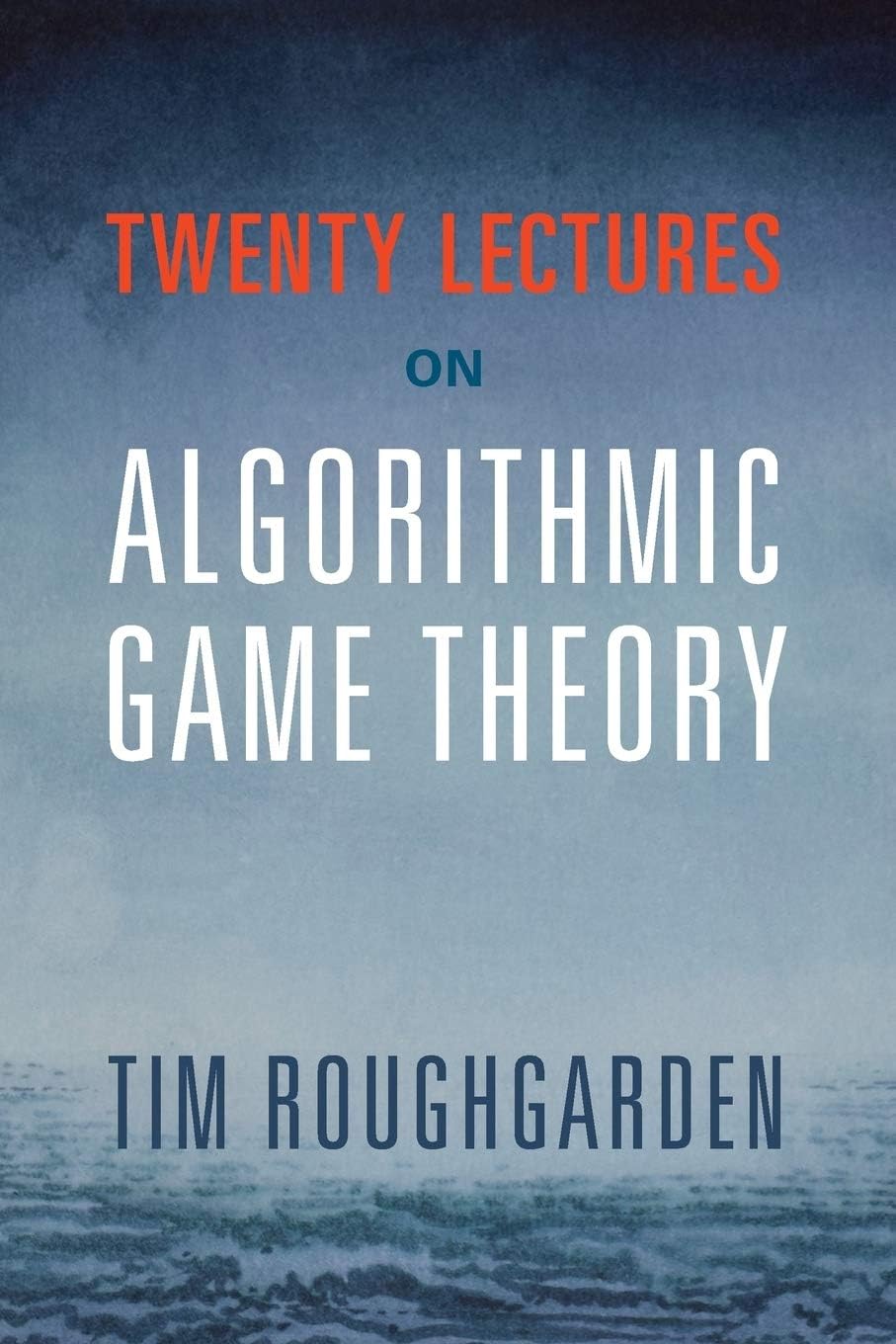
Twenty Lectures on Algorithmic Game Theory
Product ID: 288288134
Buy anything from 5,000+ international stores. One checkout price. No surprise fees. Join 2M+ shoppers on Desertcart.
Desertcart purchases this item on your behalf and handles shipping, customs, and support to Australia.
Buy Twenty Lectures on Algorithmic Game Theory 1 by Roughgarden, Tim (ISBN: 9781316624791) from desertcart's Book Store. Everyday low prices and free delivery on eligible orders. Review: Five Stars - very good and useful Review: Great book, timely delivery.
| Best Sellers Rank | 195,951 in Books ( See Top 100 in Books ) 33 in Mathematical Game Theory 170 in Higher Mathematical Education 1,077 in Computing & Internet Programming |
| Customer reviews | 4.7 4.7 out of 5 stars (30) |
| Dimensions | 15.24 x 2.06 x 22.86 cm |
| Edition | 1st |
| ISBN-10 | 131662479X |
| ISBN-13 | 978-1316624791 |
| Item weight | 508 g |
| Language | English |
| Print length | 356 pages |
| Publication date | 9 Jan. 2016 |
| Publisher | Cambridge University Press |
A**R
Five Stars
very good and useful
S**E
Great book, timely delivery.
S**0
アルゴリズム的ゲーム理論(Algorithmic Game Theory)の研究者である Tim Roughgarden が Stanford で 15年にわたり複数回実施してきた "Algorithmic Game Theory" の講義ノートの書籍版。 現時点で最新(2013年)のPDFは、本人のページからダウンロードできる。読もうかと思っていたところ、いいタイミングで書籍化されたので、勢い買って読んでいるところ。とはいえ、おおむねこのPDF資料と変わらない。差分は、 ・引用文献・索引が巻末にまとまっている。 ・PDF には含まれない Exercise, Problem が含まれている。 ・一部で最新の状況を反映している(2016年の文献もある) 章立てとしては、 ・オークションやマッチングを中心としたメカニズムデザインの基礎(2-10章) ・無秩序の代償(Price Of Anarchy ; POA)に関する理論(11-15章) ・No-Regret Algorithm などによる繰り返しゲームと均衡点との関係(16-18章) ・均衡点を求めるための計算量(19-20章) 類書があるとすると、Nisan+, Algorithmic Game Theory (2007) というごつい本があるのだけども分厚くてとても手が出ない。こちらの本はそれよりずっと敷居が低い。何とか電車でも読める。 10章までは、メカニズムデザインの基礎(と若干の応用)を説明した章であり、11章以降の内容とは一線を画している。10章までの内容としては、日本語の本では坂井豊貴著「マーケットデザイン入門」に近いが、坂井本より若干オークションの話に寄っていて、Myerson's Lemma や、特殊なオークション(ナップザック制約のある場合など)に踏み込んでいる。 著者の巻頭言では、2章~、11章~、16章~ それぞれ独立に読み始めても大丈夫とのこと(ベイジアン均衡、社会的選択理論などは含まれていない)11章以降は "最初は読み飛ばしてもいいよ" の星印も多く、レベルもアップする感じ。 元々講義資料なだけあって、どの説明にも非常にテンポがあり、証明などはスケッチにとどめて全体の理解を優先してあり、演習問題(Problem)も選択が優れていて、とても分かりやすい。広告オークションのほか、多数の事例がある。私みたいな、ミクロ経済学とゲーム理論を若干かじったくらいで何とかこの分野を理解したいという、時間のない初学者に本当にありがたい本。1章がいい分量で割れているので、勉強会か何かでテキストにするのにはいいかもしれない。 11章以降は、特に著者を中心とした最近の研究により、"smooth game" と呼ばれるある種の性質を満たすゲームのクラスと PoA との関連や、No-Regret Algorithm によってエージェント同士を繰り返しゲームで戦わせることで、利得の平均値が均衡点に収束する性質などは、最近非常に研究が活発な領域で、この辺りをカバーしている書籍としては稀有である(本当はここを読みたいのだけれども、ちょっとまだ読み進んでない。。)
M**.
I was expecting something different due to the title -- I presumed it would be a broad look at game theory and algorithms employed for solving game theory problems. I'm about halfway through the book so far and mostly the book focuses specifically on auctions, and how to design an auction mechanism that fulfills a variety of desirable criteria as well as being computationally tractable. So, for example, imagine you work at google and want to come up with a system for auctioning off ad space to advertisers to be paired with every person's search result. This is the material you'd want to understand in order to design a system that encourages honest bidding, maximizes revenue, and can be computed in real-time. The book is more about the math and the theory; algorithms mainly play a role in the abstract sense that we want to make sure it's not an NP-hard computation to determine the winner or pricing of an auction. Although the material is much more tightly focused than I expected, I am finding it very interesting. The treatment is fairly formal and dense with mathematics and proofs, so you have to like that sort of thing to get maximum enjoyment of the book, but the book summarizes the main bullet points in plain language which makes it possible to skim over some of the mathematical details and still get something out of it. Each chapter comes with exercises and problems that are very interesting and require originality and deep thinking to solve. Some of the problems have a few hints at the back of the book, but don't expect to find detailed solutions here. I would enjoy if the book had a forum where people could discuss the problems more in depth. I'm not taking this as part of a class and don't have any peers with whom to discuss the material, so I'm not getting as much out of the problems as I would like. The book doesn't assume a whole lot of prior knowledge about game theory. Some of the proofs require calculus to follow completely (e.g., as it relates to working with continuous probability distributions) but for the most part the proofs don't require a lot of specific, prior mathematical knowledge and the needed background is supplied by the book.
H**N
Great book!
A**R
Useful content, well-organized.
Trustpilot
1 month ago
3 weeks ago