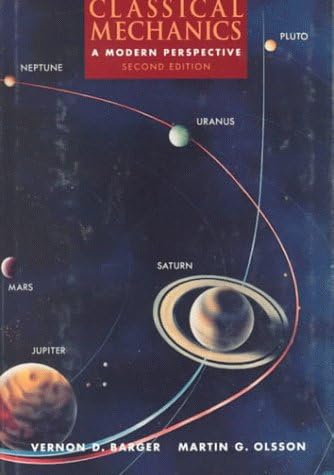
Classical Mechanics: A Modern Perspective, 2nd Edition
Product ID: 193316708
Buy anything from 5,000+ international stores. One checkout price. No surprise fees. Join 2M+ shoppers on Desertcart.
Desertcart purchases this item on your behalf and handles shipping, customs, and support to Australia.
desertcart.com: Classical Mechanics: A Modern Perspective, 2nd Edition: 9780070037342: Barger, Vernon, Olsson, Martin: Books Review: A Nice Reference Book! - I used the first addition of this book as reference to my textbook I had used for an intermediate course in classical mechanics. This was a very good reference book to supplement my studies, which assisted me in very successfully completing this course. Review: Four Stars - excellent and compact-makes an excellent textbook
| Best Sellers Rank | #2,827,224 in Books ( See Top 100 in Books ) #1,515 in Mechanical Engineering (Books) #22,464 in Mathematics (Books) |
| Customer Reviews | 4.4 4.4 out of 5 stars (15) |
| Dimensions | 6.75 x 0.75 x 9.5 inches |
| Edition | 2nd |
| ISBN-10 | 0070037345 |
| ISBN-13 | 978-0070037342 |
| Item Weight | 1.6 pounds |
| Language | English |
| Print length | 418 pages |
| Publication date | December 1, 1994 |
| Publisher | McGraw-Hill College |
J**O
A Nice Reference Book!
I used the first addition of this book as reference to my textbook I had used for an intermediate course in classical mechanics. This was a very good reference book to supplement my studies, which assisted me in very successfully completing this course.
W**D
Four Stars
excellent and compact-makes an excellent textbook
F**B
Great experience with an used book
Classical Mechanics a Modern Perspective. By Barger Olsson Second Edition, Hardcover. Size (Roughly): 24.5 x 17 x 2 centimeters. Book sold by "Jenson Books Inc" on Amazon. Announced in "Acceptable" condition. Book arrived in excellent condition as the description given by the seller on amazon. As it said on the description, no dust jacket. Most of pages have no marks on them. There are some annotations on the back of the cover like the name of the previous owner. Good book on Classical Mechanics, the third section dedicated to Lagrange method (or Lagrange Dynamics) is self contain but pretty short. Chapter five is on angular momentum and central potentials, and chapter seven is on accelerated reference frames. Good experience with the seller, I'm satisfied with my purchased.
S**A
to the point and has good references and
After I graduated with a master's in physics, this is one of the few books I kept. It's very clear, to the point and has good references and examples
B**A
Five Stars
excellent!
D**N
Short but has some interesting examples
This book, although short, is a fairly good overview of classical mechanics, which emphasizes more recent developments in the theory, such as chaotic dynamical systems. The authors do however remain concrete in their treatment, with real-world examples permeating the text. The details behind the theory of classical mechanics are presented very quickly in the book, and this might make the book difficult to read for students first exposed to mechanics at this level. Chapter one is an introduction to motion in one dimension. After a brief review of Newton's laws, the authors solve some neat problems dealing with damping forces, one being the frictional force on a drag racer, and the other with aerodynamic drag on a parachute. They also treat the undamped and damped harmonic oscillator, and the discussion is very standard. The authors are careful to point out that some force laws are too complicated to be solved analytically, but that computing methods can be used to solve the cases that are not. Computational approaches are now the rule rather than the exception in problems in mechanics, and this trend will continue in the future. After a short discussion of energy conservation, the authors introduce motion in three dimensions and give a fairly detailed overview of vector notation. Their approach to tensors though is kind of antiquated, for it motivates them via the outer product, which is reminiscent of the dyadic approach that is currently "out of fashion". The authors also discuss the simple pendulum, but do not of course introduce the elliptic curve solutions that accompany this problem. Such a treatment, however fascinating, would drive this book to a height that would make it inaccessible to the audience of students it addresses. Coupled harmonic oscillators are solved using the normal mode approach. Lagrangian mechanics is introduced in chapter 3, but not from the standpoint of variational calculus at first. Instead the authors choose to present this formulation via generalized forces. They include a discussion of constraints, and give as an example the simple pendulum with a moving support. Only later do they give the Lagrangian formulation via variational calculus, and do so rather hurriedly. Hamilton's equations are derived, and it is shown (again briefly) how Legendre transformations enter into the formalism of Hamiltonian mechanics. Conservation principles are then thought of as fundamental in the rest of the book, and the authors use momentum conservation to discuss elastic and inelastic collisions in chapter 4. Angular momentum conservation is then used in chapter 5 to discuss central forces and planetary motion. Kepler's laws are also discussed, and Rutherford scattering is discussed. All of the discussion is pretty standard and can be found in most textbooks on classical mechanics. Rigid body mechanics makes its appearance in chapter 6, wherein the authors discuss the rotational equations of motion of many-particle systems and rigid bodies. A very brief discussion of gyroscopic mechanics is given, but the authors make up for this by explaining the motion of boomerangs. The discussion is fun to read and should satisfy the curious reader as to why a boomerang returns. And, after a discussion of how to calculate the moment of inertia, the authors give a neat introduction to the physics of billiards and the superball. The latter is a popular physics demonstration and the authors show how its motion differs from an ordinary smooth ball. The difficult (and controversial) topic of accelerated coordinate systems is treated in chapter 7. The four famous "fictitious" forces are introduced, and to develop the reader's intution on these, the authors give a nice example dealing with the manufacture of telescope mirrors. The casting of the mirrors is a neat illustration of the famous Newtonian water pail experiment. The motion of the Foucault pendulum is also discussed briefly. Then after a discussion of principal axes and Euler's equations, the authors give another neat example, this time dealing with the motion of tennis rackets, which illustrates the motion of a rigid body with unequal principal moments of inertia. The physics of tops is then discussed, and in a manner which makes the underlying physics more intuitive for the reader. The authors make an attempt to understand the motion of the famous tippie-top, but don't really do so. The tippie-top is another popular demonstration in the classroom but its physics has eluded the best attempts, and this treatment is no exception. The flip times that are calculated are not in agreement at all with what is observed in the demonstration. Chapter 8 is an overview of gravitational physics, and the authors show the effects of a body moving in a non-uniform gravitational field, with an example dealing with the tides. Interestingly, the authors attempt to introduce the general theory of relativity, and do so more at a level of elementary mathematics and arm-waving arguments, but the treatment is suitable at this level. The authors show the difference between the orbits predicted by general relativity and the Newtonian theory, i.e. the famous perihelion advance. A brief overview of Newtonian cosmology is given in chapter 9, wherein the authors discuss the expansion of the universe and the cosmic redshift. After proving the virial theorem, they discuss the effects of dark matter on the rotations of spiral galaxies and groups of galaxies, which is currently a very hot topic in astrophysics. The special theory of relativity is treated in chapter 10, and the discussion is very standard. Readers are introduced to relativistic mechanics and some of the counterintuitive physics of the theory. The last chapter of the book is an introduction to non-linear dynamics and chaos. It is defined as sensitive dependence on initial conditions, although this is not a strong enough condition. The Duffing oscillator is offered as an example of chaotic behavior and the transition to chaos is studied as a function of the driving frequency. This brings up concepts from bifurcation theory, such as the idea of a strange attractor. Numerical analysis plays the dominant role in these theories.
J**E
This book has too many errors
Of all the physics books, I have seen and used, this has the most errors in it. And they arn't just typeo's, this book also has conceptual errors in it. This book also has "unique" and sometimes cryptic ways of proving, and presenting concepts. This apparitly apeals to Professors who already know classical mechanics, but for the first time sudent it is quite troublesome. In short if you want a book you can trust, and you can learn the first time around from, don't choose this one. It has to be the worst physics text I have had inflected on me yet at this level.
N**)
Good, concise, compact and modern book.
Prof. Barger and Olsson show a new perspective in introducing the classical mechanics to junior level undergraduate in Physics. They successfully give a fresh treatment of mechanics by introducing the lagrangian in the earlier part of the book. Recommended for use in junior level mechanics physics.
Trustpilot
1 week ago
3 weeks ago