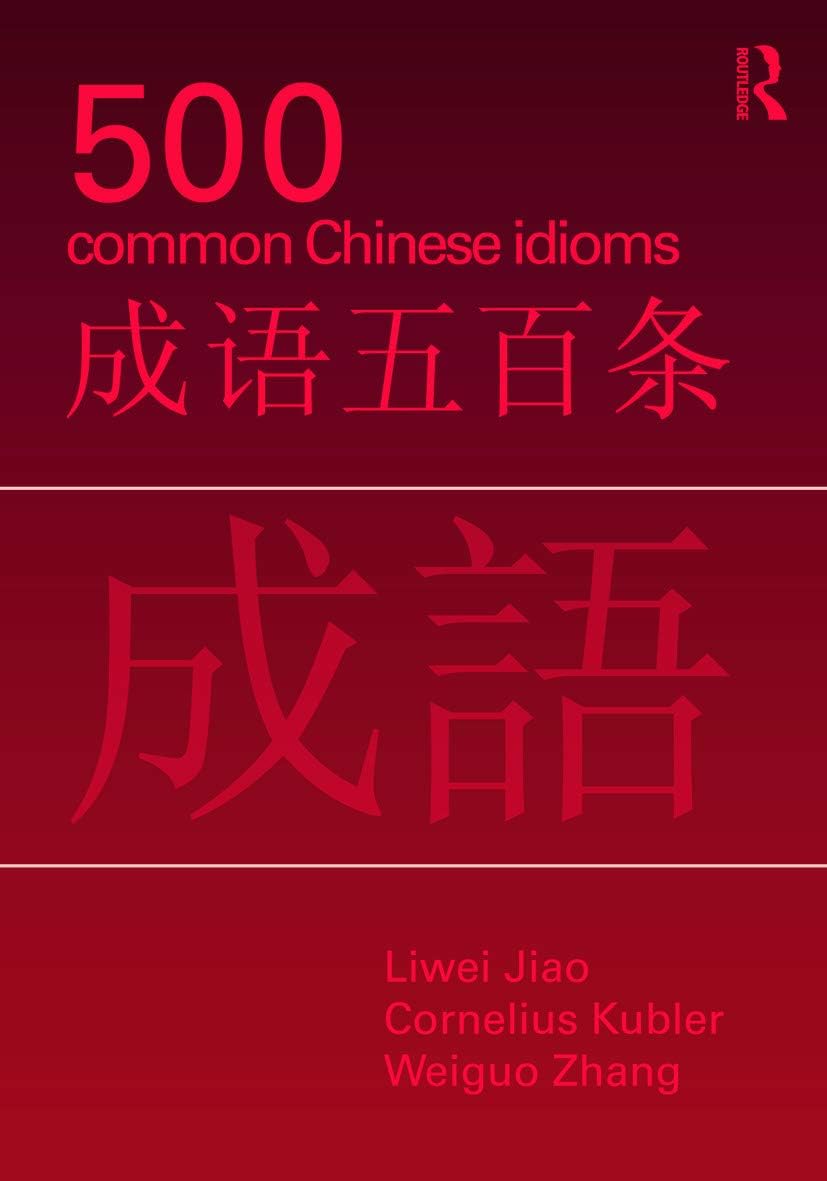
500 Common Chinese Idioms: An Annotated Frequency Dictionary
Product ID: 13398685
Desertcart purchases this item on your behalf and handles shipping, customs, and support to Australia.
desertcart.com: 500 Common Chinese Idioms: An Annotated Frequency Dictionary: 9780415776820: Jiao, Liwei, Kubler, Cornelius, Zhang, Weiguo: Books Review: Best chengyu (Chinese idiom) dictionary for English speakers that I have ever seen - If you are a native English speaker studying Chinese, this chengyu dictionary is an absolute must. I have spent years being frustrated by a) chengyu dictionaries that were only written in Chinese without any pinyin or other help for non-native Chinese speakers, b) chengyu books with stories in English that explain the chengyu, but don't give examples of how to use it or how common the chengyu is. FINALLY, the authors of this book have recognized a need for a better chengyu dictionary for English speakers, and have created the perfect chengyu resource. It includes ALL possible features helpful to English-speaking students (i.e. pinyin, simplified and traditional characters, example sentences, thoughtful explanations that don't rely on English idioms, explanations of subtleties in meaning and usage, and pinyin and stroke order indices). However, the BEST part is that the chengyu are listed according to frequency of usage in Chinese society. At the beginning of the book, the authors explain how they used corpus data to determine which 500 chengyu are most frequently used. This is SO helpful! I can study all the chengyu in this book with confidence that I am going to hear them being spoken and see them in books and newspapers! It also validates my previous language-learning efforts. I cannot tell you how delighted I was to find that some of the chengyu I have learned over the years are actually in the top 50. Now I know it was worth my time memorizing them! I am so pleased with this book and the ingenuity and thoughtfulness of its authors that I am going to recommend it to all of my friends who are learning or teaching Chinese. I cannot praise this book enough. Thank you, Jiao Liwei, Cornelius C. Kubler, and Zhang Weiguo for providing the English-speaking world with this amazing resource! Review: Authoritative collection of useful chengyu - Useful collection for building set phrases while learning. The entries balance literal and figurative explanations while including a couple real world usage examples. It would benefit from clearer indications if the terms work in modern conversational contexts in most regions, or if they have political connotations or feel archaic, or are, say, less or more common in Taiwan or the North. Every tenth entry is from a folk tale or well known story, and these appear earlier than they are prevalently used. Authors were right these are interesting enough to boost, would be highly highly interested in a longer list only of Chengyu from these tales as a stand-alone project. Recommend a searchable ebook version more accessibly priced. Still great work.
| Best Sellers Rank | #262,426 in Books ( See Top 100 in Books ) #17 in Chinese Language Instruction (Books) #483 in Foreign Dictionaries & Thesauruses #672 in Foreign Language Instruction (Books) |
| Customer Reviews | 4.1 4.1 out of 5 stars (28) |
| Dimensions | 6.85 x 0.74 x 9.69 inches |
| Edition | 1st |
| ISBN-10 | 0415776821 |
| ISBN-13 | 978-0415776820 |
| Item Weight | 1.3 pounds |
| Language | English |
| Print length | 328 pages |
| Publication date | November 22, 2010 |
| Publisher | Routledge |
E**R
Best chengyu (Chinese idiom) dictionary for English speakers that I have ever seen
If you are a native English speaker studying Chinese, this chengyu dictionary is an absolute must. I have spent years being frustrated by a) chengyu dictionaries that were only written in Chinese without any pinyin or other help for non-native Chinese speakers, b) chengyu books with stories in English that explain the chengyu, but don't give examples of how to use it or how common the chengyu is. FINALLY, the authors of this book have recognized a need for a better chengyu dictionary for English speakers, and have created the perfect chengyu resource. It includes ALL possible features helpful to English-speaking students (i.e. pinyin, simplified and traditional characters, example sentences, thoughtful explanations that don't rely on English idioms, explanations of subtleties in meaning and usage, and pinyin and stroke order indices). However, the BEST part is that the chengyu are listed according to frequency of usage in Chinese society. At the beginning of the book, the authors explain how they used corpus data to determine which 500 chengyu are most frequently used. This is SO helpful! I can study all the chengyu in this book with confidence that I am going to hear them being spoken and see them in books and newspapers! It also validates my previous language-learning efforts. I cannot tell you how delighted I was to find that some of the chengyu I have learned over the years are actually in the top 50. Now I know it was worth my time memorizing them! I am so pleased with this book and the ingenuity and thoughtfulness of its authors that I am going to recommend it to all of my friends who are learning or teaching Chinese. I cannot praise this book enough. Thank you, Jiao Liwei, Cornelius C. Kubler, and Zhang Weiguo for providing the English-speaking world with this amazing resource!
T**.
Authoritative collection of useful chengyu
Useful collection for building set phrases while learning. The entries balance literal and figurative explanations while including a couple real world usage examples. It would benefit from clearer indications if the terms work in modern conversational contexts in most regions, or if they have political connotations or feel archaic, or are, say, less or more common in Taiwan or the North. Every tenth entry is from a folk tale or well known story, and these appear earlier than they are prevalently used. Authors were right these are interesting enough to boost, would be highly highly interested in a longer list only of Chengyu from these tales as a stand-alone project. Recommend a searchable ebook version more accessibly priced. Still great work.
A**.
not meant for the Kindle
The formatting of the kindle version just makes your eyes want to cry.
W**R
This is a nice book for self-study at the intermediate to advanced level
This is a nice book for self-study at the intermediate to advanced level. The idioms are often heard in common speech even in normal conversation, in the same way an American speaker might say "raining cats and dogs" or use a literary expression such as "all's well that ends well". The book has the usual Routledge attention to attractive typesetting and clear layout. The idioms are arranged in order of use, according to an extensive study. So the learner can begin at the start with confidence that the material will be almost immediately useful.
P**X
DO NOT BUY KINDLE EDITION!!!
This applies to the Kindle edition only. DO NOT BUY! Only the English and Pinyin content is actually in an e-book font. The Hanzi are all image files, and so tiny you need a magnifying glass to make them out. Calling this a Kindle edition at all is false advertising. I have returned the Kindle edition for a refund, and when that goes through I plan to buy the actual book.
G**S
Why then do I dislike the book
500 Common Chinese Idioms does have features that commend it: historical and literary explanations that provide a background to the idioms listed, an innovative methodology in selecting those most frequently used in writing and speech and, finally, example sentences that show usages in practical application. Why then do I dislike the book? I find its image deeply marred by the use of example sentences that on occasion qualify as rank political propaganda for the statist regime currently governing China and which clearly reflect racist or xenophobic nationalism, to boot. Two very good examples of this may be found on pages 177 and 183: on the former, one example sentence suggests that wholesale worship of things foreign leads to bullying social behaviors while, on the latter, the example sentence there stridently proclaims that China is opposed to any criticism of its human rights record by other countries. It is true that Professor Jiao and his colleagues tell the reader in the book's Introduction that nothing in the contents of any of the book's sentence examples is indicative of their personal beliefs. Nevertheless, the inclusion of such sentences violates a cardinal rule that any self-respecting reference work should follow and that is not to allow partisan political sentiments or cultural prejudices to begin coloring content (and here I wish to make it clear that I would have criticized this book equally severely had it included example sentences pandering to a pro-western cultural or political stance). As things stand, I must deem 500 Common Chinese Idioms a missed opportunity to reach more promising heights in the crafting of a good reference work. And I confess myself very unforgiving at the product I ended up getting and which is now resting silently at the bottom of my wastebasket.
A**T
Buy the hard copy. The Kindle, which I ...
Buy the hard copy. The Kindle, which I unfortunately bought, has Chinese character that are so small that even changing text as large as possible does not help - and the letters are then way too big. I just ordered the hard copy as well, because the preview shows the characters as the same size as letters - hope that's right. Maybe someone knows how to make the Kindle Chinese characters larger - I can't see how.
C**R
terrible adaptation to a electronic book
Chinese characters way too small to read comfortably, and this can't be adjusted. Filled with typos. It's like they didn't even try. Terrible ripoff for such an expensive book.
E**L
Full of Chinese propaganda as example sentences. Eg. “Interfere” Mao warned the US not to interfere in Chinese affairs. The lay out is really clumsy too. The meaning needs to be clearly labelled and not the same font as all the other details
A**O
La app de Kindle, necesaria para consultar este libro, me está dando muchos problemas, tarda siglos en pasar de una página a otra, se queda colgada, no funciona bien. Esto me está impidiendo consultar son soltura este interesante libro. ¿Podrían, por favor, corregir estas anomalías?
K**T
Every idiom is thoroughly explained with good examples. Very useful when trying to yake your Mandarine Chinese to the next level.
M**E
After more than eight years self-study Chinese, I decided to delve deeper. This is a treasure trove of language. Many of the idioms you will never use in normal conversation, however , if one pearl of wisdom slips out....as in #98 风风雨雨。。。。' many difficulties ' I used with my local chip shop Chinese proprietor asking me 'how are you'?, I replied '很多风风雨雨。meaning ' many ups and downs' . If one pearl slips out in conversation, the language genie has come out of the bottle. Beware - highly recommended.
D**B
Excellent resource
Trustpilot
2 days ago
1 week ago